
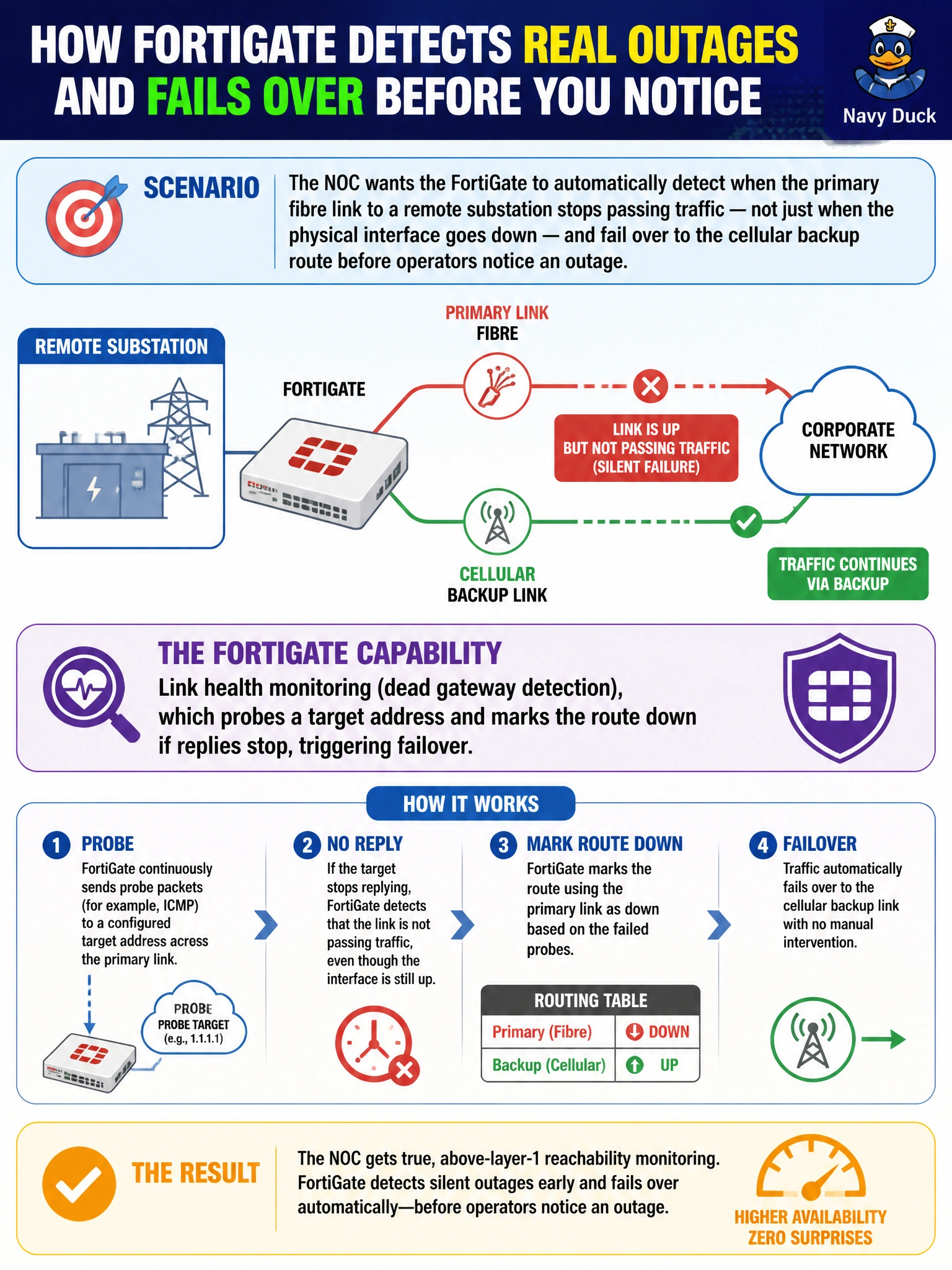
The NOC wants the FortiGate to automatically detect when the primary fibre link to a remote substation stops passing traffic — not just when the physical interface goes down — and fail over to the cellular backup route before operators notice an outage. Which FortiGate capability is designed for this kind of active, above-layer-1 reachability check?
Select an answer to reveal the explanation.
Short Explanation
A cable can look perfectly fine — link light on, interface up — while nothing actually gets through on the other end. Link health monitoring is the FortiGate actively knocking on a door further down the path, and if nobody answers, it assumes that route is broken and switches to the backup.
Full Explanation
Dead gateway detection, configured as a link health monitor on a static route, periodically probes a target address beyond the immediate next hop and marks the associated route inactive if probes stop returning, which removes it from the routing table and lets a lower-priority backup route, such as the cellular link, become active without waiting for a physical link-down event that may never occur during a routed-but-unreachable failure. Priority alone only decides which of two already-active routes is preferred; it has no built-in mechanism to detect that a supposedly active link has stopped actually forwarding traffic, so it cannot trigger failover by itself. FortiGuard web-filtering categories evaluate URL reputation for web traffic and have no relationship to link reachability or failover. Setting administrative distance to zero is not a meaningful or supported way to indicate route health, and zero is reserved for directly connected routes rather than being a valid tuning knob for failover behavior. To confirm the monitor works, deliberately block the probe target upstream of the fibre link in a maintenance window and verify the routing table drops the fibre route and traffic shifts to cellular.