
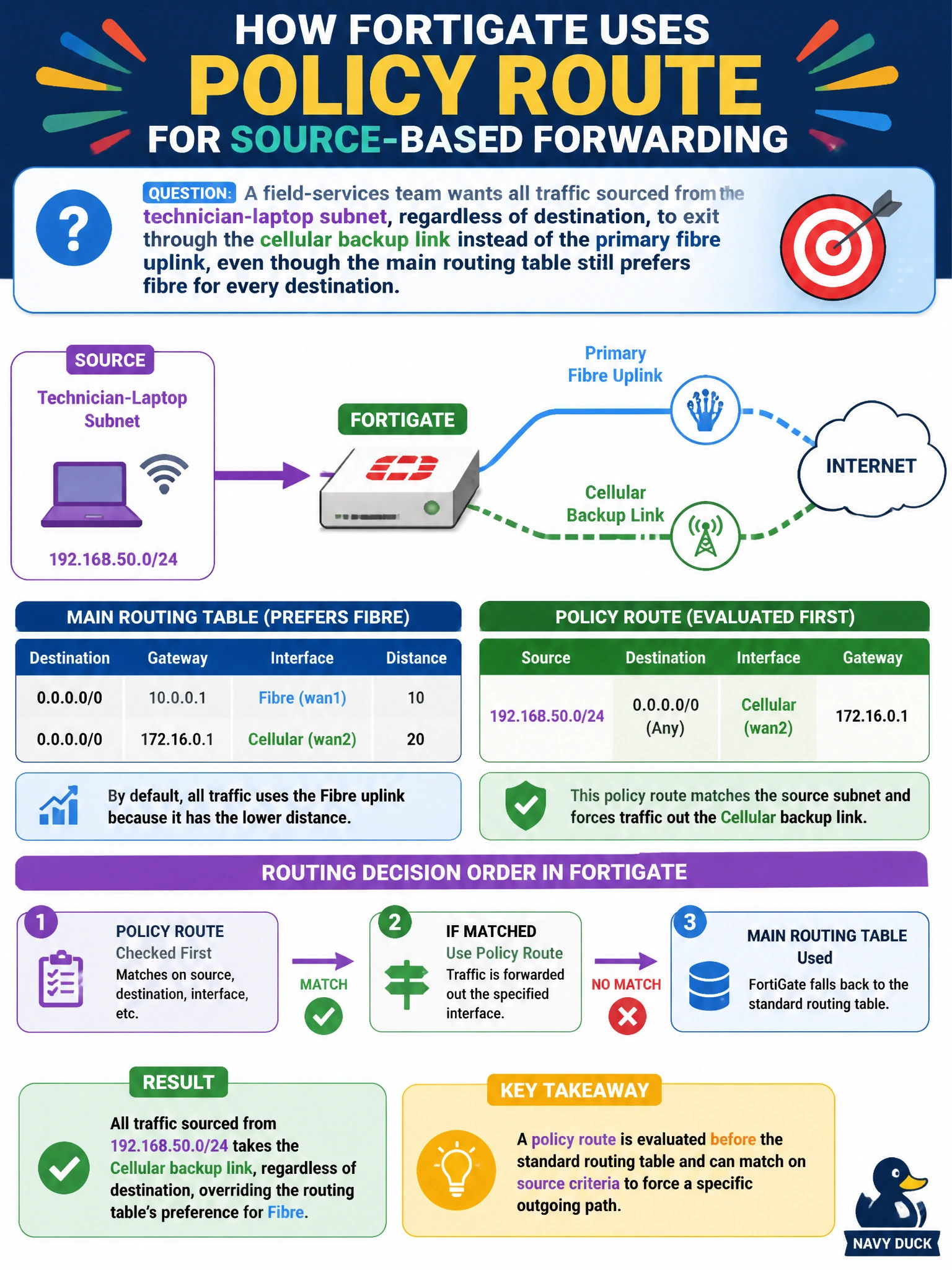
A field-services team wants all traffic sourced from the technician-laptop subnet, regardless of destination, to exit through the cellular backup link instead of the primary fibre uplink, even though the main routing table still prefers fibre for every destination. Which FortiGate routing feature is designed for this kind of source-based forwarding override?
Select an answer to reveal the explanation.
Short Explanation
A policy route is like a special instruction that gets read before the regular map: "if this traffic came from the technician subnet, ignore the usual roads and take this one instead." It short-circuits the normal route lookup for exactly the traffic you describe.
Full Explanation
Policy routes are evaluated ahead of the standard destination-based routing table lookup and can match on criteria the routing table cannot use alone, such as source address, incoming interface, protocol, or port, then force matching traffic out a specified interface and gateway regardless of what the routing table would otherwise select. This makes them the correct tool for sending all technician-laptop-sourced traffic over the cellular link while every other source keeps using fibre. A blackhole route only discards traffic; it cannot redirect it to a different working interface, so it cannot accomplish this goal at all. Raising the fibre static route's administrative distance to an unusably high value is a blunt instrument that would push every destination, not just the technician subnet, toward cellular, undermining normal traffic too. ECMP requires multiple routes of identical distance and priority to the same destination and load-balances by hashing rather than by source subnet, so it cannot guarantee this specific subnet's traffic goes to cellular. A good check afterward is to run a trace from a technician laptop and confirm the path egresses via the cellular interface while other subnets still show fibre.