
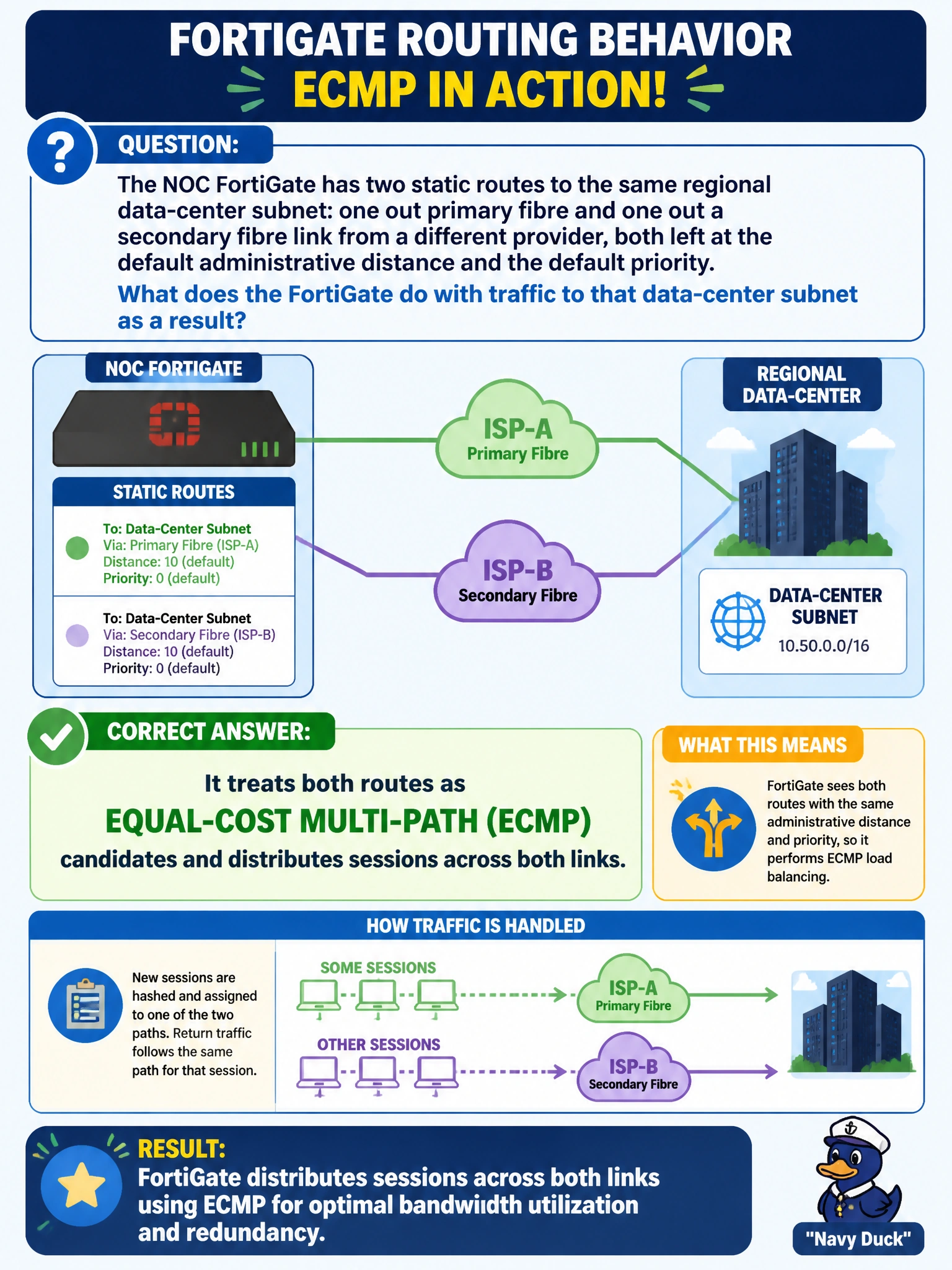
The NOC FortiGate has two static routes to the same regional data-center subnet: one out primary fibre and one out a secondary fibre link from a different provider, both left at the default administrative distance and the default priority. What does the FortiGate do with traffic to that data-center subnet as a result?
Select an answer to reveal the explanation.
Short Explanation
When two paths look exactly equally good on paper — same distance, same priority — the FortiGate doesn't pick a favorite. It spreads new sessions across both links like a fair dispatcher instead of leaving one link idle.
Full Explanation
Equal-cost multi-path routing activates automatically whenever two or more routes to the same destination prefix share identical administrative distance and identical priority; the FortiGate installs all of them as active routes and distributes new sessions across the available links according to its configured load-balancing method, rather than treating one as primary and the other as idle standby. This differs from the priority-based failover case, where a lower-priority route is actively preferred and a higher-priority route only takes over on failure — ECMP has no such preference because nothing distinguishes the routes. Configuration order plays no role in the decision, so the first-configured-wins option is incorrect. FortiOS does not reject duplicate equal routes as invalid; that is exactly the condition ECMP is designed to use productively. Nor is the secondary route disabled pending a failure — both stay active simultaneously. An operational check is to generate several distinct sessions to the data-center subnet and confirm, via the session list or interface counters, that both fibre links carry traffic rather than only one.