
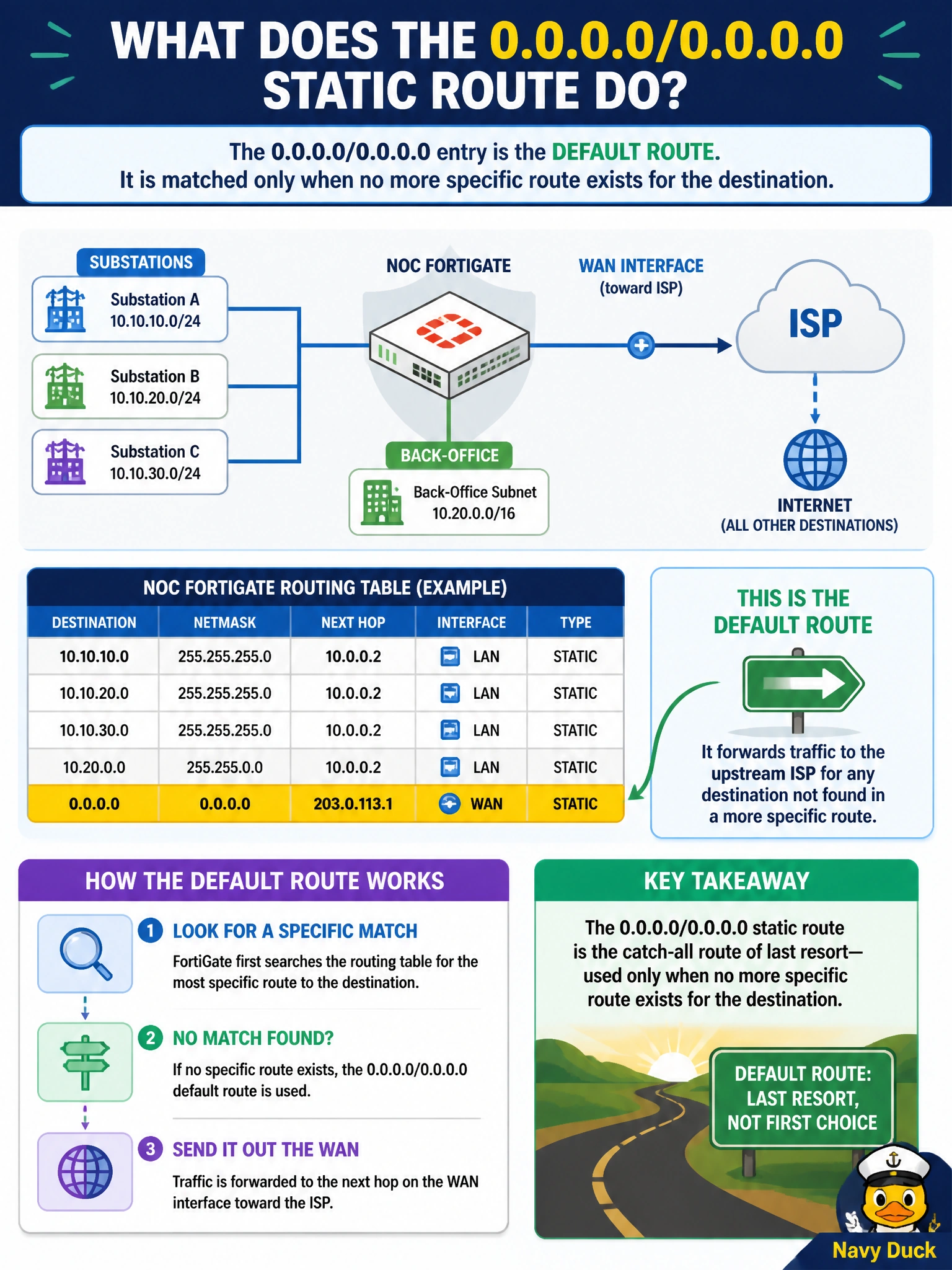
A regional utility's NOC FortiGate has specific static routes for every known substation and back-office subnet, plus a 0.0.0.0/0.0.0.0 static route pointing out the WAN interface toward the utility's upstream ISP. What role does that 0.0.0.0/0.0.0.0 entry play in the routing table?
Select an answer to reveal the explanation.
Short Explanation
Think of it as the catch-all mailbox at the end of the hallway: every specific mailbox gets checked first, and only mail with no better match ends up there. The default route is exactly that catch-all — the least specific entry a FortiGate can have.
Full Explanation
A 0.0.0.0/0.0.0.0 route is the least specific possible prefix, matching every destination address, so by the longest-prefix-match rule it is only ever selected when no more specific route — static, connected, or dynamically learned — covers the destination. For the NOC, this means traffic to a known substation subnet always takes its dedicated route, and only traffic to unlisted destinations, such as general internet-bound traffic, falls through to the default route and the upstream ISP. Calling it an override inverts the actual precedence: specificity, not table position, decides the match. It is not reserved for return traffic only — return traffic follows whatever route matches its own destination just like any other packet, and a default route is frequently the busiest entry in a table serving general egress. It also does not disable routing; the FortiGate continues to route normally using every other configured route alongside it. To confirm this in practice, check that traffic to a defined substation subnet still uses its specific route in the routing table even while the default route remains active.