
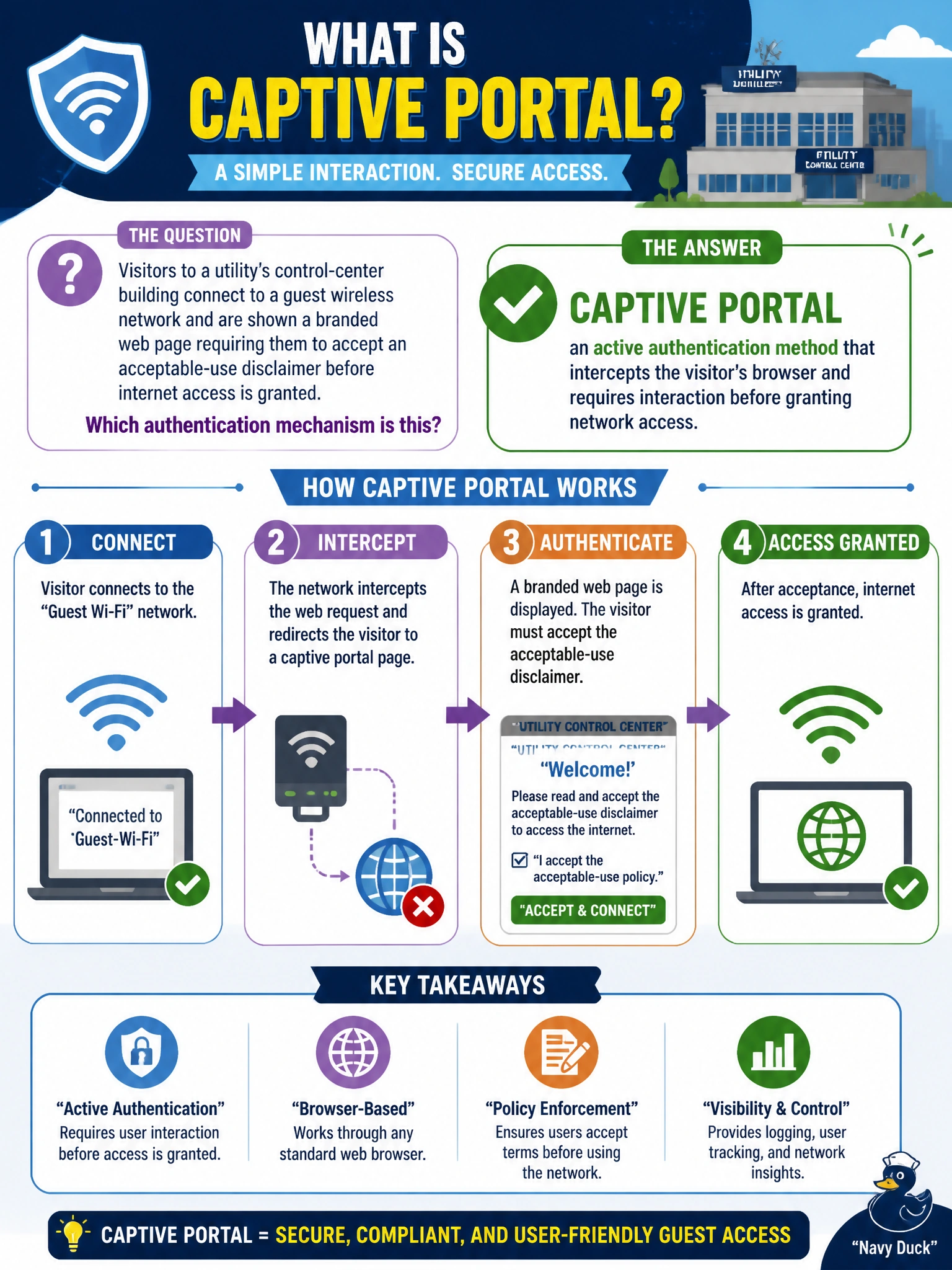
Visitors to a utility's control-center building connect to a guest wireless network and are shown a branded web page requiring them to accept an acceptable-use disclaimer before internet access is granted. Which authentication mechanism is this?
Select an answer to reveal the explanation.
Short Explanation
You've hit a captive portal before at a hotel or coffee shop — the browser gets hijacked to a page you can't skip until you click something. That's exactly what's happening at the utility's front door for guest wifi: no login prompt with a real username, just an interactive gate that has to be satisfied before traffic flows. It's active because the visitor has to do something, not passive because nobody is watching a domain logon.
Full Explanation
A captive portal is an active authentication mechanism that intercepts a client's outbound web traffic and redirects it to a FortiGate-hosted or custom page, requiring some interaction — accepting terms, entering a voucher code, or supplying credentials — before normal access is permitted; a simple disclaimer-acceptance gate for guest wifi is a textbook captive portal use case. FSSO is incorrect because it is a passive mechanism tied to observing an already-authenticated domain logon event, which a walk-in visitor's personal device would never generate. LDAP describes a directory-lookup protocol for verifying credentials against a corporate directory, which does not fit a guest with no corporate account. Two-factor authentication describes adding a second verification factor to an existing login, not the disclaimer-click flow described here, and nothing in the scenario mentions a hardware token. A useful caveat: captive portals can be configured to require only acceptance (no real credential) or to require an actual guest account, so the presence of a portal alone does not guarantee strong identity verification — it verifies interaction, not necessarily identity. To confirm, check the wireless firewall policy for a captive-portal authentication scheme rather than a group-based or FSSO-based one.