
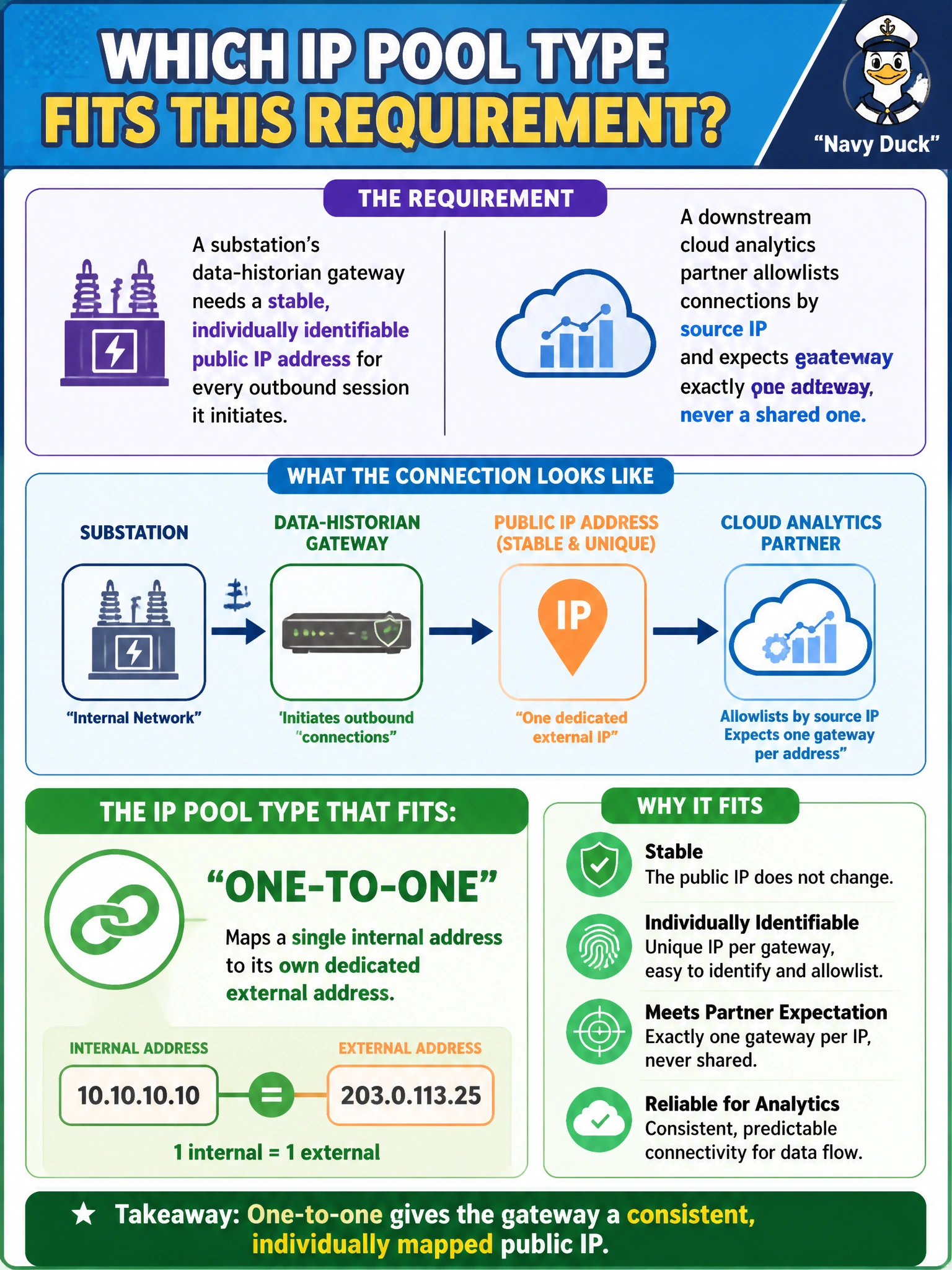
A substation's data-historian gateway needs a stable, individually identifiable public IP address for every outbound session it initiates, because a downstream cloud analytics partner allowlists connections by source IP and expects exactly one gateway per address, never a shared one. Which IP pool type fits this requirement?
Select an answer to reveal the explanation.
Short Explanation
When a partner allowlists by 'one clean IP per device,' you want a one-to-one pool — it's a dedicated public address that's always this gateway's, never shared with anyone else's traffic.
Full Explanation
A one-to-one IP pool maps a specific internal address to its own dedicated external address on a fixed, exclusive basis, which is exactly what's needed when a downstream partner's allowlisting logic assumes a clean, individually attributable source IP per device rather than a shared, port-differentiated address. Overload pools are built for the opposite goal, maximizing how many hosts can share a small number of addresses, and while sessions from different hosts are indeed still distinguishable by port internally, the partner's allowlist sees only the shared external address, which fails a requirement built around one gateway per address. A fixed port range pool is about preserving source ports, not about dedicating an address to one host; it can still be configured to allow multiple hosts to share addresses, so it doesn't inherently guarantee the one-device-one-address mapping being asked for here. Port block allocation is a mechanism for handing out contiguous port ranges to hosts sharing an overload-style pool, primarily to make per-host activity traceable in logs when many hosts share one address, it is a refinement of shared-address NAT, not a replacement for a dedicated one-to-one mapping. Operationally, an engineer can confirm the one-to-one mapping is behaving correctly by checking that the historian gateway's outbound sessions always translate to the same external address in the session table, regardless of how many sessions are open concurrently.