
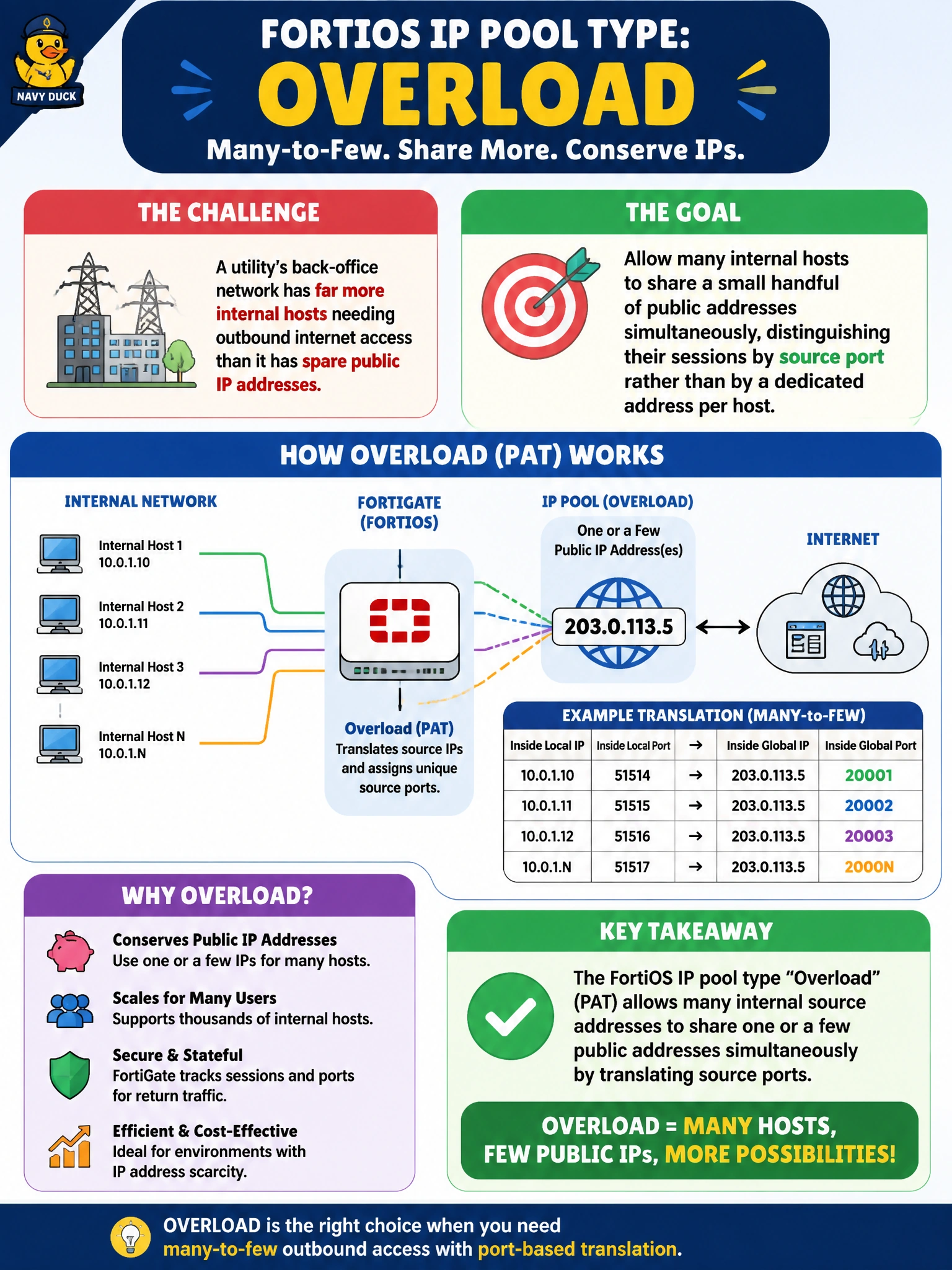
A utility's back-office network has far more internal hosts needing outbound internet access than it has spare public IP addresses. The network engineer wants many internal hosts to share a small handful of public addresses simultaneously, distinguishing their sessions by source port rather than by a dedicated address per host. Which FortiOS IP pool type is designed for this?
Select an answer to reveal the explanation.
Short Explanation
Overload is the classic 'lots of internal hosts, one public address' trick — it's the same idea as home-router NAT, where dozens of devices all share one public IP and the router tells sessions apart by port number.
Full Explanation
The overload IP pool type performs many-to-few source NAT: many internal hosts can share one or a small number of public addresses at the same time, because FortiOS distinguishes each session using a translated source port in addition to the shared address, the same fundamental mechanism as typical port address translation. This directly matches a scenario with far more internal hosts than spare public addresses, since it conserves address space by design rather than requiring one public address per host. A one-to-one IP pool does the opposite: it maps each internal address to a dedicated external address on a fixed basis, which is useful when a host needs a stable, individually identifiable public address, but it does not conserve address space and doesn't fit a many-hosts-few-addresses requirement. A fixed port range pool preserves the original source port instead of allowing FortiOS to reassign it freely, which actually reduces how many concurrent sessions can share a given address, since the pool can no longer disambiguate purely by reassigning ports, the opposite of what's needed for maximum sharing. The claim that disabling overload is what enables sharing has cause and effect backwards: overload is the setting that enables sharing in the first place, and turning it off moves toward more restrictive, less space-efficient translation. To confirm overload behavior, an engineer can check the session table and see multiple internal hosts' sessions mapped to the same external address with different translated source ports.