
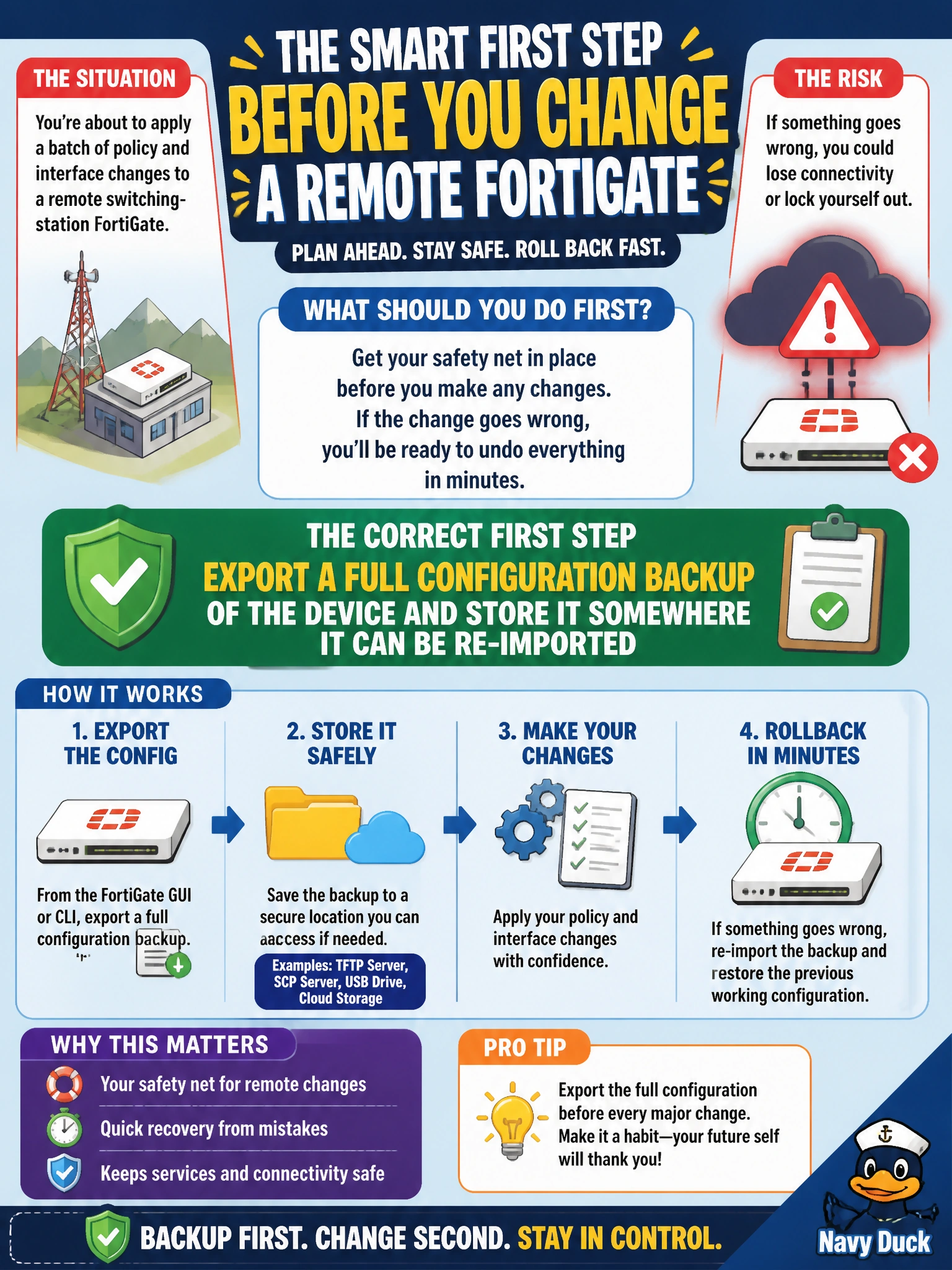
Before applying a batch of policy and interface changes to a remote switching-station FortiGate, an engineer wants a safety net that lets them undo everything in minutes if the change goes wrong. What should they do first?
Select an answer to reveal the explanation.
Short Explanation
Think of it like saving your work before a risky edit: a configuration export is a snapshot the engineer can restore in minutes if the new policy or interface changes break something, instead of rebuilding it all by hand from memory. None of the other options give the device a rollback point.
Full Explanation
A configuration backup captures the device's full running configuration as a file that can be re-imported, giving the engineer a clean rollback point if a batch of changes causes an outage or misconfiguration. This is the standard safety practice before any nontrivial change window, especially at a remote site where a bad change means a truck roll. Increasing log retention affects how much historical traffic and event data is stored locally; it doesn't protect the configuration itself or provide any rollback capability. Enabling SNMP polling helps a monitoring system observe device health after the fact, but it does nothing to preserve the pre-change state. Registering a new support contract concerns license entitlement and update eligibility, unrelated to configuration safety. One caveat worth knowing: a saved configuration is generally only guaranteed to restore cleanly onto the same or a compatible firmware version, so the practical check is confirming both that the backup completed successfully and that firmware hasn't changed in the interim before relying on it as a rollback plan.