
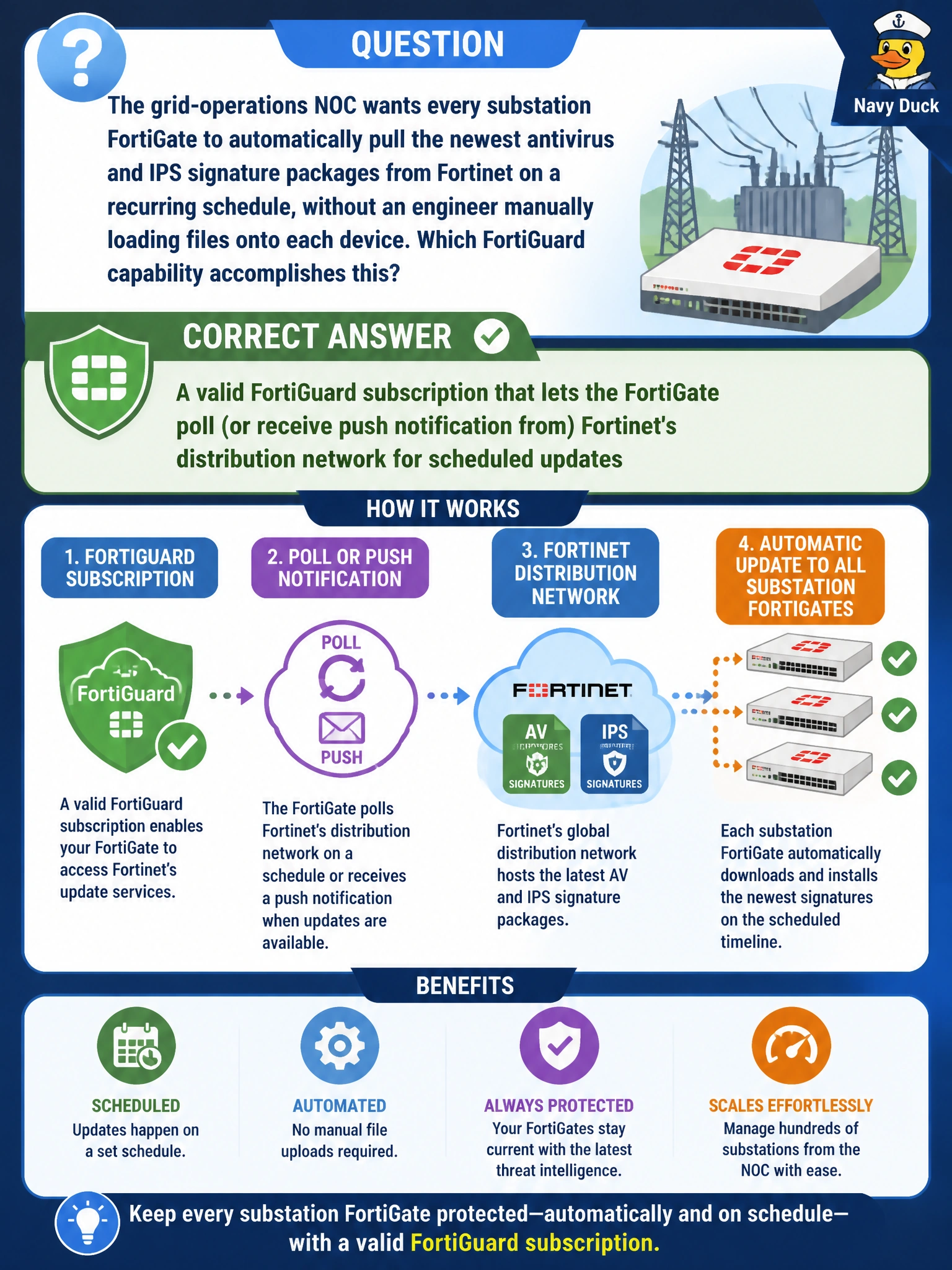
The grid-operations NOC wants every substation FortiGate to automatically pull the newest antivirus and IPS signature packages from Fortinet on a recurring schedule, without an engineer manually loading files onto each device. Which FortiGuard capability accomplishes this?
Select an answer to reveal the explanation.
Short Explanation
Think of FortiGuard like a subscription box that keeps refilling itself: as long as the FortiGate can reach Fortinet's distribution network and the subscription is active, fresh antivirus and IPS content shows up on a schedule with no engineer touching a single substation device. Reboots and file copies don't do any of that work; the subscription and connectivity do.
Full Explanation
FortiGuard is Fortinet's cloud-delivered update service: once a device has a valid license, it can either poll the distribution network on a configured interval or receive a push notification that tells it new content is ready, then pull the package itself. That mechanism keeps antivirus, IPS, web filtering, and application-control databases current without touching every box in the field. A cron job copying files from a NOC server invents an update channel Fortinet doesn't use and creates a single point of failure at the file server. Redirecting traffic through a proxy changes the path packets take, not how signature content gets refreshed. Rebooting doesn't trigger a definitions fetch at all; it just restarts services with whatever content is already on disk. The operational caveat: this only works if the substation FortiGate has outbound reachability to FortiGuard and the license hasn't lapsed, so a good check is confirming FortiGuard connectivity and license status both show valid before assuming updates are flowing.