
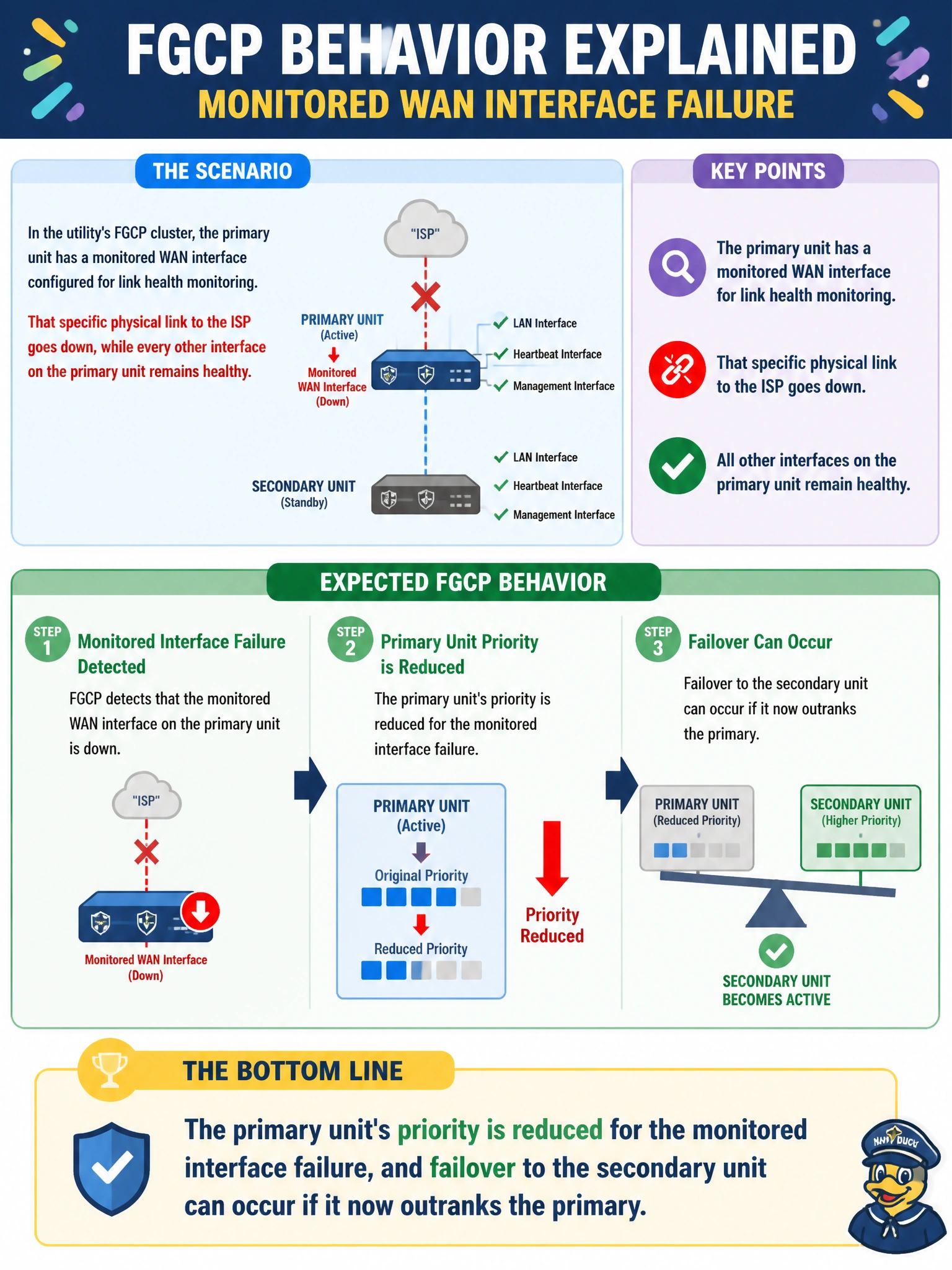
In the utility's FGCP cluster, the primary unit has a monitored WAN interface configured for link health monitoring. That specific physical link to the ISP goes down, while every other interface on the primary unit remains healthy. What is the expected FGCP behavior?
Select an answer to reveal the explanation.
Short Explanation
FGCP doesn't just watch whether a unit is powered on — you can tell it to watch specific interfaces too. When a monitored link like that WAN port drops, the primary's effective priority takes a hit, and if that drop lets the secondary outrank it, your cluster fails over on its own.
Full Explanation
FGCP supports interface monitoring, where specific interfaces are designated for link health tracking as part of the HA configuration, and a failure on any monitored interface reduces that unit's effective device priority rather than requiring the entire unit to go offline. If the resulting priority makes the secondary unit's effective priority higher, FGCP automatically triggers failover, moving the primary role to the healthier unit without waiting for a complete hardware or power failure — precisely the behavior expected when a single monitored WAN link fails while everything else stays up. The claim that only full-unit power loss triggers failover ignores the entire purpose of interface monitoring, which exists specifically to detect degraded connectivity on individual links. FGCP does not reboot the affected unit as a recovery action for a monitored-interface failure — that's not part of the automatic HA mechanism for this condition. Failover under interface monitoring is automatic by design, not something an administrator must manually force; manual failover is a separate, optional action. To confirm the behavior is configured correctly, check the HA monitored-interface settings on both units and verify the priority drop and failover occur when the monitored link is disconnected in a controlled test.