
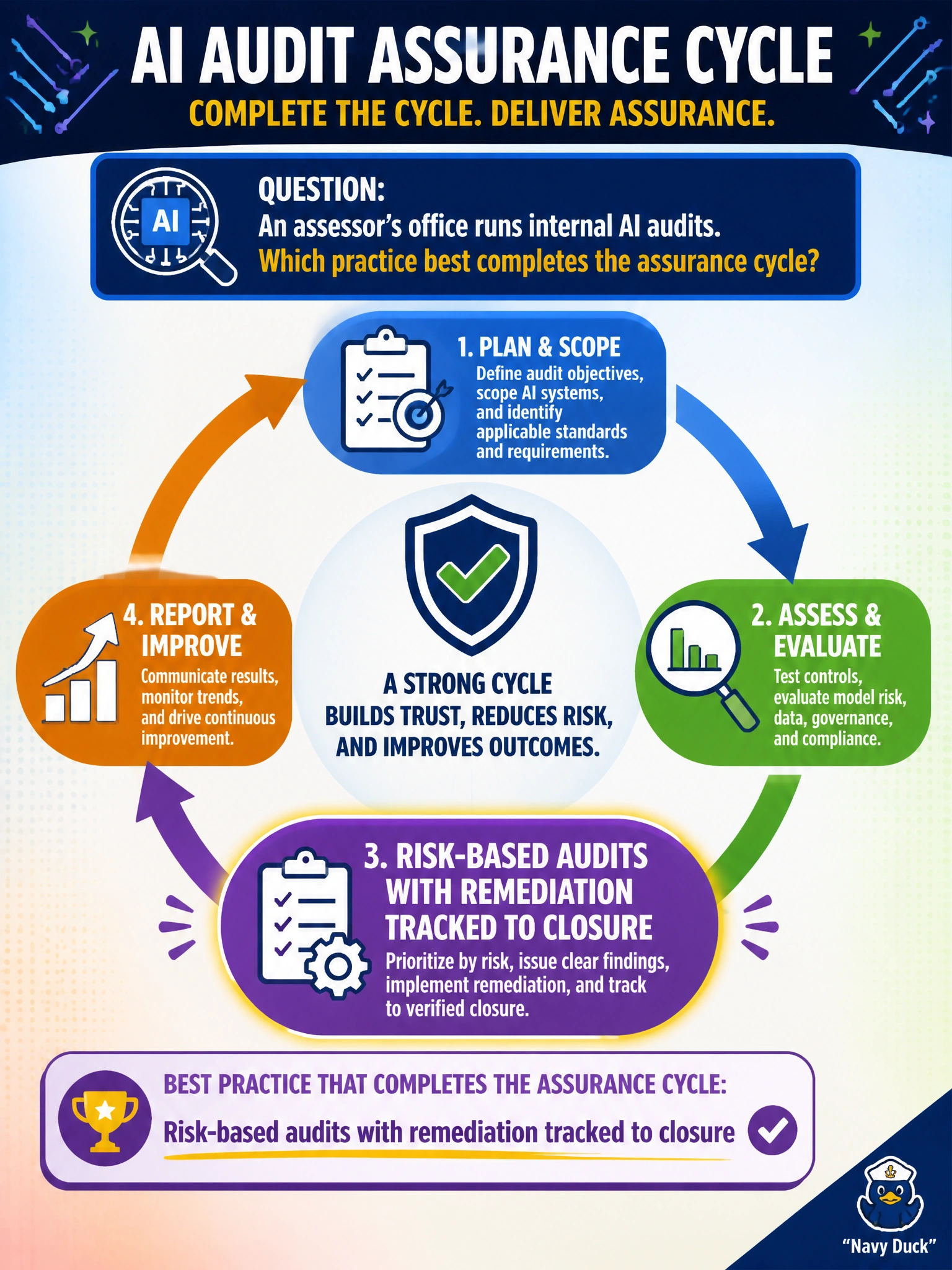
An assessor’s office runs internal AI audits. Which practice best completes the assurance cycle?
Select an answer to reveal the explanation.
Short Explanation
Finding problems is half the job; closing them is the other half. Run risk-based audits and track fixes to the finish line—like work orders that don’t die in the inbox.
Full Explanation
An assessor’s office running internal AI audits completes the assurance cycle with risk-based audits whose remediation is tracked to closure. Findings without owners and due dates do not reduce risk; closing the loop—assign, remediate, verify, close—turns audit work into control improvement for production valuation AI and related tools that affect taxpayer equity, appeal fairness, and public trust in assessments.
Filing findings with no owners, due dates, or closure tracking creates a museum of problems rather than a remediation program that actually lowers municipal risk. Archiving every finding as “accepted forever” without review freezes risk acceptance and skips re-evaluation when exposure, models, or statutes change. Auditing only low-risk pilot tools while ignoring production valuation AI focuses effort where harm is lowest and leaves the highest-impact system unexamined.
Exam caveat: municipal AI assurance cycles end at verified remediation (or governed residual-risk acceptance with periodic review), not at finding generation alone. Operational check: for each open AI finding, confirm owner, due date, risk rating, and closure evidence; escalate overdue high-risk items on valuation AI to GRC and IT leadership on a fixed cadence.