
An elections office integrates vendor model APIs. Which credential practice best fits?
Select an answer to reveal the explanation.
Short Explanation
API keys aren’t parade confetti. You can keep vendor credentials in secrets management and rotate them regularly—election integrations deserve grown-up credential hygiene.
Full Explanation
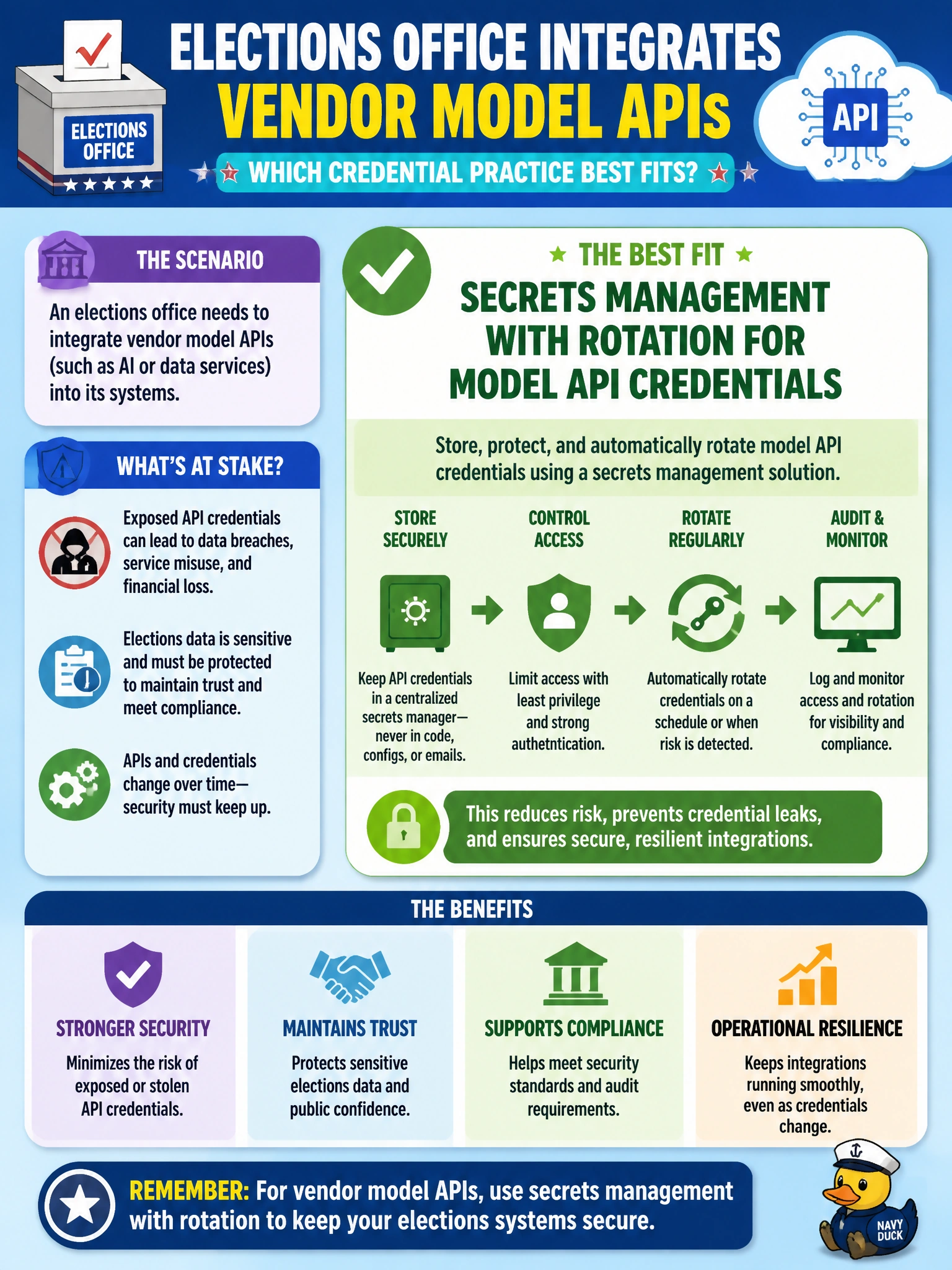
An elections office integrating vendor model APIs should use secrets management with rotation for model API credentials. A secrets manager keeps keys out of source code and public election-night slide decks, applies access policies, supports audit trails, and enables revocation when staff change or compromise is suspected. Rotation limits how long stolen credentials remain useful, which matters when the availability and integrity of supporting AI services can affect public trust, even if models are not counting ballots. Hard-coding API keys in public slide decks exposes them to anyone with access or screenshots. Sharing one forever password in a citywide chat channel spreads access without a clear rotation path. Never rotating keys because election systems are too busy leaves long-lived credentials in place when adversaries may be especially interested. Exam caveat: secrets management with rotation is the expected control for vendor model API credentials; convenience sharing and static keys are classic failure modes. Practical check: move model API keys into an approved secrets manager, grant least-privilege service identities, set rotation schedules and break-glass revocation procedures, scan repositories and decks for leaked keys, and verify rotated credentials in staging before election windows.