
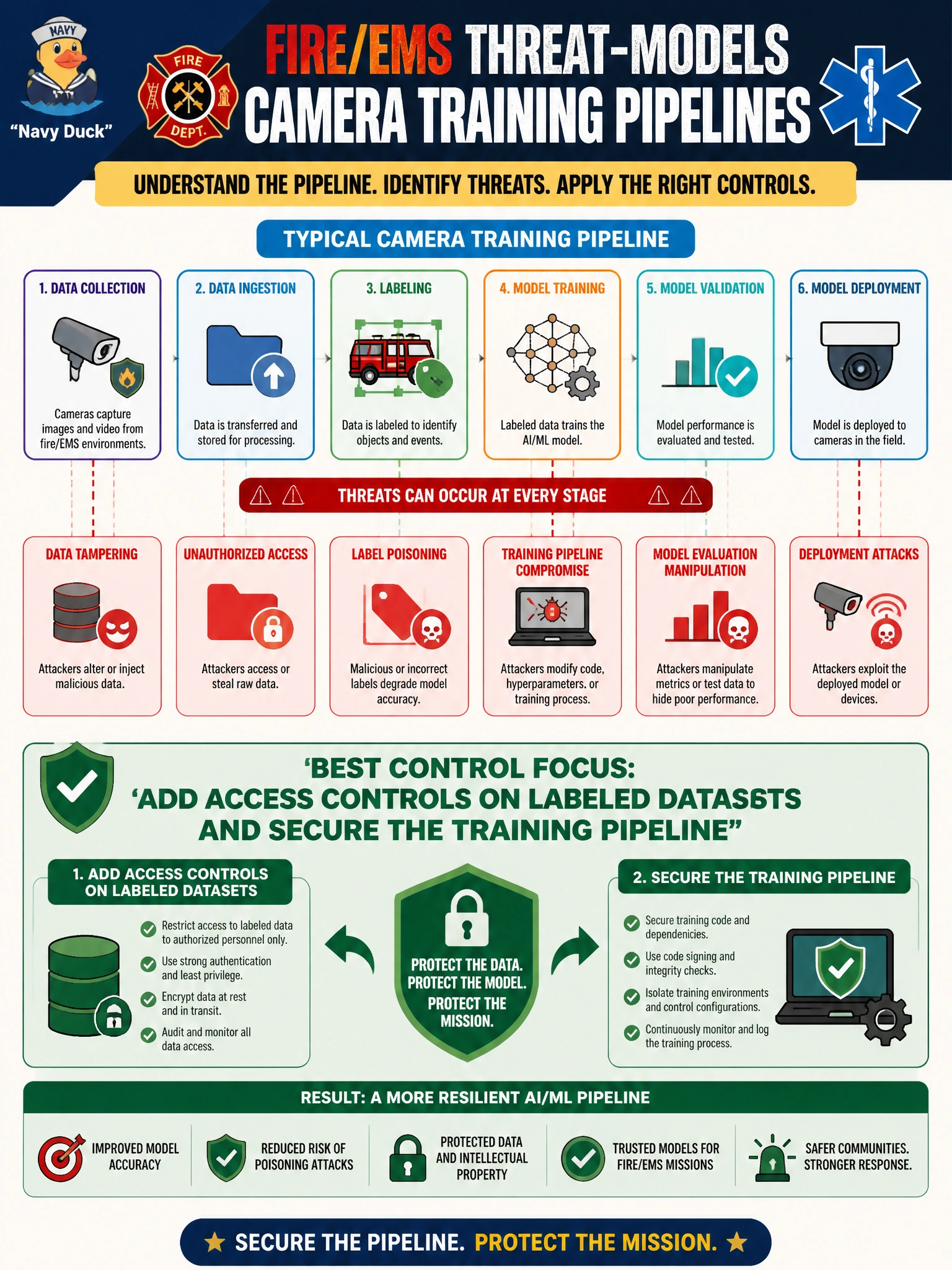
Fire/EMS threat-models camera training pipelines. Which control focus best fits?
Select an answer to reveal the explanation.
Short Explanation
The training kitchen needs locks too. Protect labeled datasets and the pipeline—Fire/EMS vision models are only as safe as the data path behind them.
Full Explanation
Fire/EMS camera training pipelines need access controls on labeled datasets and secured pipeline infrastructure because labeled emergency footage is both sensitive and high-value for poisoning or leakage. Access controls limit who can read, label, export, or modify datasets used to train models that may later support safety-related decisions. Securing the pipeline covers identity for jobs, integrity of training code and configs, audit logging, and protection of intermediate artifacts. Threat modeling that stops at the finished model ignores the dataset and CI path where many real compromises begin.
Leaving labeled datasets world-readable on shared drives invites unauthorized viewing of emergency scenes and trivial dataset tampering. Ignoring pipeline access because “only the finished model matters” misses poisoning, exfiltration, and integrity failures upstream. Publishing raw labeled emergency footage without review for convenience creates privacy, operational-security, and victim-dignity harms incompatible with public-safety stewardship.
Exam caveat: for training pipelines, dataset access and pipeline hardening are first-class controls—not afterthoughts relative to the exported model file.
Operational check: place Fire/EMS labeled data in access-controlled stores with least privilege and MFA for admins; restrict training runners; log dataset access; prohibit world-readable shares; and verify threat-model findings map to implemented pipeline controls before the next training run.