
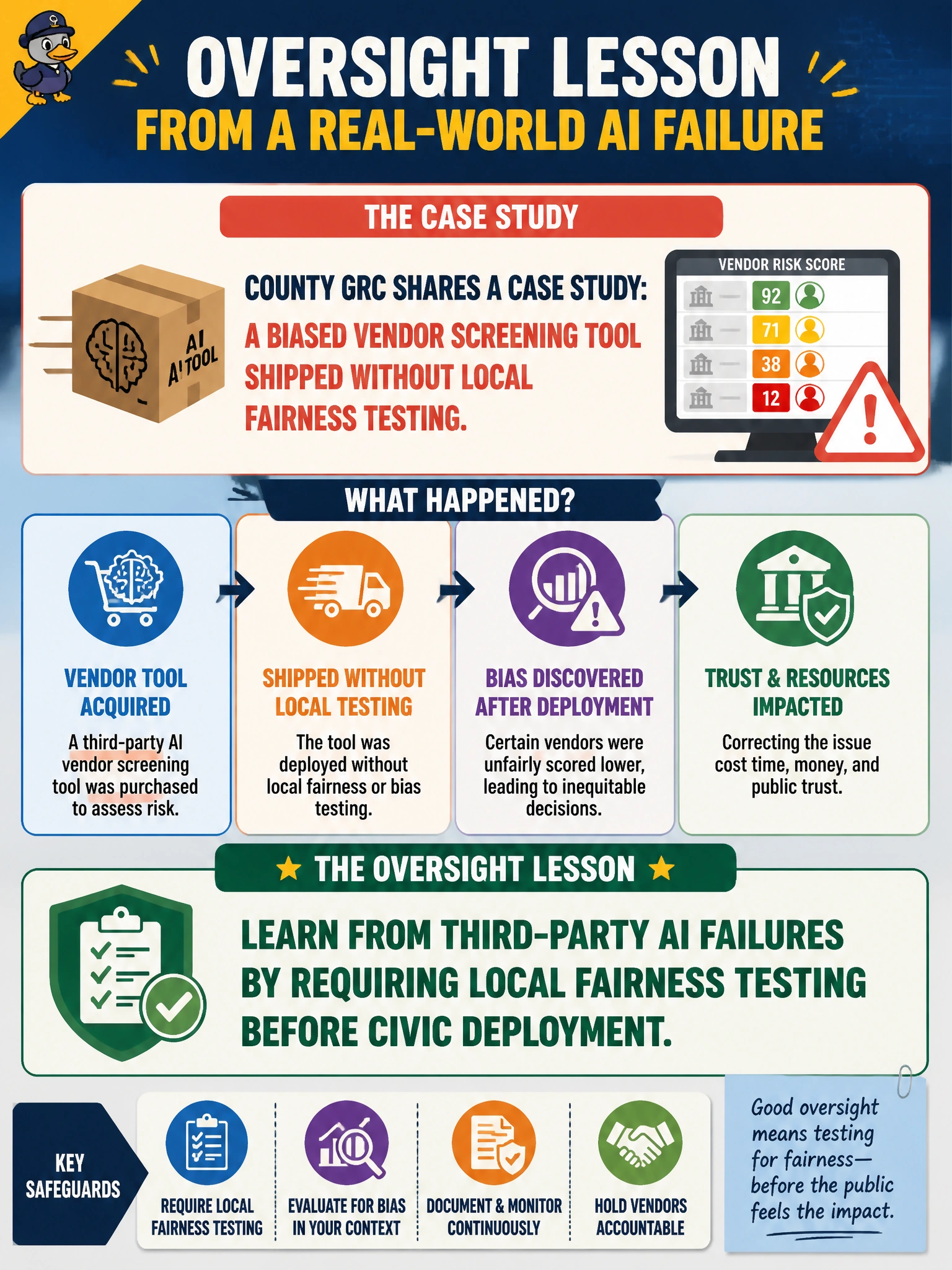
County GRC shares a case study after a biased vendor screening tool shipped without local fairness testing. What oversight lesson fits?
Select an answer to reveal the explanation.
Short Explanation
Someone else’s biased screener is your free lesson. Require local fairness testing before you put a vendor model in front of residents.
Full Explanation
County GRC sharing a case study after a biased vendor screening tool shipped without local fairness testing is teaching an oversight lesson from third-party failure. Learn from third-party AI failures by requiring local fairness testing before civic deployment is correct because vendor claims and offsite evaluations may not reflect the county’s population, job mix, or data conditions. Local fairness testing before deployment converts someone else’s failure into a preventive control for municipal hiring or benefits screening AI.
Ignore vendor failures because case studies never improve controls fails by concept: case studies are a primary input to control improvement in GRC. Skip fairness testing whenever a vendor claims the model is “neutral” fails by concept: neutrality claims are not a substitute for local empirical testing. Treat biased screening outcomes as solely a marketing problem fails by concept: biased outcomes are a fairness, legal, and trust problem—not a brochure issue.
Exam caveat: local fairness testing design depends on the use case and protected-class/outcome definitions available to the county; the exam tests the requirement to test locally before civic deployment, not a single universal metric. Testing should be completed before production exposure of residents.
Operational check: add a mandatory local fairness-testing gate to the county AI deployment checklist for vendor screening tools; block go-live until results are reviewed; document thresholds and residual bias acceptance if any; and file the case-study lesson in GRC so future procurements inherit the control.