
Code enforcement notices construction patterns changing after a new zoning code. Which AI risk should they flag?
Select an answer to reveal the explanation.
Short Explanation
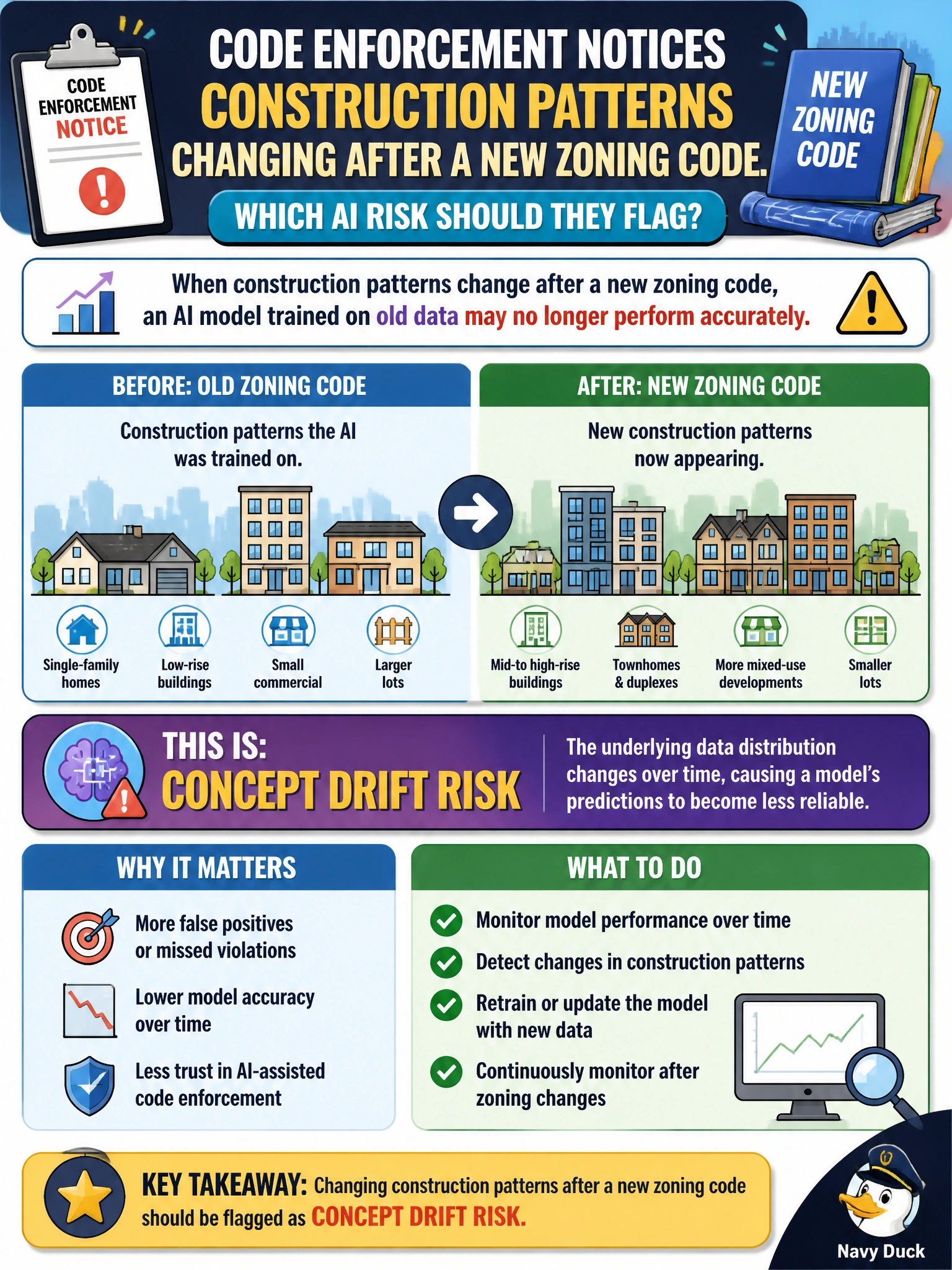
Zoning rewrote the world; the model may still be living in last year’s patterns. That’s concept drift—flag it and monitor, don’t blame the cyan cartridge.
Full Explanation
Code enforcement noticing construction patterns changing after a new zoning code should flag the AI failure mode that follows distribution shift in the real world. Concept drift risk when construction patterns change after a new zoning code is correct because models trained on prior patterns can degrade when the data-generating process changes, producing more errors on permits, inspections, or anomaly flags. Municipal code-enforcement AI needs monitoring and possible retraining when policy-driven pattern shifts occur—not a set-and-forget assumption.
Only the risk that printers run out of cyan ink fails by concept: consumables issues are not model drift and do not explain post-zoning prediction degradation. The belief that models never need monitoring after go-live fails by concept: it rejects continuous monitoring, which is exactly what drift management requires. Only risks from cafeteria loyalty programs fails by concept: cafeteria loyalty is unrelated to zoning-driven construction pattern change and AI performance.
Exam caveat: concept drift is about changing relationships between inputs and outcomes over time; it is not the same as a simple software bug or a one-off bad batch. Zoning change is a classic civic trigger, but drift can also come from economic shifts or enforcement policy changes.
Operational check: after a zoning-code change, baseline code-enforcement AI error rates and key data distributions; enable drift monitors on features and outcomes tied to construction patterns; schedule human review of elevated-error cohorts; and open a retrain/revalidate gate before treating model scores as equally trustworthy as pre-change.