
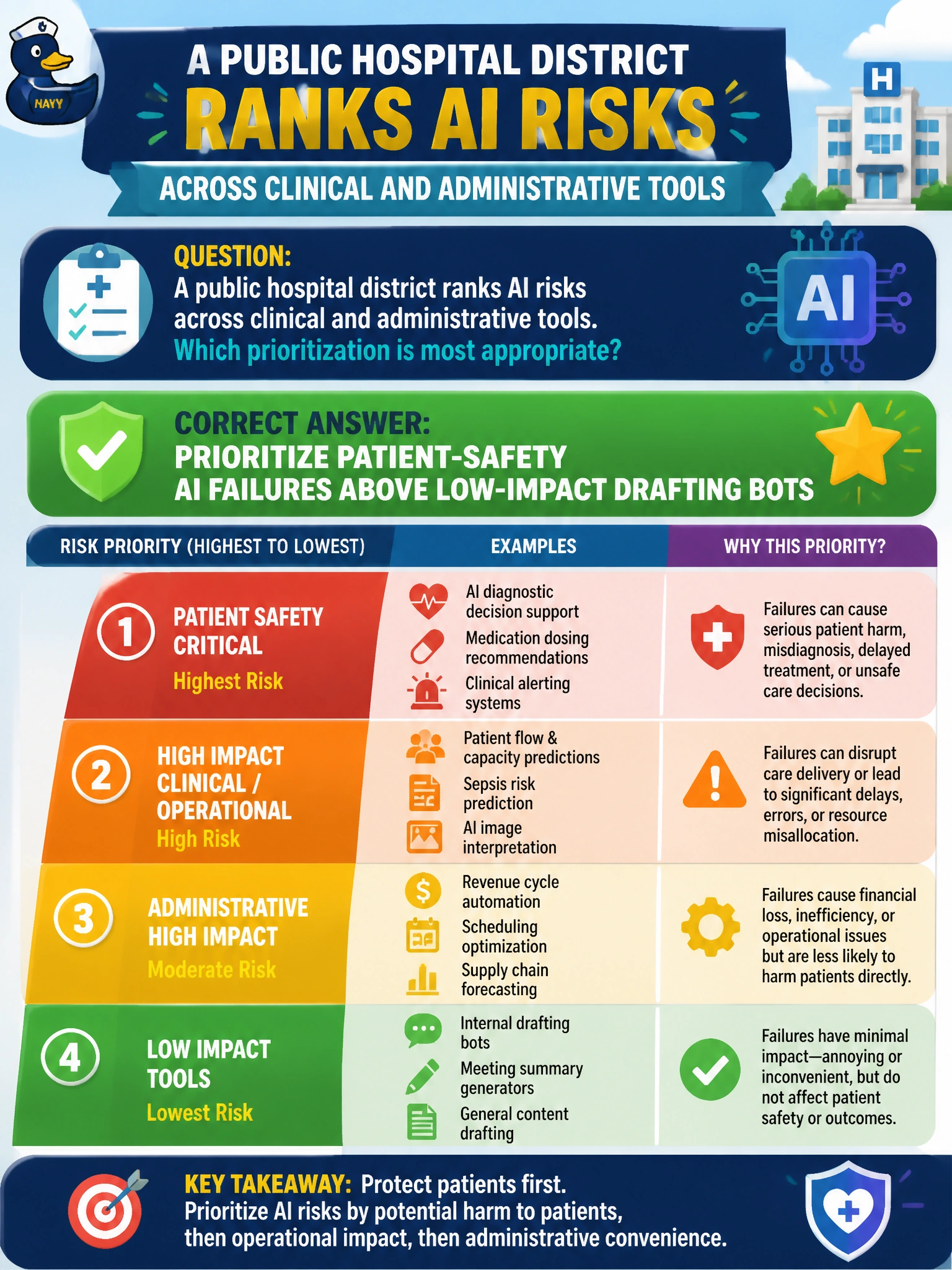
A public hospital district ranks AI risks across clinical and administrative tools. Which prioritization is most appropriate?
Select an answer to reveal the explanation.
Short Explanation
Not every bot is equal. Patient-safety failures jump the line over cute drafting tools—rank by harm, not booth swag.
Full Explanation
A public hospital district ranking AI risks across clinical and administrative tools must prioritize by severity of harm to the mission—especially patient safety. Prioritize patient-safety AI failures above low-impact drafting bots is correct because clinical AI failure modes can affect diagnosis support, triage, medication workflows, or care coordination, while low-impact drafting bots mainly affect productivity. Municipal/public hospital risk prioritization is harm- and criticality-driven, not equal-weight or marketing-driven.
Prioritize low-impact drafting bots above all clinical safety concerns fails by concept: it inverts severity and misallocates scarce governance attention. Rank solely by which vendor bought the nicest booth at a conference fails by concept: vendor marketing spend is not a risk severity measure. Treat every AI risk as equal regardless of harm to patients fails by concept: equal-weighting ignores differential impact and breaks ERM prioritization logic in healthcare settings.
Exam caveat: administrative AI can still matter (privacy, availability), but when forced to rank, patient-safety failure modes outrank low-impact drafting. Prioritization does not mean ignoring admin tools entirely—it means sequencing depth of controls and oversight.
Operational check: build the hospital district AI risk inventory with impact tags for patient safety versus administrative productivity; sort treatment backlog so clinical safety risks receive earlier control design, monitoring, and executive review; and verify drafting-bot risks are queued lower unless they touch PHI or clinical decision pathways.