
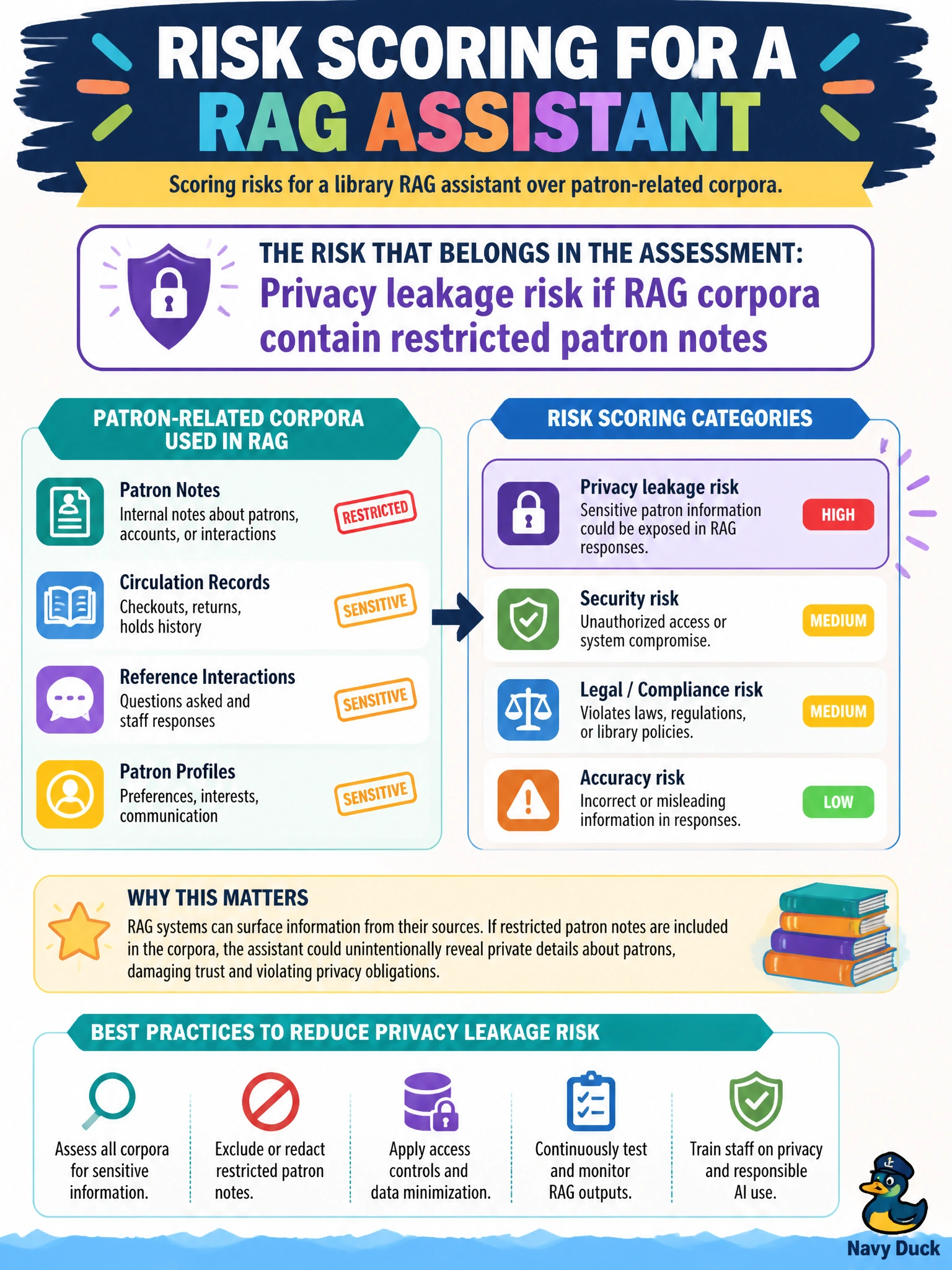
A library scores risks for a RAG assistant over patron-related corpora. Which risk belongs in the assessment?
Select an answer to reveal the explanation.
Short Explanation
RAG over library notes can spill restricted patron stuff if you’re not careful. Score privacy leakage as a real risk—embeddings don’t erase duties.
Full Explanation
When a library scores risks for a RAG assistant over patron-related corpora, privacy leakage risk belongs in the assessment if corpora contain restricted patron notes. Retrieval-augmented generation can surface sensitive snippets into answers or logs when restricted notes are embedded and retrieved. Municipal libraries often hold confidential staff notes, contact details, or protected circumstances; RAG design must treat those corpora as privacy-sensitive, not as harmless text piles.
Claiming RAG systems cannot leak restricted notes under any design fails by concept because retrieval plus generation is precisely a disclosure pathway when sensitive text is indexed. Claiming privacy ends when text is embedded for retrieval fails because embeddings and retrieved chunks remain personal-data processing with leakage potential. Claiming only printed books create privacy risk fails because digital patron notes are often more sensitive than published holdings.
Exam caveat: access controls on the chat UI are insufficient if the retriever can pull restricted notes into context for unauthorized queries or for broad staff roles. Operational check: classify patron-related corpora before indexing, exclude or tightly segment restricted notes, redaction-test retrieval answers, and monitor for sensitive-field leakage in RAG responses and traces.