
Emergency management must prioritize AI risks under limited resources. Which prioritization approach best fits civic public-safety outcomes?
Select an answer to reveal the explanation.
Short Explanation
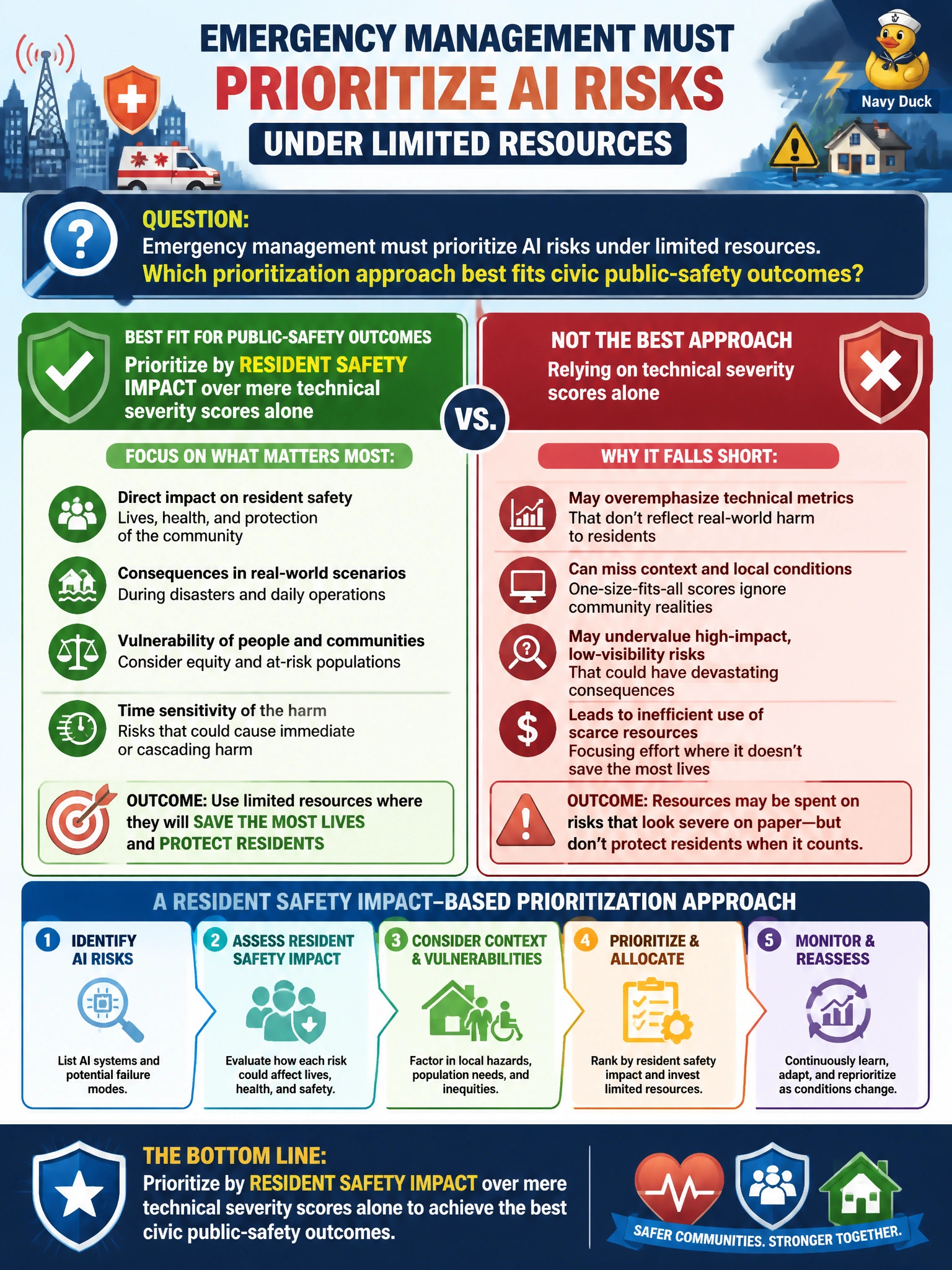
In EM, resident safety beats “cool tech” and vanity AUC. Prioritize AI risks by who gets hurt in the real world—not only by technical severity scores.
Full Explanation
Emergency management prioritizing AI risks under limited resources should prioritize by resident safety impact over mere technical severity scores alone. Civic public-safety outcomes elevate harms that injure people, delay response, or degrade life-safety decisions above internally impressive CVSS-like scores that do not map to resident impact. Resource-constrained triage therefore weights consequence to the public mission, then applies technical severity inside that framing.
Ranking solely by how interesting the technology sounds to engineers fails by concept because novelty is not a risk priority criterion. Prioritizing only risks that affect internal dashboards fails because dashboard inconvenience can outrank life-safety AI failures under that distorted lens. Ignoring resident harm if the model’s AUC looks strong fails because aggregate accuracy can coexist with catastrophic subgroup or edge-case safety failures.
Exam caveat: technical severity remains useful for exploitability analysis, but in municipal emergency AI it is subordinate to resident safety consequence when resources force ordering. Operational check: score AI risks with an explicit resident-safety impact dimension, require safety owners to validate rankings, and fund treatments for top safety-impact items before lower-impact technical curiosities.