
An assessor’s office wants to expand valuation AI into appeals recommendations. What should happen before the expansion?
Select an answer to reveal the explanation.
Short Explanation
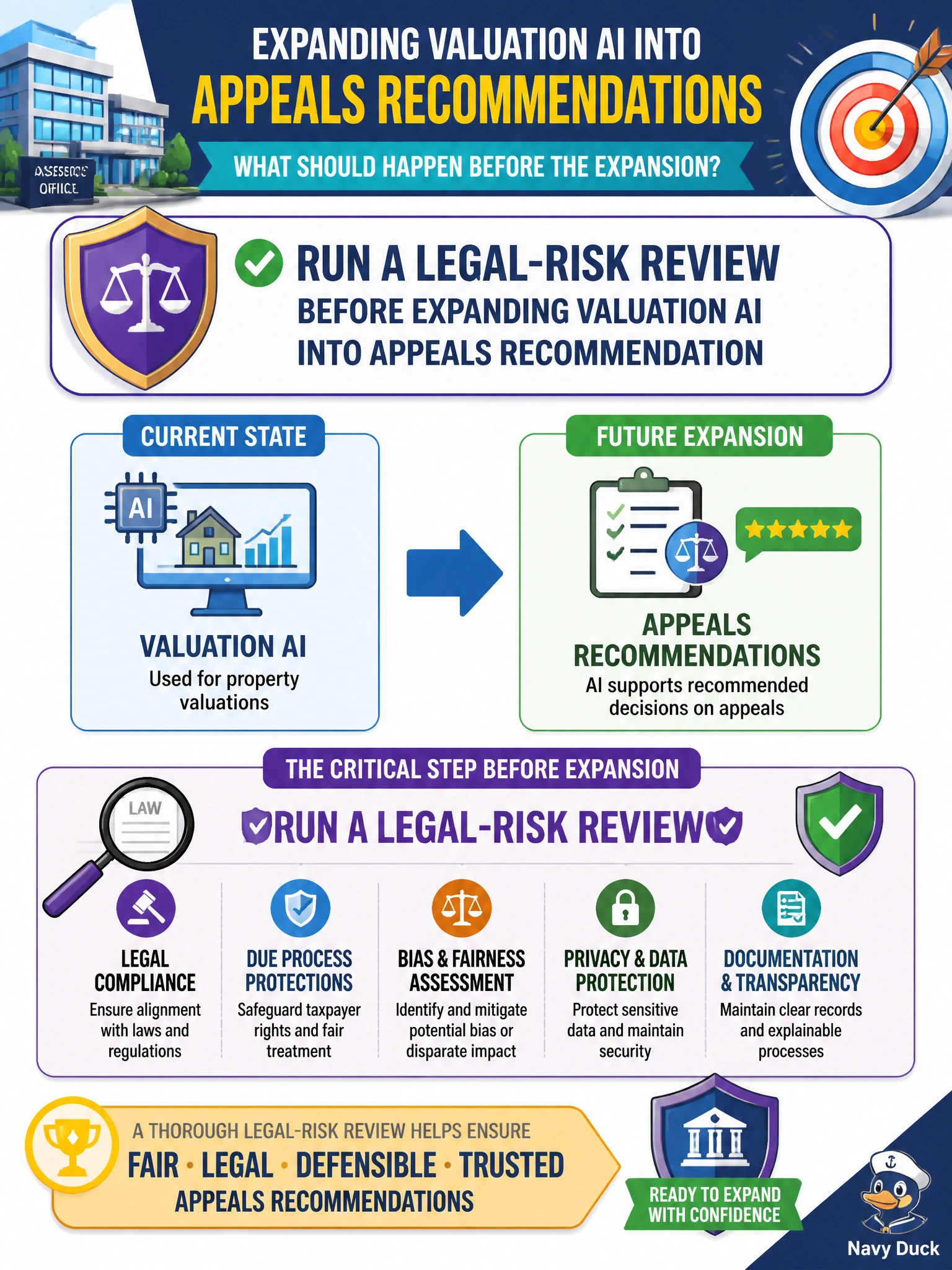
Appeals recommendations aren’t just a feature toggle. Expand valuation AI into that lane only after a legal-risk review—not a midnight ship.
Full Explanation
Before an assessor’s office expands valuation AI into appeals recommendations, it should run a legal-risk review. Valuation support and appeals recommendation are different legal-risk surfaces: appeals touch contestable outcomes, procedural fairness, and potential reliance by hearing officers or staff. A pre-expansion legal-risk review maps authority, disclosure, human oversight, bias/challenge pathways, and recordkeeping before the model’s influence grows into quasi-adjudicative advice.
Shipping overnight with no legal review to “move fast” fails by concept because speed without authority and process review is how municipalities create due-process and ultra vires exposure. Assuming valuation accuracy automatically covers appeals liability fails because predictive accuracy is not the same as lawful, fair appeals procedure. Letting a vendor decide the legal scope without county counsel fails because vendors do not hold the county’s statutory duties or litigation risk.
Exam caveat: even “recommendation-only” appeals AI can create constructive reliance if staff treat outputs as decisive; the legal review must address real-world use, not brochure intent. Operational check: require written counsel sign-off before enabling appeals features, document human decision rights, and pilot with sampling of recommendation vs. final outcomes before production expansion.