
Fire/EMS evaluates a vendor tool advertised as “AI Act ready.” What should municipal buyers demand?
Select an answer to reveal the explanation.
Short Explanation
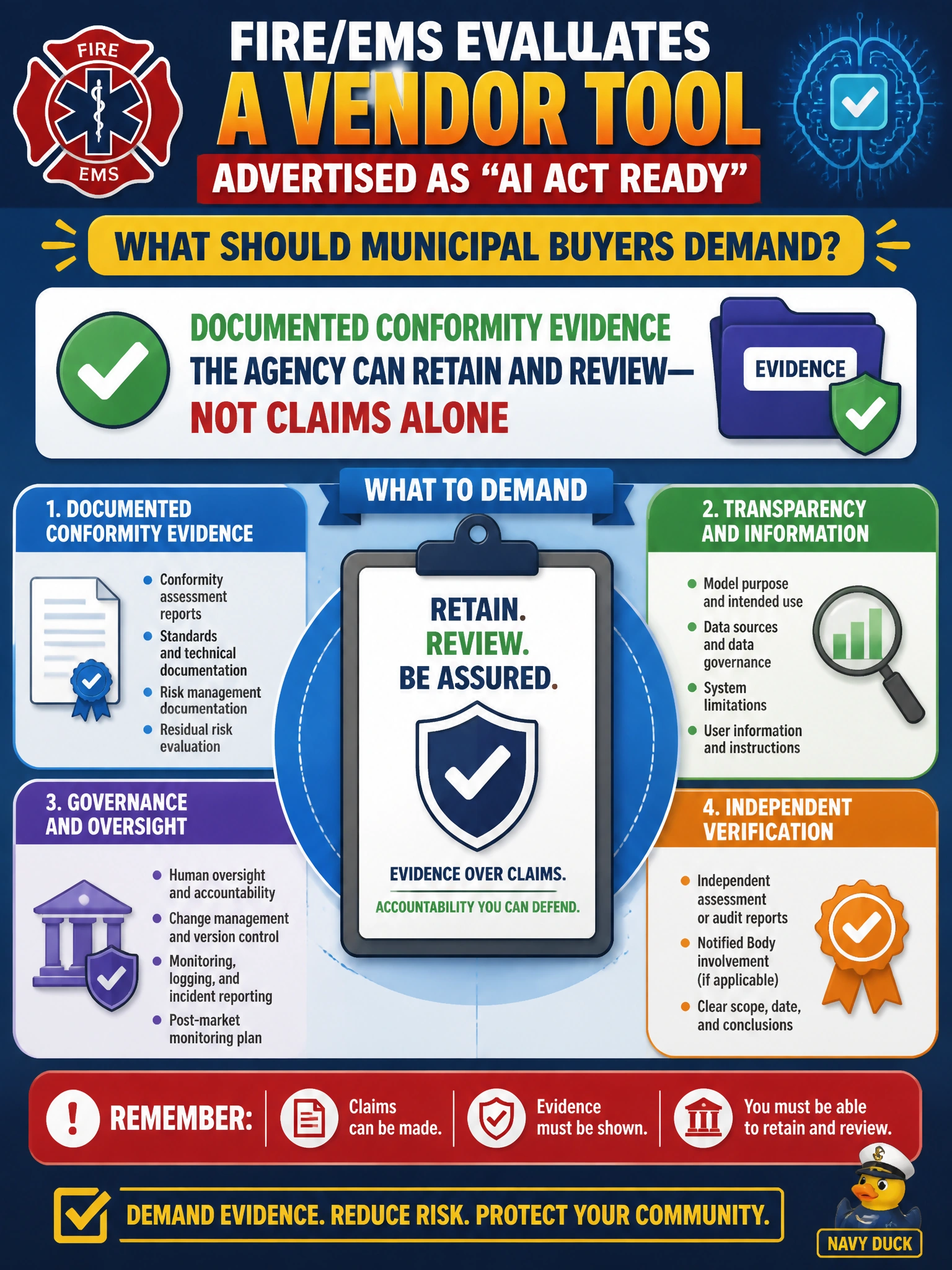
“AI Act ready” on a slide isn’t evidence. Fire/EMS needs conformity docs the agency can keep and review—not brochure vibes.
Full Explanation
Municipal buyers evaluating a Fire/EMS vendor tool advertised as “AI Act ready” should demand documented conformity evidence the agency can retain and review—not marketing claims alone. Civic procurement for safety-adjacent AI needs artifacts the city can store, audit, and revisit: assessments, intended-use statements, risk classifications as claimed, control descriptions, and update commitments. Retained evidence lets legal, risk, and operations challenge drift when the product or the regulatory landscape changes.
Blind trust because the brochure uses the words “AI Act” fails by concept: slogans are not conformity proof and create false assurance. A promise that marketing claims replace local evidence forever fails because agencies remain accountable for their deployment context and cannot outsource proof to slogans. Skipping review if the salesperson sounds confident fails because confidence is not an evidence substitute in public-sector acquisition.
Exam caveat: vendor “AI Act ready” labels may reflect a claimed product posture, not the city’s specific high-risk use case, localization, or integration; buyers still must assess fitness for the municipal deployment. Operational check: put evidence retention and update-notification clauses in the contract, store conformity packets in the AI system record, and re-review after material model or feature changes before expanding Fire/EMS reliance.