
A county privacy office reviews GenAI that logs resident chat transcripts. What should it primarily align?
Select an answer to reveal the explanation.
Short Explanation
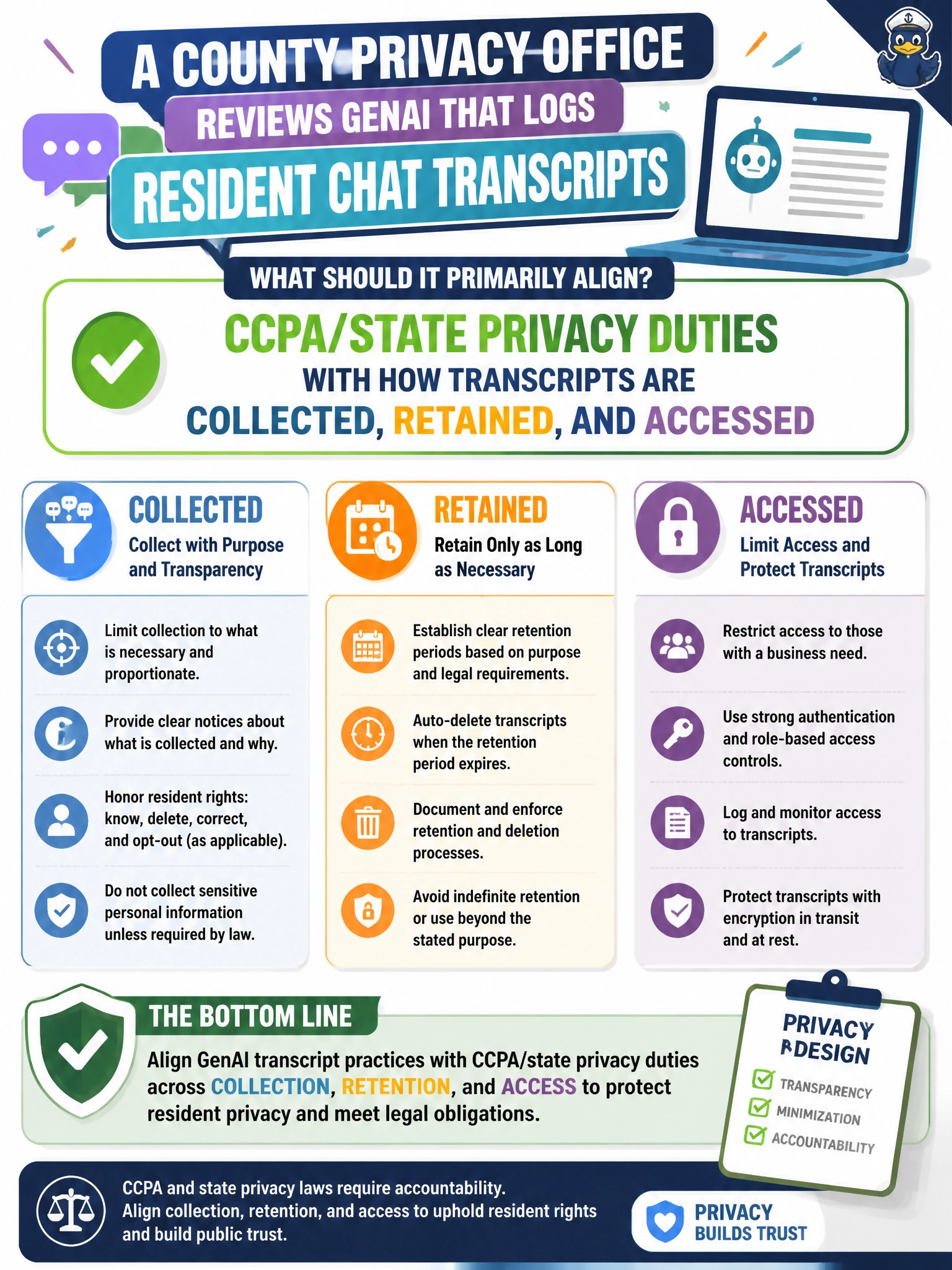
When your GenAI logs resident chats, privacy duties still matter. Align applicable privacy rules with how transcripts are collected, retained, and accessed; don’t treat those records as free-for-all data.
Full Explanation
GenAI that logs resident chat transcripts engages privacy duties. The county privacy office should align CCPA and applicable state privacy requirements with how transcripts are collected, retained, and accessed. That includes notice and transparency, purpose limitation, access controls, retention schedules, deletion or request handling where applicable, and vendor processing terms. Transcripts may contain personal information about residents’ needs, locations, and circumstances, so treating them as ordinary IT telemetry without privacy analysis misses the point. Selling all resident chats to advertisers by default fails to respect privacy duties and can undermine trust in county digital services. Retaining every transcript indefinitely in a broad-access archive without notifying residents is also inconsistent with responsible privacy practice: unbounded, opaque retention and unrestricted access are core risks for conversational personal data. The claim that privacy law never applies to municipal chatbots is incorrect; government chatbots that collect personal information may remain subject to applicable state privacy regimes and local policy, even when described as “just a bot.” Exam caveat: whether CCPA applies to a government entity can depend on jurisdiction-specific rules, so do not assume either coverage or exemption without checking. Practical check: map transcript flows end to end, verify notices and retention schedules, limit access by least-privilege roles, and test a sample privacy request or deletion workflow against GenAI log stores.