
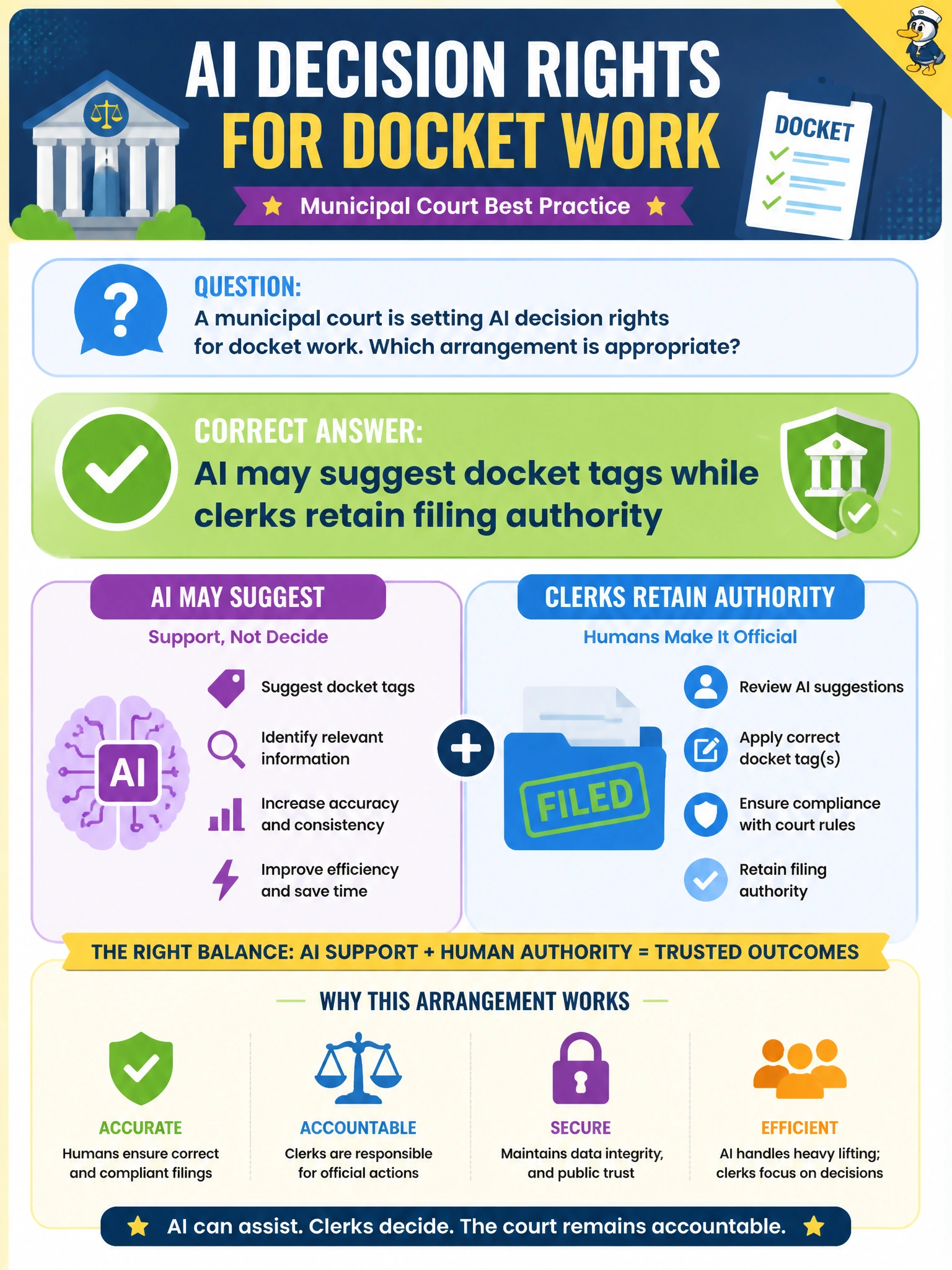
A municipal court is setting AI decision rights for docket work. Which arrangement is appropriate?
Select an answer to reveal the explanation.
Short Explanation
AI can whisper a docket tag suggestion; clerks still own the filing stamp. Suggestion versus authority is the whole ballgame in court ops.
Full Explanation
In municipal court operations, decision rights must separate assistive AI from legal authority. Allowing AI to suggest docket tags while clerks retain filing authority preserves efficiency for triage without transferring the act of filing—or the accountability that comes with it—to a model. Clerks can accept, edit, or reject suggestions; the court of record remains a human-controlled process consistent with justice-system norms, auditability, and due-process expectations.
AI filing all pleadings with no clerk review fails because pleadings carry legal consequences that require human accountability and verification against court rules. Replacing judicial signatures on final orders fails by concept: adjudicative authority is not delegable to an unsupervised model under ordinary civic governance. Requiring clerks to accept every AI tag without override rights fails the control purpose of suggestion systems—without override, “suggestion” becomes de facto automation of docket classification.
Exam caveat: suggestion-plus-human-authority is the pattern for many justice AI uses; the exam contrast is authority vs. assistance, not “AI never helps courts.” Operational check: configure docket AI so tags are proposed not filed, log clerk accept/reject rates, and verify no pathway exists for AI to complete filings or apply judicial signatures without authenticated human action.