
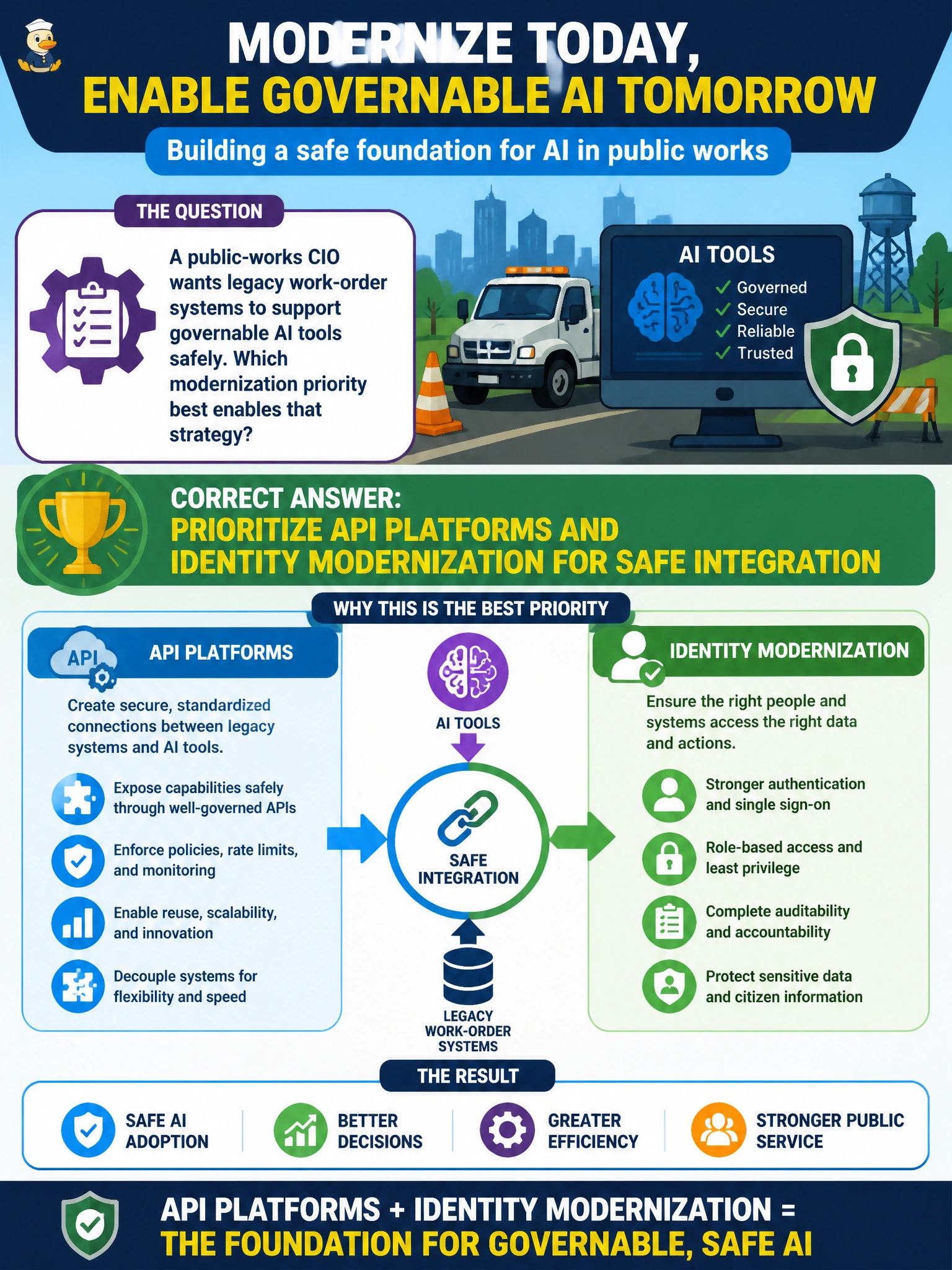
A public-works CIO wants legacy work-order systems to support governable AI tools safely. Which modernization priority best enables that strategy?
Select an answer to reveal the explanation.
Short Explanation
AI that can’t talk to work orders safely is just a demo. API platforms plus modern identity are the on-ramps that let tools integrate without blowing up security.
Full Explanation
The correct answer is prioritizing API platforms and identity modernization for safe integration of governable AI with legacy work-order systems. A public-works CIO enabling AI tools needs controlled interfaces (APIs, event streams) and modern identity (authentication, authorization, least privilege, audit) so models and assistants can read or write work orders without becoming a security bypass. That modernization is what makes AI strategy operable inside municipal IT constraints.
Disabling all authentication to make integrations trivial fails by concept because it trades convenience for unacceptable compromise of work-order integrity and resident data. Hand-copying work orders into spreadsheets for every model call fails as an unsustainable, error-prone anti-pattern that cannot scale or audit cleanly. Banning all interfaces so AI stays completely isolated forever fails because isolation without integration leaves AI as a disconnected demo unable to support real public-works workflows.
Exam caveat: enabling AI safely is about platforms and identity—not removing security or refusing all connectivity. Operational check: prioritize an API gateway and identity modernization roadmap, require AI tools to use service accounts with scoped permissions, and log all work-order reads/writes for audit.