
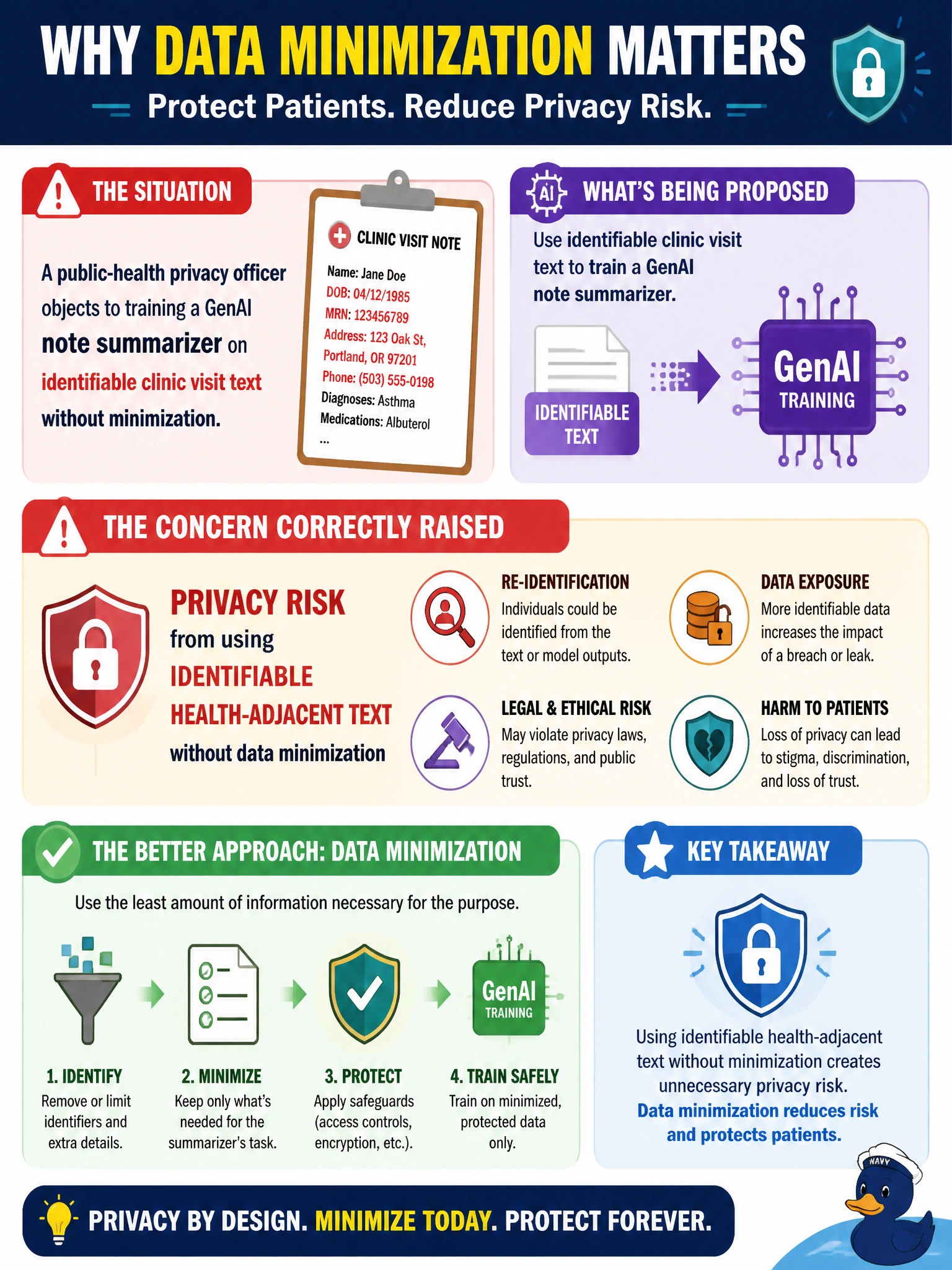
A public-health privacy officer objects to training a GenAI note summarizer on identifiable clinic visit text without minimization. What concern is the officer correctly raising?
Select an answer to reveal the explanation.
Short Explanation
Feeding raw identifiable clinic notes into a summarizer without trimming them down is like leaving medical charts on a bus. Privacy officers are right to demand minimization up front—not after something leaks.
Full Explanation
A public-health privacy officer objecting to training a GenAI note summarizer on identifiable clinic visit text without minimization is correctly raising privacy risk from using identifiable health-adjacent text without data minimization. Training on full identifiers expands exposure, retention, and misuse surface before any production benefit is proven.
Why the other options fail by concept: Claiming GenAI summarizers never process text and need no privacy review is absurd given the modality. Treating minimization as required only after a breach inverts privacy-by-design. Asserting clinic visit text is always public information exempt from protection contradicts ordinary health privacy expectations and policy.
Exam caveat: Even when formal HIPAA status is debated for a dataset, municipal and ethical privacy standards often still require minimization, access control, and purpose limitation. De-identification quality matters—simple name stripping may leave re-identifiable combinations.
Operational check: Before any training job, apply minimization (drop direct identifiers, reduce free text where possible, use approved de-identification), record lawful basis and retention, restrict training environments, and require privacy sign-off. Prefer summarizing with retrieval over retained identifiable corpora when feasible.