
A utility cybersecurity board asks how to separate accountabilities in an AI outage predictor. Which separation best supports clear governance?
Select an answer to reveal the explanation.
Short Explanation
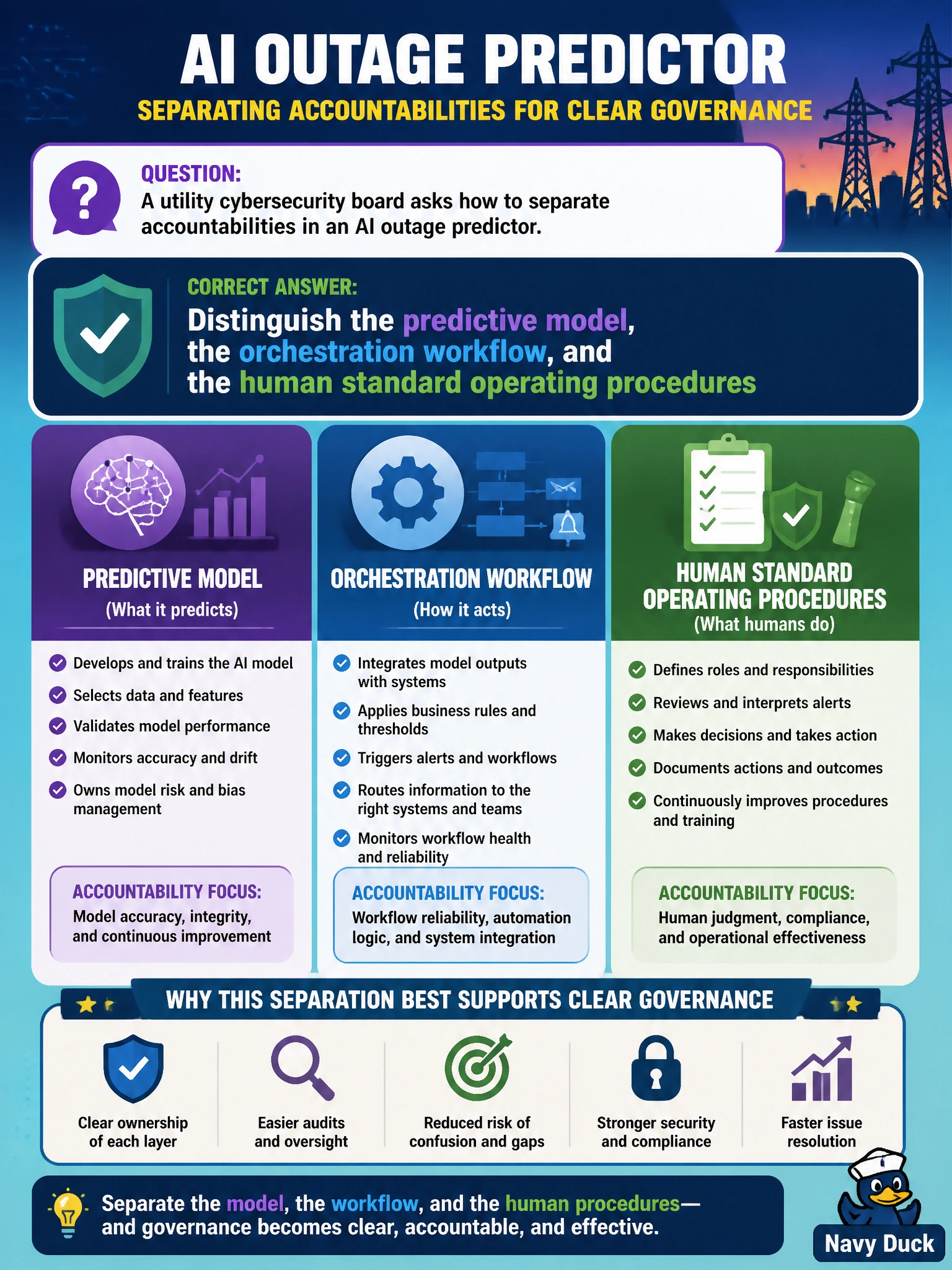
An outage predictor is a three-layer sandwich: the model that scores risk, the orchestration that moves tickets around, and the human SOPs that say who acts. Pull those layers apart on the org chart or nobody knows who owns a failure.
Full Explanation
A utility cybersecurity board asking how to separate accountabilities in an AI outage predictor should distinguish the predictive model, the orchestration workflow, and the human standard operating procedures. Clear separation lets the organization assign owners, controls, and incident response to the right layer instead of blaming a vague “the AI.”
Why the other options fail by concept: Treating model, orchestration, and human SOPs as one inseparable black box with a single owner label prevents root-cause analysis and control design. Assigning all accountability only to the GPU vendor and none to municipal operators ignores operational ownership of prompts, thresholds, and crew actions. Documenting only dashboard colors while ignoring model and process components is cosmetic governance.
Exam caveat: Layers interact—model drift can look like orchestration bugs, and SOP non-compliance can look like model failure—so separation must include interfaces and shared logs, not siloed blame. Vendors remain responsible for their components under contract, but the utility retains operational accountability.
Operational check: Publish an RACI for the outage predictor spanning model owner, orchestration/platform owner, and SOP/operations owner; map monitoring alerts to each layer; and run a tabletop where a bad prediction, a stuck workflow, and a missed SOP step are diagnosed separately with evidence trails.