
An assessor’s office prepares to approve a valuation-assist model. Which artifacts most directly support governable documentation of how the AI system was built?
Select an answer to reveal the explanation.
Short Explanation
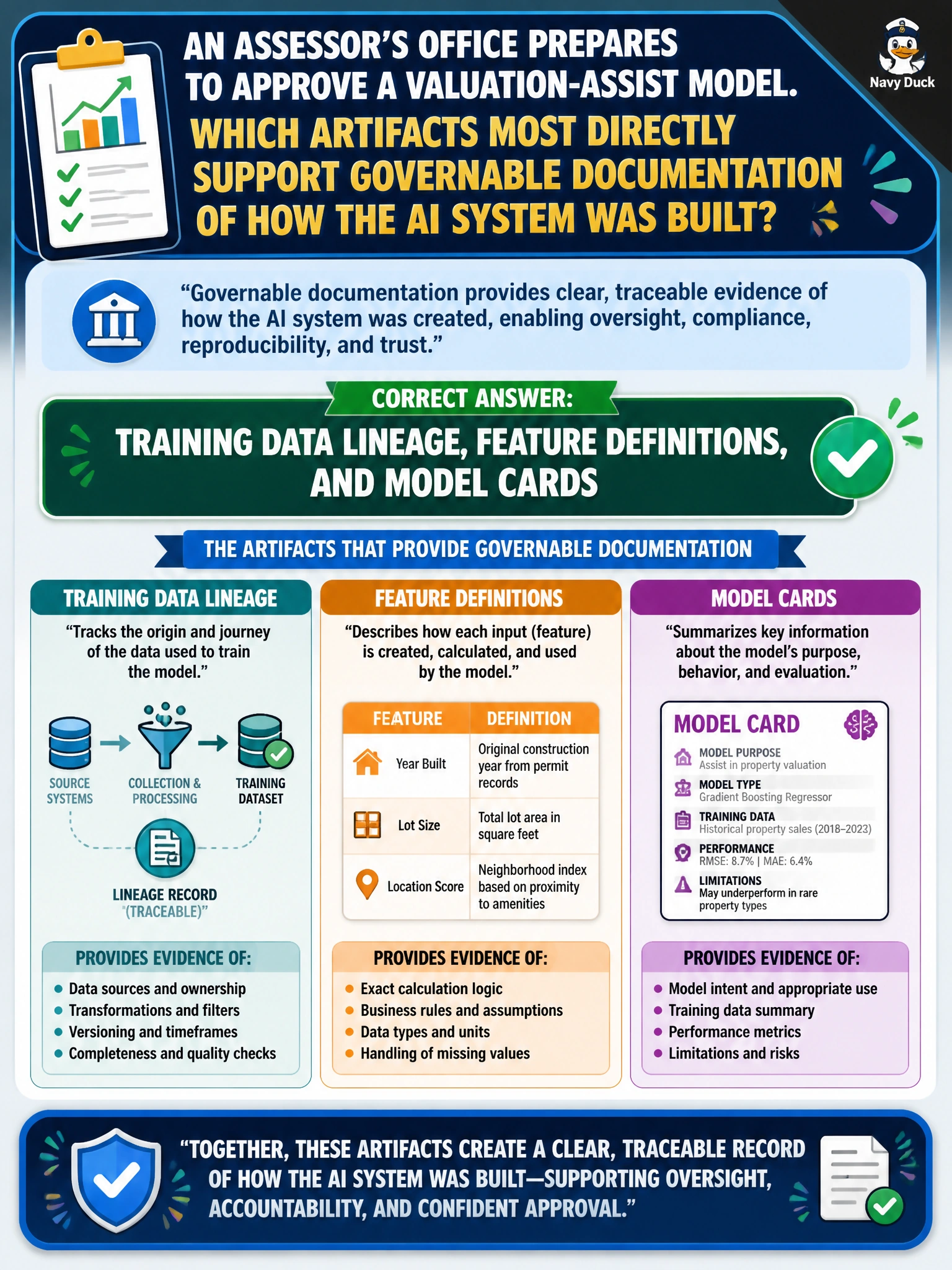
Before green-lighting a valuation helper, you want the paper trail: where the training data came from, what features mean, and a model card that explains the system. Nicknames and hallway handshakes do not count as governance artifacts.
Full Explanation
An assessor’s office preparing to approve a valuation-assist model most directly supports governable documentation with training data lineage, feature definitions, and model cards. Those artifacts explain what the system learned from, what inputs mean, and how the model is intended to behave—material for boards, auditors, and appeals processes.
Why the other options fail by concept: A slide with only a product nickname and no technical content cannot support oversight. A marketing brochure that omits data and model details is persuasion, not documentation. A verbal hallway agreement that documentation is unnecessary is incompatible with public accountability for valuation-affecting tools.
Exam caveat: Documentation quality matters as much as existence—stale model cards and undocumented feature changes recreate the same risk. Valuation assists that influence assessments inherit heightened explainability and challenge expectations even when a human remains “in the loop.”
Operational check: Before approval, require lineage from source CAMA/deed systems to training extracts, a feature dictionary with owners, and a model card covering intended use, limits, metrics, and monitoring. Store them in the AI inventory and refresh on each material retrain or feature change.