
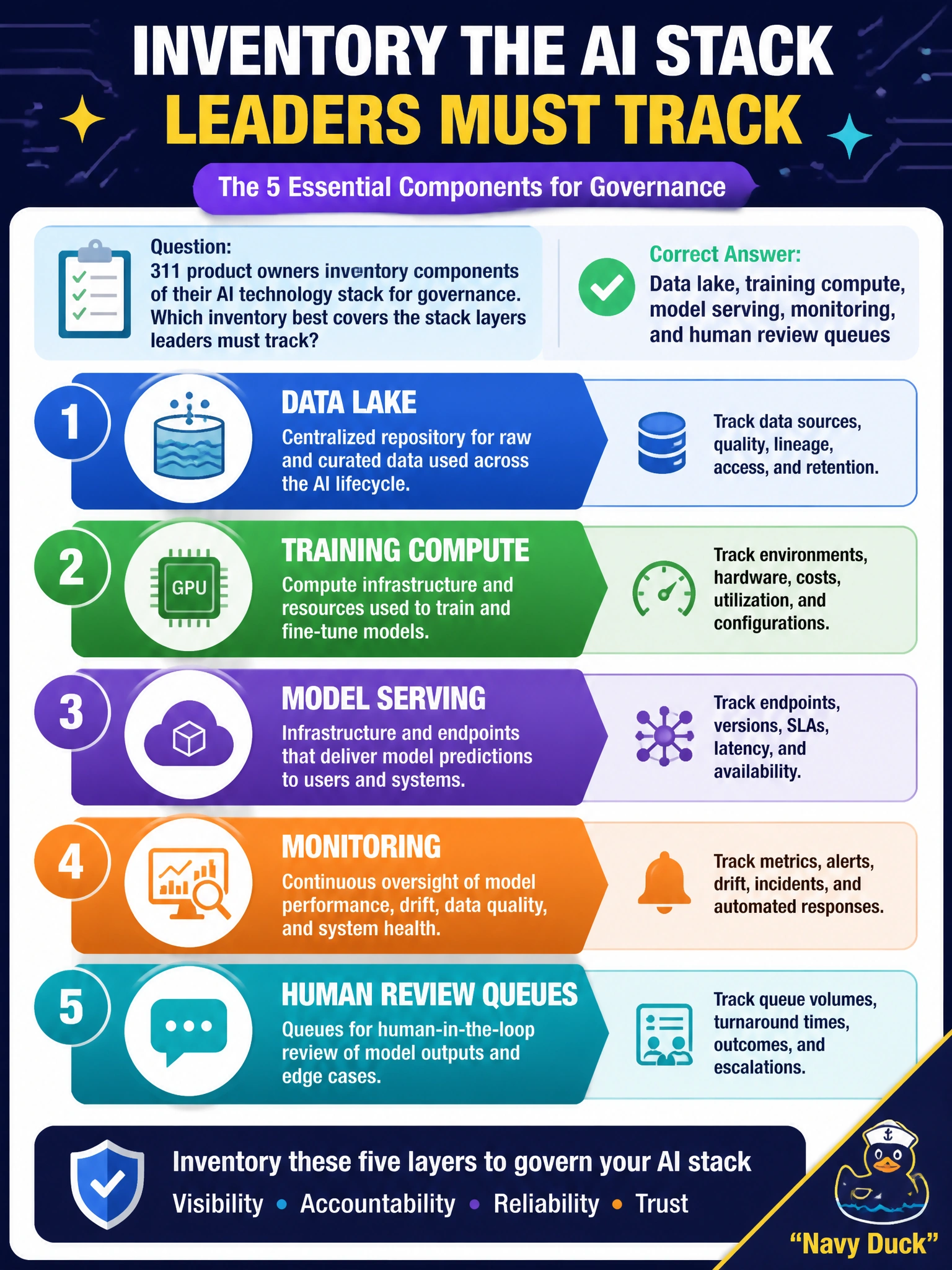
311 product owners inventory components of their AI technology stack for governance. Which inventory best covers the stack layers leaders must track?
Select an answer to reveal the explanation.
Short Explanation
An AI stack is like a city water system: reservoir (data), treatment plant (training), pipes (serving), gauges (monitoring), and someone watching the gauges (human review). Inventory all those layers—not just the shiny faucet on the website.
Full Explanation
When 311 product owners inventory components of their AI technology stack for governance, leaders must track substantive layers: data lake, training compute, model serving, monitoring, and human review queues. Those layers are where bias, outages, cost, and accountability actually live for a municipal intake system.
Why the other options fail by concept: Inventorying only the chat widget skin ignores data and serving risk. Listing marketing slogans and vendor logos without technical components produces a brochure, not a control surface. Treating desktop printers used by agents as the primary AI stack confuses peripherals with the learning and decision path.
Exam caveat: UI components can matter for accessibility and disclosure, but they are not a substitute for data/model/serving/monitoring/human-review inventory. Human review queues are part of the stack for high-impact 311 routing—not an afterthought outside “AI.”
Operational check: Produce a stack inventory worksheet for 311 AI with owners and evidence per layer (datasets and retention; training environment; serving endpoints and auth; monitoring metrics and alerts; human review SLAs). Use it in change control and incident retrospectives whenever triage behavior changes.