
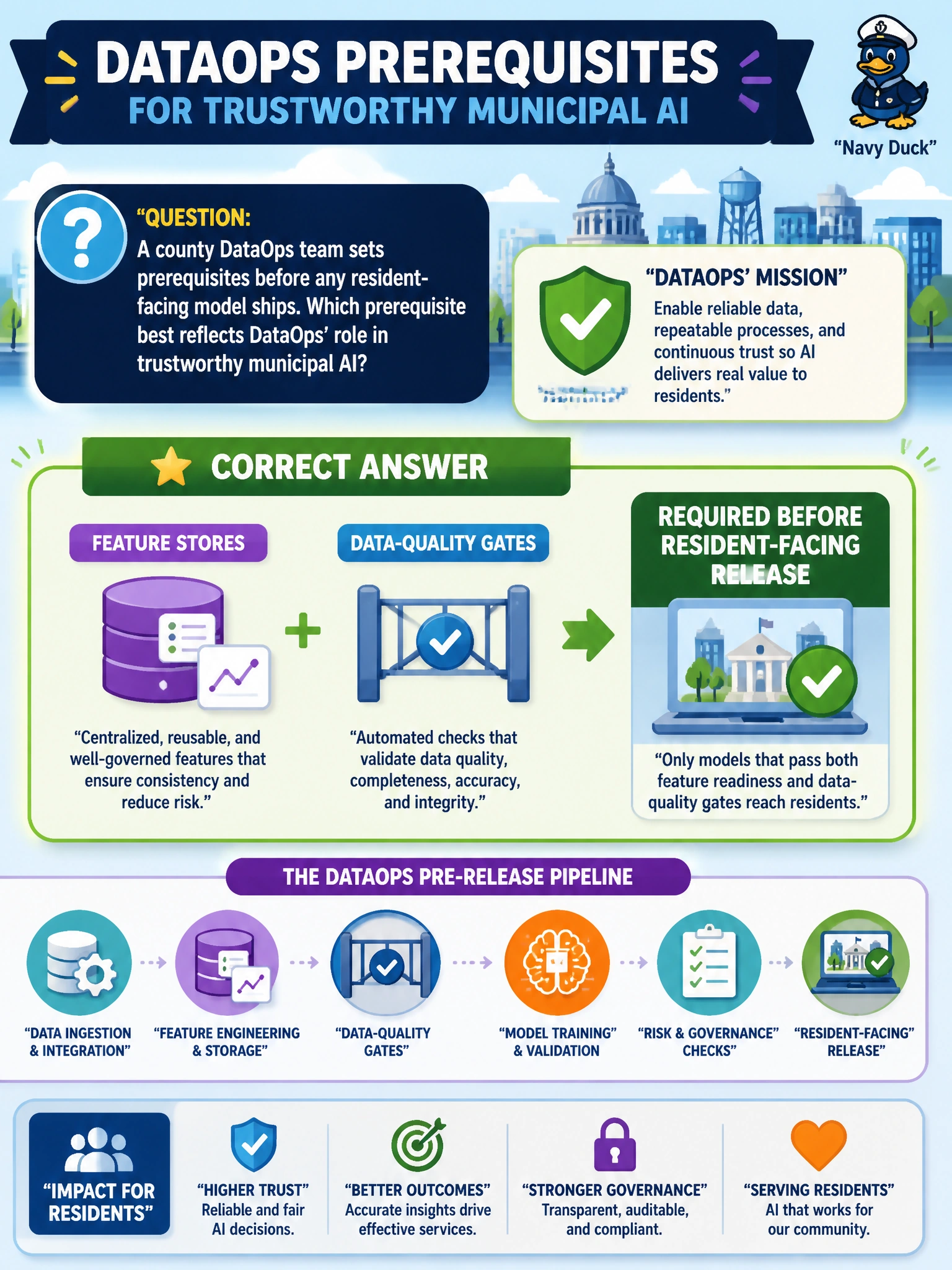
A county DataOps team sets prerequisites before any resident-facing model ships. Which prerequisite best reflects DataOps’ role in trustworthy municipal AI?
Select an answer to reveal the explanation.
Short Explanation
If the ingredients are messy, the recipe fails—even if the oven is fancy. Feature stores and data-quality gates are how counties keep the ingredients consistent before a resident-facing model goes live. DataOps is that kitchen discipline for AI.
Full Explanation
A county DataOps team setting prerequisites before any resident-facing model ships should treat feature stores and data-quality gates as required before resident-facing release. DataOps’ role is to keep training and serving inputs consistent and fit for purpose so models do not silently drift or encode garbage-in decisions that harm residents.
Why the other options fail by concept: Deleting data-quality checks to accelerate portal launch trades short-term speed for unfair or incorrect outcomes. Allowing undocumented feature definitions so teams move faster guarantees training/serving skew and irreproducible audits. Skipping feature stores because “production inference never needs consistent inputs” contradicts how reliable municipal scoring actually works.
Exam caveat: Feature stores and quality gates do not replace model validation or fairness review; they are necessary data foundations. Overly rigid gates without clear ownership can stall delivery—so define SLAs and exception paths, but do not ship resident-facing AI with unchecked inputs.
Operational check: Block production promotion unless features used at inference are registered, documented, and passing agreed quality rules (completeness, range, freshness). Log gate failures, assign DataOps owners, and re-test after schema changes before the resident-facing model returns to service.