
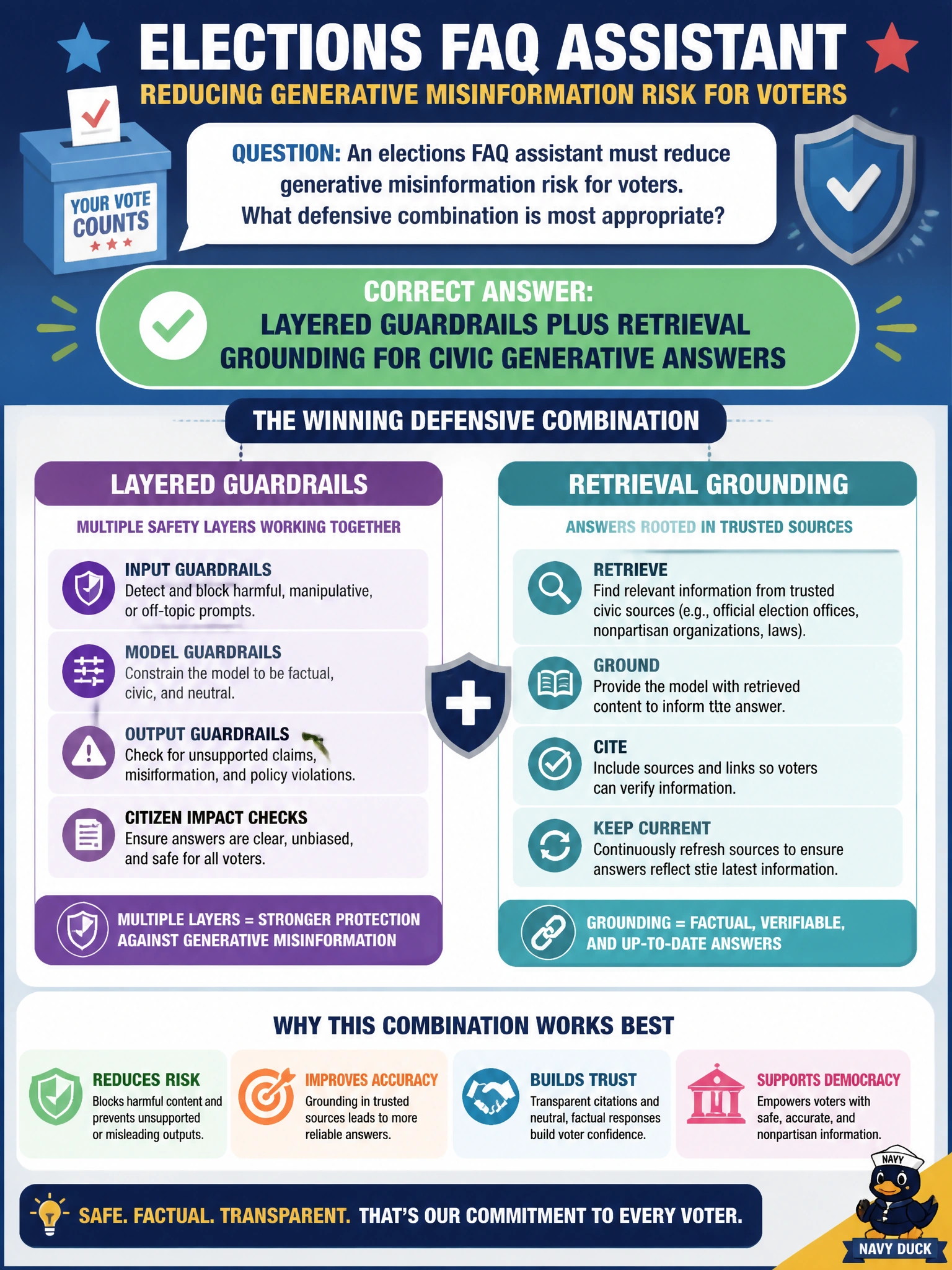
An elections FAQ assistant must reduce generative misinformation risk for voters. What defensive combination is most appropriate?
Select an answer to reveal the explanation.
Short Explanation
For election FAQs, stack guardrails and ground answers in trusted retrieval—don’t freestyle civic facts. Neon drop boxes aren’t misinformation defense.
Full Explanation
An elections FAQ assistant must reduce generative misinformation risk for voters with layered guardrails plus retrieval grounding for civic generative answers. Guardrails constrain disallowed topics, speculative electioneering claims, and unsafe instructions; grounding forces answers to authorized, versioned election materials (deadlines, polling locations, ballot rules) with citations rather than free-form model memory. Layering matters because a single weak filter still allows fluent falsehoods on high-stakes civic facts, while grounding alone without policy filters may still surface out-of-policy content if retrieval is poisoned or incomplete. For elections information, this combination is defensive engineering against generative misinformation that can suppress or confuse voters even without classic cybersecurity compromise. Neon paint on ballot drop boxes, glitter-backed poll-worker pins, and patterned voting-booth curtains fail conceptually: booth cosmetics do not constrain generation or ground answers in trusted sources. Branding is not misinformation defense. Exam caveat: 'trust the base model' or single shallow keyword filters are insufficient when the stem asks for the most appropriate defensive combination on elections FAQs. Operational check: require retrieval from an allow-listed elections corpus with visible citations, enforce topic guardrails, red-team for common misinformation prompts, and block answers that lack grounding when policy requires it.