
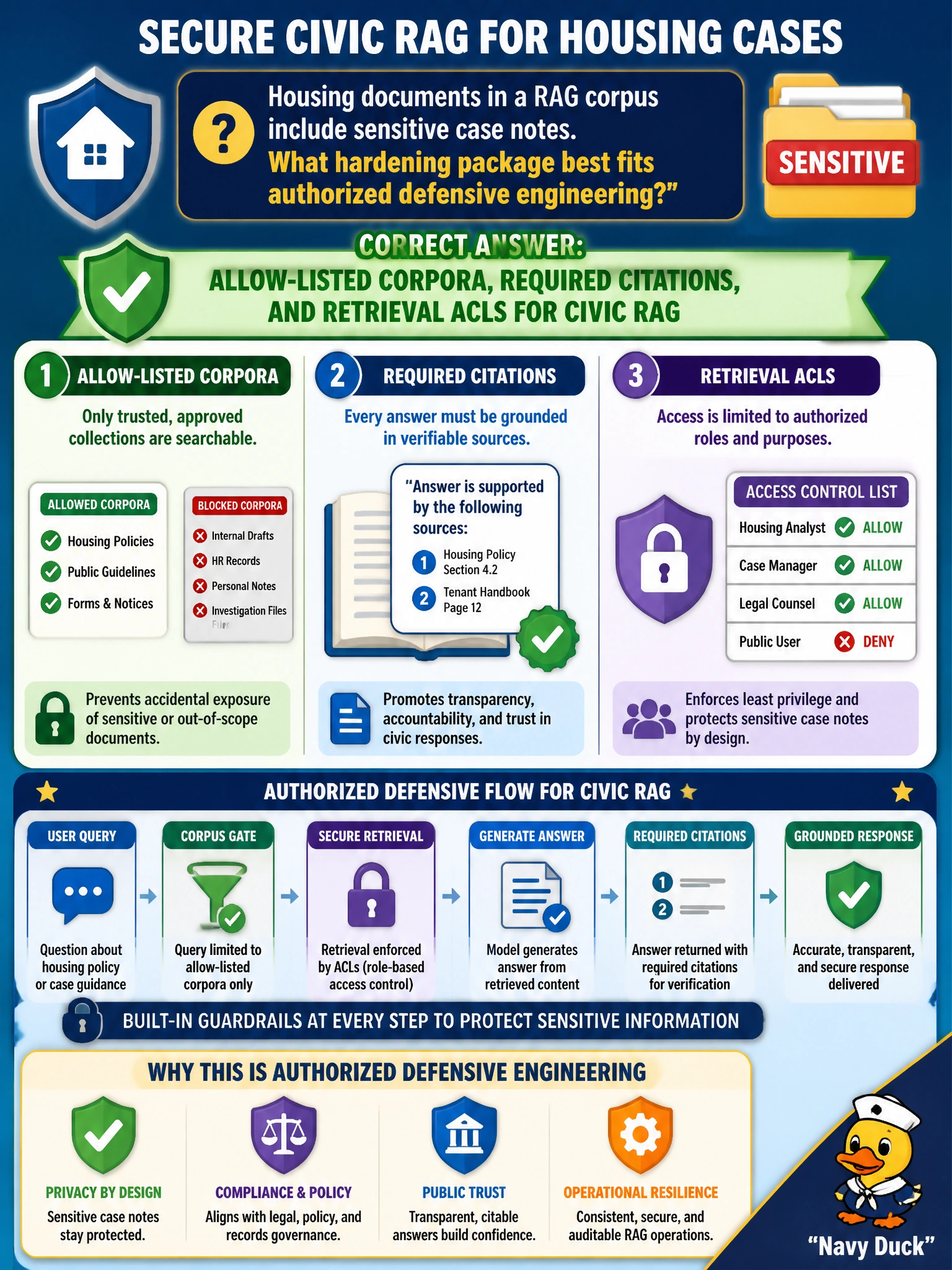
Housing documents in a RAG corpus include sensitive case notes. What hardening package best fits authorized defensive engineering?
Select an answer to reveal the explanation.
Short Explanation
RAG hardening is three locks: only trusted docs, show your sources, and ACLs so case notes don’t wander. At-rest encryption with tenant-wide decrypt rights still lets the wrong roles pull case notes.
Full Explanation
Housing documents in a RAG corpus that include sensitive case notes are best hardened, under authorized defensive engineering, with allow-listed corpora, required citations, and retrieval ACLs for civic RAG. Allow-listing ensures only approved, curated sources enter the searchable set so ad-hoc dumps of case notes do not become broadly retrievable. Required citations force answers to show which authorized document grounded the claim, improving auditability and reducing free-form hallucination about housing rules. Retrieval ACLs enforce that only roles cleared for sensitive case content can retrieve those chunks, separating public policy guidance from confidential resident case details. Together these controls address the distinctive RAG failure mode in municipal housing systems: sensitive content mixed into generative answers without authorization or provenance. Enabling shared embedding caches across departments for faster civic recall creates shared retrieval pathways that let case notes move between departments without role-based gating, increasing exposure rather than containing it. Applying at-rest encryption with tenant-wide decrypt rights for case queries still permits any tenant role to decrypt and retrieve sensitive case notes, so encryption without retrieval ACLs does not stop unauthorized access. Indexing summarized case abstracts with linked chunk retrieval for context still exposes case substance through linked chunks and does not restrict which roles can retrieve the abstracts or their source documents. The package that actually fits this failure mode is curating the corpus, forcing citations, and gating retrieval by role, together. Exam caveat: at-rest encryption with tenant-wide decrypt rights is insufficient when the stem points at corpus sensitivity and retrieval; look for allow-lists, citations, and ACLs as the package. Operational check: inventory the housing RAG sources against an allow-list, deny retrieval of case-note collections to public-tier roles, require citation fields in answers, and penetration-test whether an unprivileged session can surface sensitive notes via crafted queries.