
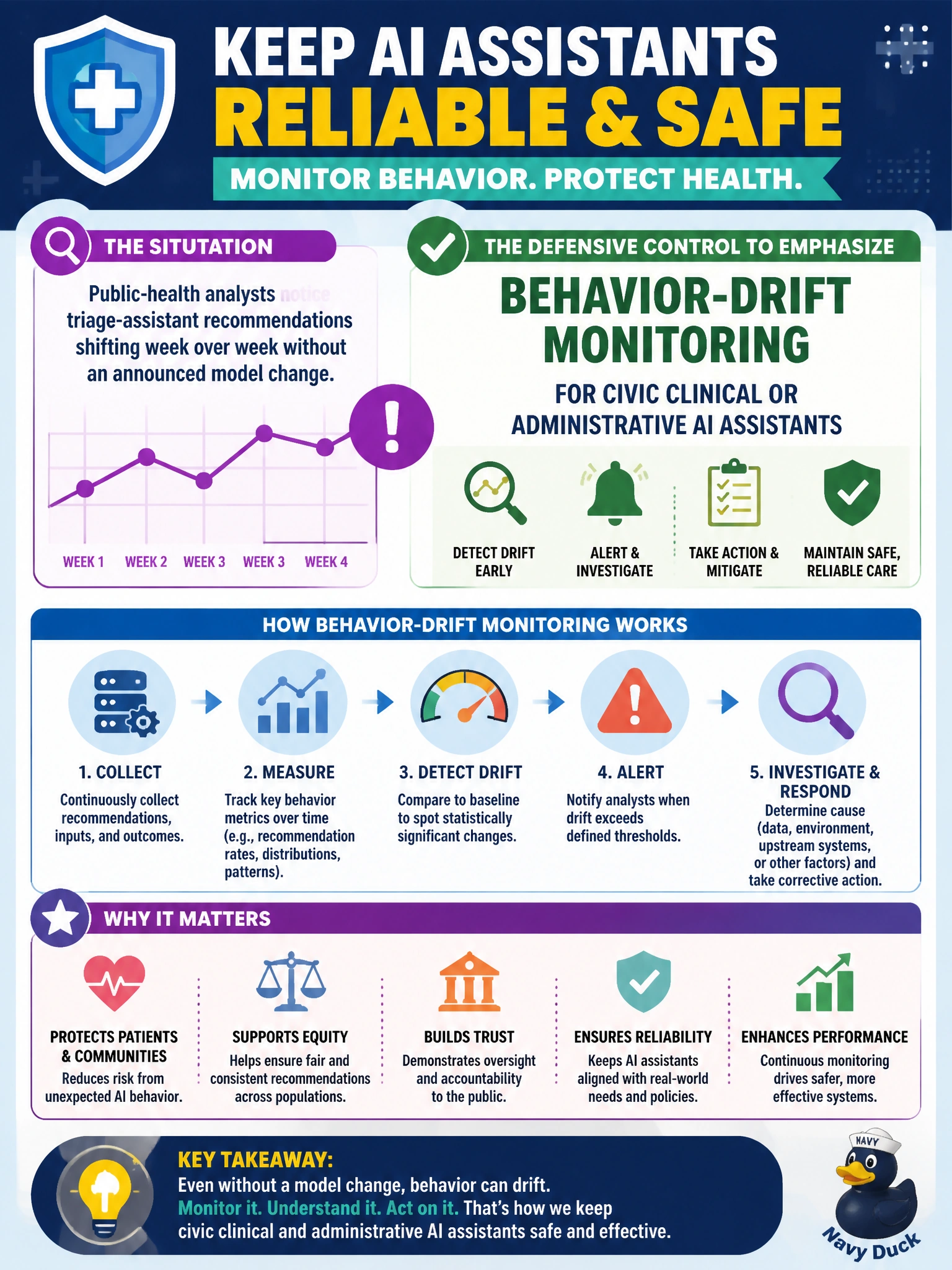
Public-health analysts notice triage-assistant recommendations shifting week over week without an announced model change. What defensive control should they emphasize?
Select an answer to reveal the explanation.
Short Explanation
When advice quietly slides week to week, that's drift—watch the behavior, not just credential rotation. Rotating API credentials doesn't monitor model behavior.
Full Explanation
Public-health analysts seeing triage-assistant recommendations shift week over week without an announced model change should emphasize behavior-drift monitoring for civic clinical or administrative AI assistants. Drift may stem from silent vendor model swaps, corpus updates, prompt edits, data pipeline changes, or compromise; credential rotation alone will not surface gradual shifts in triage suggestions that affect resident care pathways. Defensive control means tracking output distributions, key decision rates, disagreement with clinician baselines, and alert thresholds so unexpected movement triggers investigation before harm scales. For municipal health assistants, drift monitoring is a safety and integrity control, not merely MLOps nicety, because unannounced behavioral change undermines validated clinical or administrative assumptions. Pre-deployment red-team testing for clinical prompt injection scenarios is a pre-deployment activity aimed at adversarial inputs, not a way to catch gradual week-over-week behavioral drift in live triage recommendations. Scheduled rotation of API credentials for clinical assistant service accounts is an access-control hygiene task and does not monitor output behavior or detect drift in triage recommendations. A point-in-time fairness audit using historical triage case records is a static, backward-looking check and does not provide ongoing surveillance of week-over-week shifts in live assistant behavior. What analysts need is ongoing monitoring of the assistant's actual output behavior over time, not API credential rotation or a point-in-time fairness audit. Exam caveat: do not equate 'rotate API credentials' alone with drift monitoring; the stem highlights behavioral change without announced updates, which demands ongoing output surveillance. Operational check: instrument the triage assistant with weekly behavioral metrics and thresholds owned by public-health analytics, alert on statistically meaningful shifts, and require root-cause review (prompt/corpus/vendor/change log) before accepting the new baseline.