
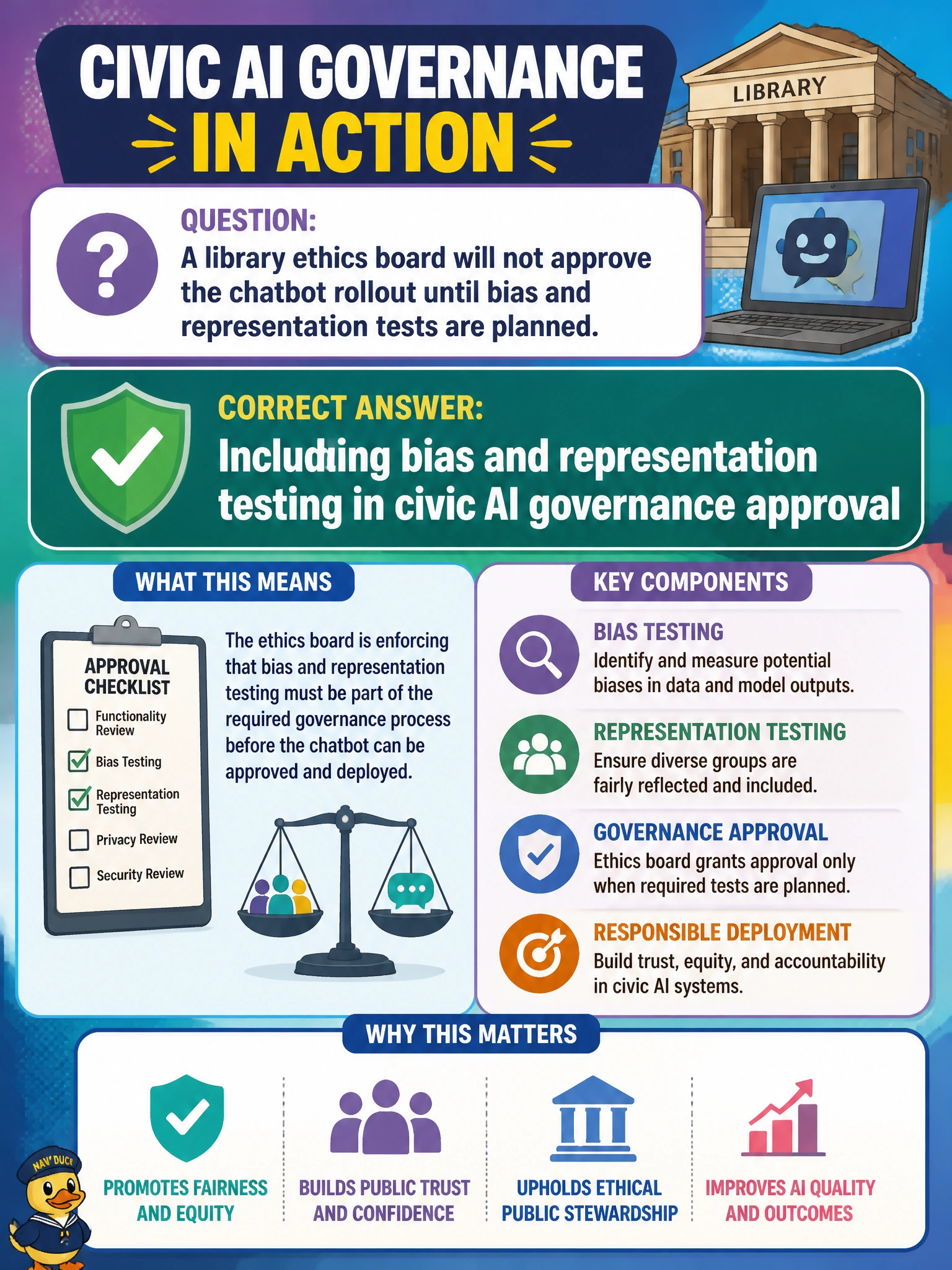
A library ethics board will not approve the chatbot rollout until bias and representation tests are planned. What governance principle does that enforce?
Select an answer to reveal the explanation.
Short Explanation
Ethics saying “show the bias test plan” means fairness isn’t optional frosting—it’s part of the go gate. You can’t swap post-deployment transparency reports for the bias test the board wants to see.
Full Explanation
A library ethics board refusing chatbot rollout until bias and representation tests are planned enforces the governance principle that fairness evaluation is part of approval for resident-facing civic AI, not an optional post-launch luxury. Library chatbots influence access to information across diverse communities; untested systems can systematically under-serve or mischaracterize groups, amplify stereotypes in recommendations, or provide uneven quality of research help. Requiring a planned bias and representation test suite—datasets, metrics, review cadence, and remediation thresholds—before approval ties equity evidence to the go gate alongside functional and security checks. That principle keeps ethics boards from rubber-stamping demos and forces service owners to budget evaluation as a first-class deliverable. Requiring pre-deployment red-team review for civic AI circulation services addresses adversarial security coverage, not the planned bias and representation evaluation the ethics board is requiring as a condition of approval. Documenting training data provenance for civic AI governance records is a record-keeping step, not the planned bias and representation test suite the board requires before it will approve the rollout. Publishing post-deployment transparency reports for civic AI performance happens after launch and cannot substitute for the pre-approval bias and representation test plan the board is demanding. The principle enforced here is that bias and representation testing has to be planned and completed as part of approval, not replaced by provenance documentation, post-deployment reporting, or red-team review scope. Exam caveat: distinguish ethics-board governance (planned evaluation as approval evidence) from purely technical filter tuning; the stem asks what principle the board enforces. Operational check: attach a bias/representation test plan with owners and exit criteria to the library chatbot change record, run pre-launch evaluation on agreed scenarios, and hold rollout if critical disparity findings lack remediation or formal acceptance.