
Emergency management runs AI tabletops for the crisis-comms assistant but never documents lessons. What governance practice is missing?
Select an answer to reveal the explanation.
Short Explanation
Tabletops without after-action reports are like drills with no debrief—everyone leaves, nothing changes. You could expand the scenarios, but that still doesn’t capture lessons learned. Just archiving transcripts or rewriting templates won’t create the after-action report you need.
Full Explanation
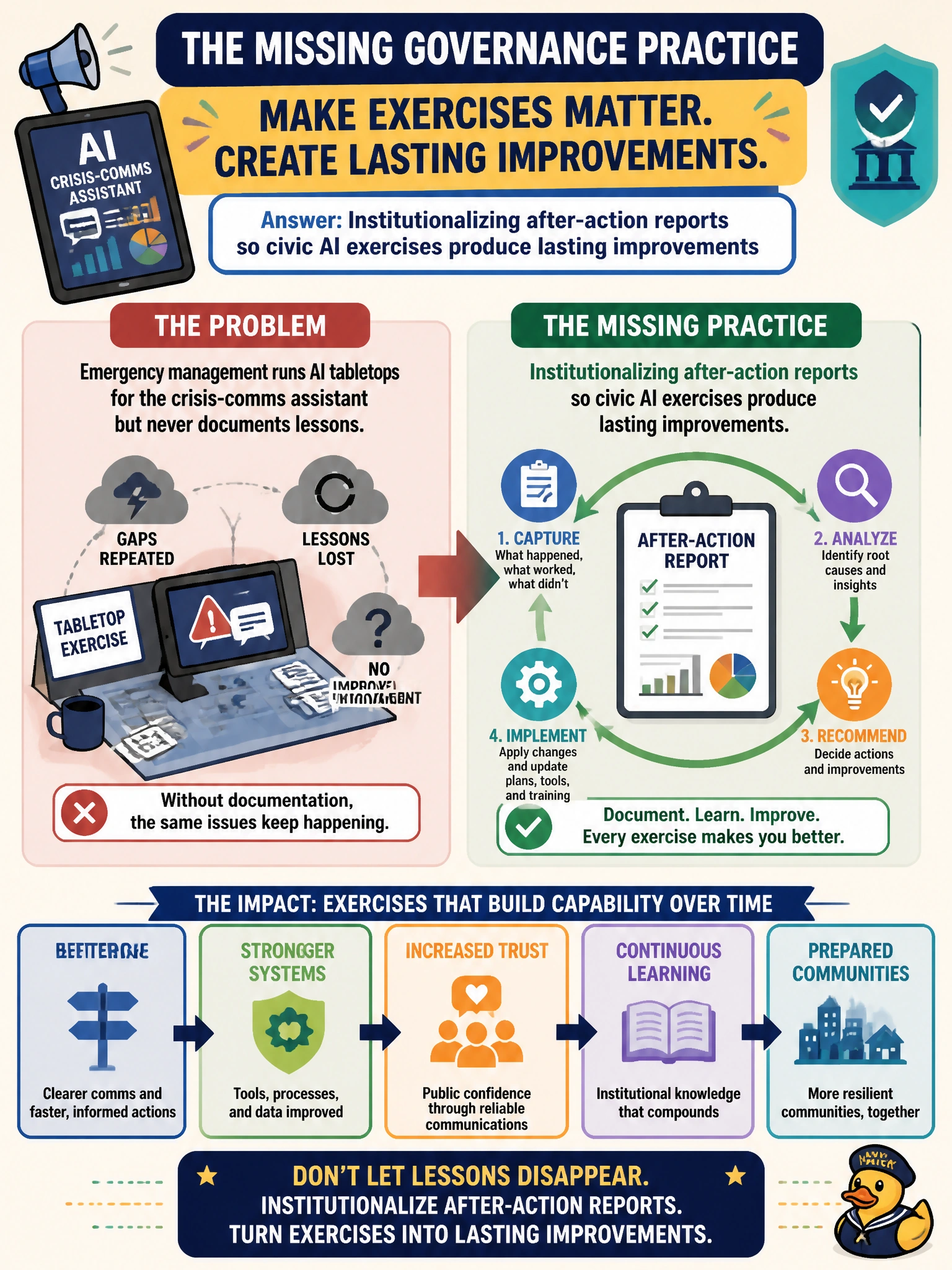
Emergency management that runs AI tabletops for the crisis-comms assistant but never documents lessons is missing institutionalized after-action reports (AARs) so civic AI exercises produce lasting improvements. Tabletops surface decision failures—unclear containment of a manipulated assistant, weak public messaging when the bot hallucinates during an emergency, missing prompt/tool evidence for IR—but without AARs those insights evaporate when participants leave the room. Governance should require AARs that capture timeline, decisions, gaps, and assigned corrective actions that update playbooks, training, monitoring rules, and control configurations for the crisis-comms assistant. Institutionalizing the learning cycle converts episodic exercises into continuous improvement of municipal AI readiness, which matters when the assistant may influence public instructions under stress. Archiving complete exercise transcripts in centralized storage for audit retention purposes stores a record but does not institutionalize after-action reviews or drive corrective actions for the crisis-comms assistant. Expanding future tabletop scenarios to cover additional hazards and response injects adds variety but does nothing to ensure lessons from this exercise are documented and carried forward. Updating crisis communication playbooks with revised approval roles and templates changes procedures but does not replace the missing after-action report that documents what actually happened and what must improve. What's missing is the discipline of writing the AAR down and feeding it into playbooks, not merely archiving transcripts, expanding scenarios, or editing templates. Exam caveat: the stem already assumes exercises occur; the missing governance practice is documenting and feeding lessons forward, not merely expanding scenarios or adding injects. Operational check: after each crisis-comms AI tabletop, publish an AAR within a fixed SLA, track corrective actions in the risk or IR backlog, and verify at least one playbook or detection change closed before the next exercise.