
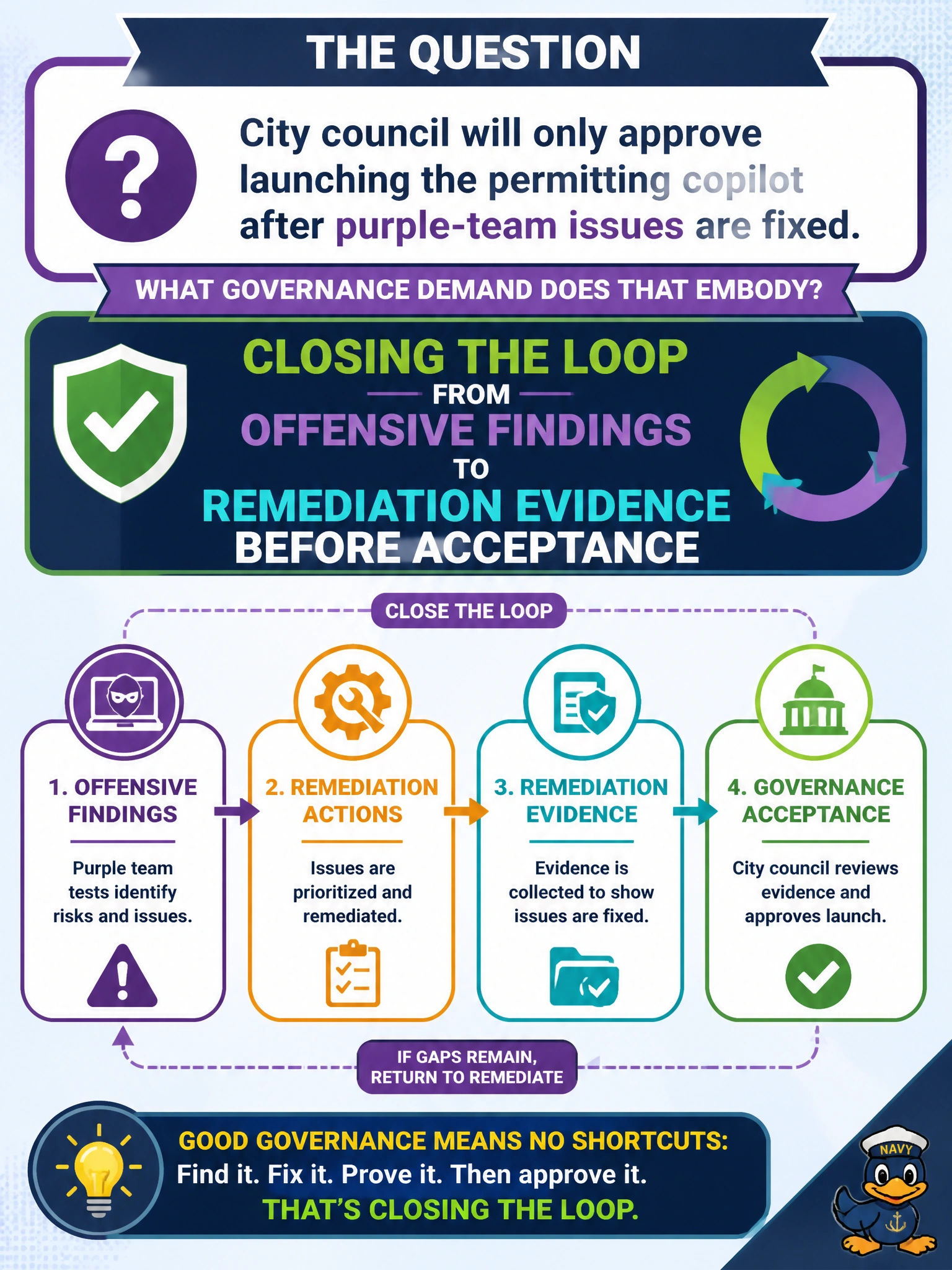
City council will only approve launching the permitting copilot after purple-team issues are fixed. What governance demand does that embody?
Select an answer to reveal the explanation.
Short Explanation
Council saying “fix the purple-team findings first” is closing the loop—findings aren’t souvenirs; they’re tickets that block launch until done. Checking accuracy benchmarks during a pilot doesn’t verify that purple-team issues are remediated, so it isn’t the go/no-go gate.
Full Explanation
City council conditioning launch of the permitting copilot on closing purple-team findings embodies governance that treats authorized offensive results as acceptance criteria, not as optional reports. Closing the loop means each finding is tracked to remediation, compensating control, or formal residual-risk acceptance with an owner and review date before the service is approved for resident-facing use. Without that loop, purple-team work becomes theater: the municipality can claim it tested aggressively while still shipping known prompt-injection paths, tool-abuse routes, or retrieval leakage into production permitting workflows. Effective municipal acceptance therefore demands evidence artifacts—ticket IDs, retest results, configuration diffs, and sign-off—that map findings to fixes. That practice aligns security T&E with political and operational accountability for systems that influence permits, fees, and timelines affecting residents and businesses. The distractors fail conceptually: logging purple-team findings in a risk register to inform future release planning substitutes paperwork for verified remediation before acceptance, which is a different governance failure than the one council is guarding against here. Validating model accuracy benchmarks during pilot evaluation before procurement approval addresses model performance, not the verified remediation of purple-team findings that council is demanding—a benchmark score isn't proof that known attack paths are closed. Scheduling recurring adversarial testing after deployment to monitor emerging threats does not replace the requirement to remediate known purple-team issues before acceptance; post-deployment monitoring cannot ship known critical attack paths into production permitting workflows. None of these create the documented link from finding to verified fix that closing the loop requires. Exam caveat: do not confuse 'we ran a purple team' with 'we governed the results'; the distinguishing governance demand is remediation evidence before acceptance. Operational check: block production promotion of the permitting copilot until the findings backlog for critical and high AI issues is empty or explicitly accepted by the risk committee, and sample that retests actually validate the claimed fixes against the original attack narratives.