
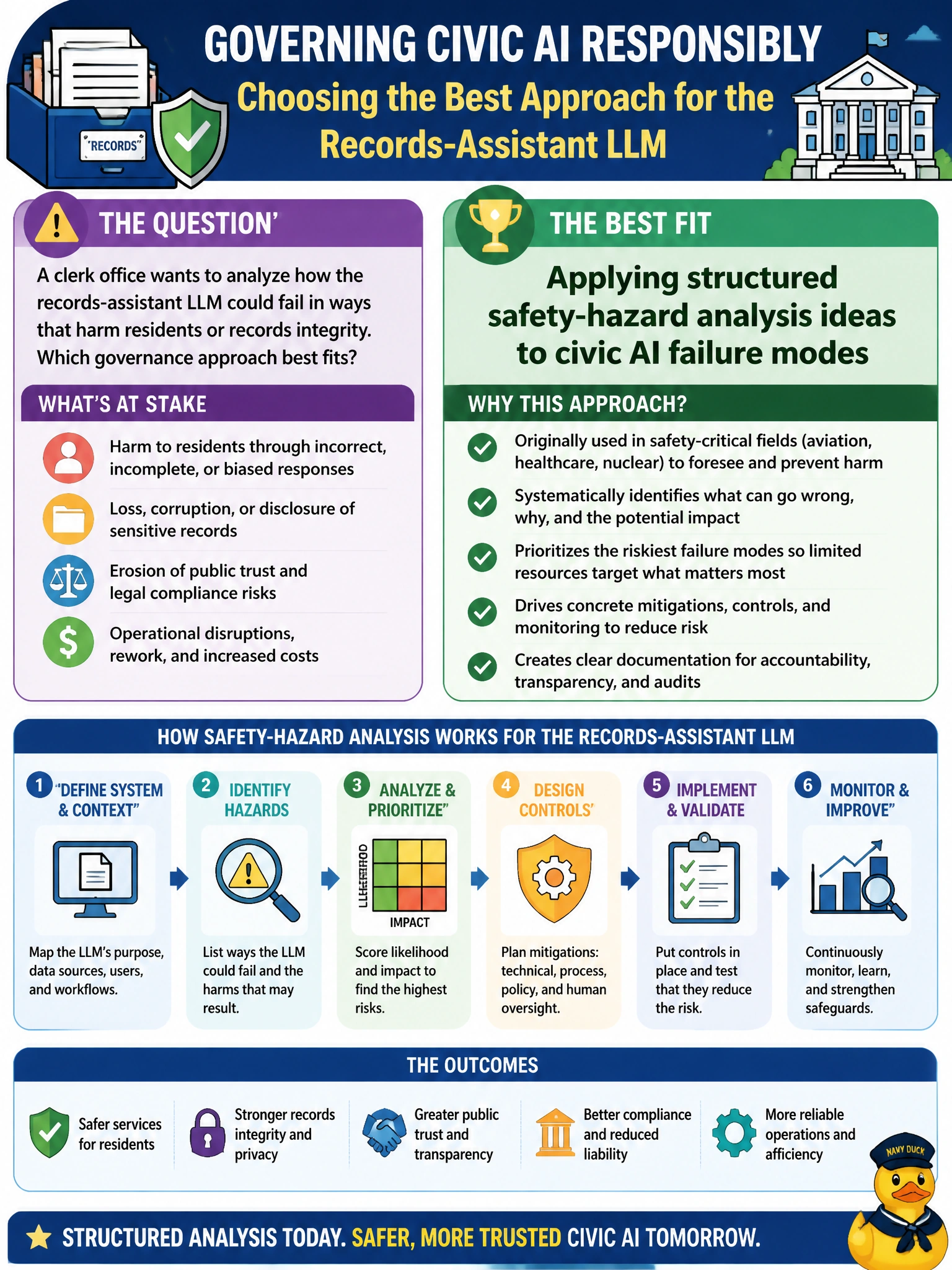
A clerk office wants to analyze how the records-assistant LLM could fail in ways that harm residents or records integrity. Which governance approach best fits?
Select an answer to reveal the explanation.
Short Explanation
Hazard analysis for AI is like a pre-flight checklist for weird failure modes—map how the bot can go wrong before residents feel it. Tracking resident satisfaction scores at the clerk counter doesn't show you how the assistant can fail.
Full Explanation
Structured safety-hazard analysis adapted to civic AI is the governance approach that fits a clerk-office records-assistant because it forces the municipality to inventory how the model can fail in ways that harm residents or records integrity—wrong retrieval of sealed cases, confident fabrications about filing deadlines, silent corruption of citation trails, or privilege escalation through tool misuse—then score severity, likelihood, and detectability, and assign mitigations before go-live. Unlike tracking resident satisfaction scores for clerk counter service quality, hazard-oriented analysis treats the assistant as a socio-technical system whose failure modes include privacy breaches of resident PII in clerk records, integrity failures that misstate official procedures, and availability failures that strand time-sensitive filings. Governance then uses that inventory to prioritize testing and evaluation, monitoring, and control design rather than discovering harms only after public complaints. The distractors fail by concept, not by degree: documenting data retention schedules for public records request compliance audits is a records-management task, but it's not a structured way to inventory how the assistant can fail and harm residents or records. Tracking resident satisfaction scores for clerk counter service quality measures counter interactions, not misretrieval, fabrication, or privilege-escalation scenarios a hazard analysis is built to surface. Reviewing vendor uptime reports for records system availability assurance checks system availability, but it does not analyze this clerk office's own AI failure modes. None of these produce the structured, resident-harm-focused hazard inventory the governance approach requires. Exam caveat: exam items may tempt candidates to equate any 'risk discussion' with formal hazard analysis; look for structured failure-mode thinking tied to resident harm and records integrity, not informal brainstorming or UX polish. Operational check: require a living hazard register for the records assistant that lists top failure modes, linked mitigations, evidence of T&E against those modes, and named municipal owners, and verify the register is reviewed when prompts, tools, or corpora change.