
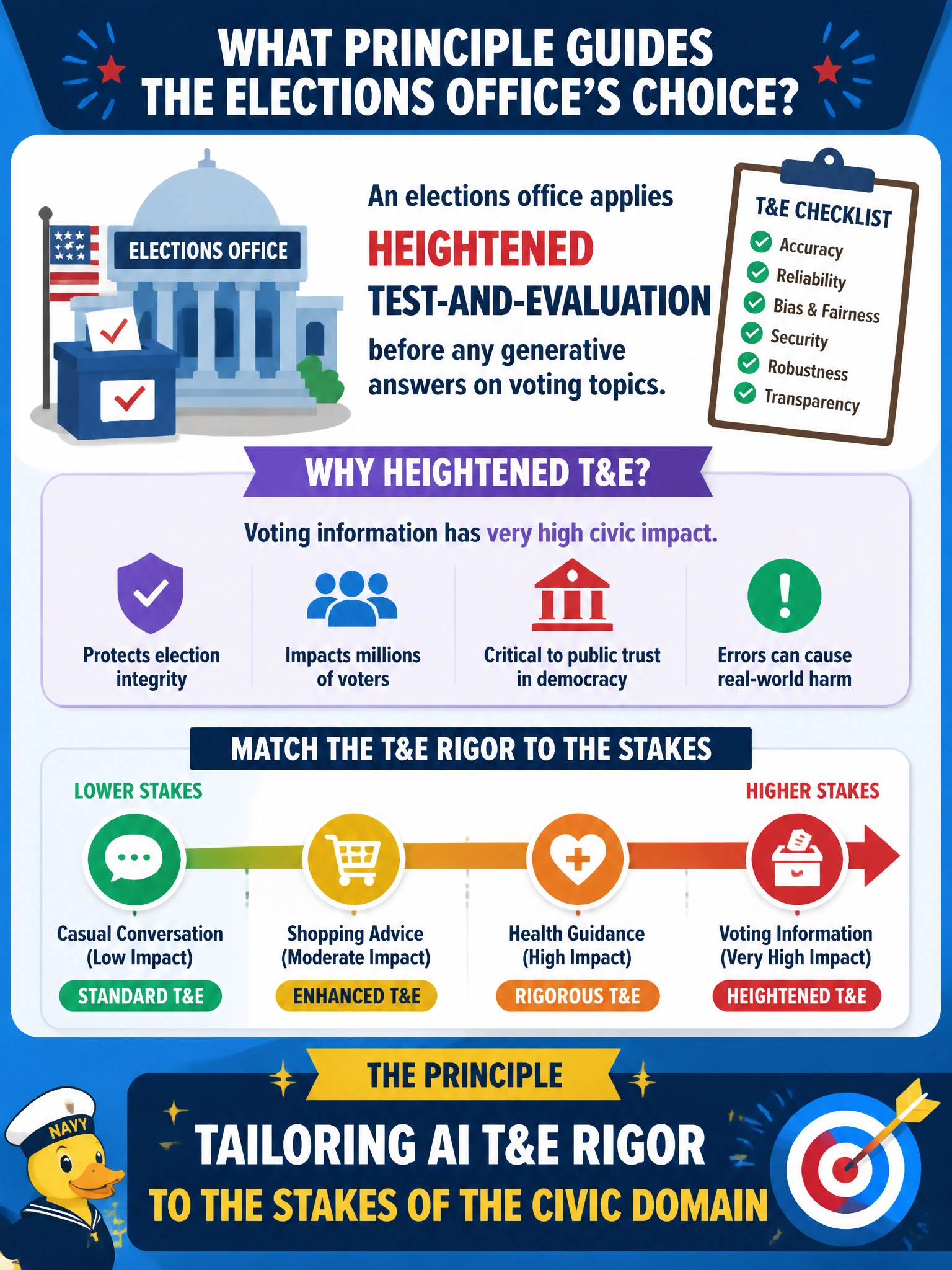
An elections office applies heightened test-and-evaluation before any generative answers on voting topics. What principle guides that choice?
Select an answer to reveal the explanation.
Short Explanation
Election talk is high stakes—turn the testing dial way up before the bot speaks about voting.
Full Explanation
Heightened test-and-evaluation before any generative answers on voting topics is guided by the principle of tailoring AI T&E rigor to the stakes of the civic domain. Elections content can affect trust, turnout, and lawful process; therefore evaluation depth, adversarial coverage, and go/no-go bars should exceed those used for low-stakes FAQs or routine municipal information bots.
Prioritizing inference speed for voter helpdesk response times optimizes how fast answers come back, but it doesn't scale the actual test-and-evaluation rigor applied before generative answers go out on voting topics. Reusing test thresholds validated for low-risk helpdesk use is exactly the flat, one-size-fits-all approach the principle rejects—elections content needs more, not the same. Relying on post-deployment voter feedback to catch errors inverts the priority: higher stakes should buy more evaluation before answers go live, not less, and post-launch feedback cannot prevent harm from reaching voters first. The guiding principle is matching T&E depth to how much is riding on the topic, not chasing inference speed, porting over low-risk helpdesk thresholds, or waiting for post-deployment voter feedback.
Exam caveat: rigor scaling is risk-based governance, not a claim that low-stakes systems need zero testing. Also ensure elections T&E covers jurisdiction-specific rules and refusal or escalation behavior, not only generic jailbreak corpora copied from unrelated domains.
Operational check: define an elevated T&E suite and release bar for voting-topic generative features, require documented pass evidence with named reviewers, and block public answering on elections until those gates clear. Revisit the elevated bar whenever election rules or generative capabilities change so rigor stays matched to current stakes.