
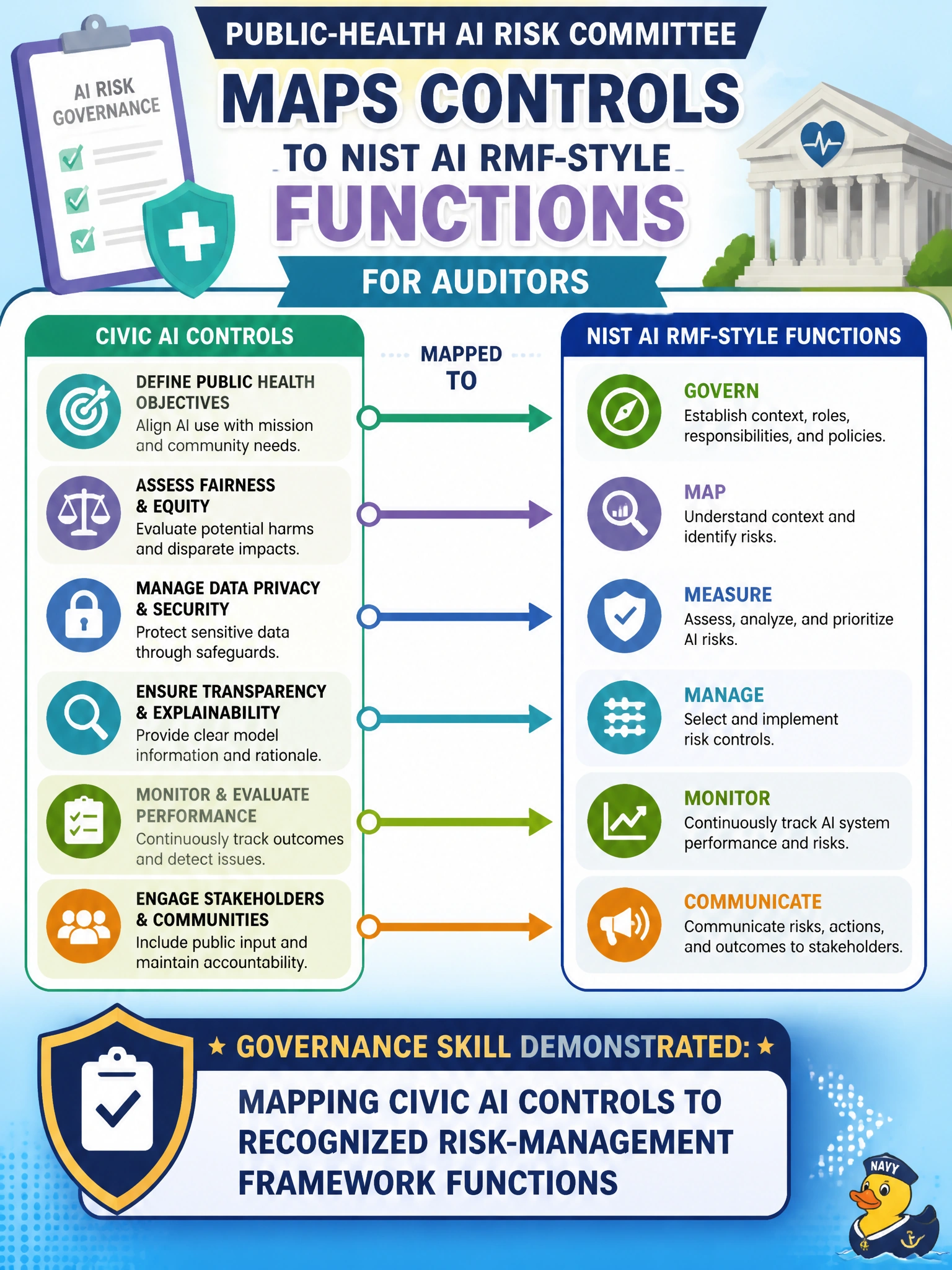
A public-health AI risk committee maps controls to NIST AI RMF-style functions for auditors. What governance skill does that demonstrate?
Select an answer to reveal the explanation.
Short Explanation
Auditors speak framework language—map your city controls to those functions so the story is clear.
Full Explanation
Mapping controls to NIST AI RMF-style functions for auditors demonstrates mapping civic AI controls to recognized risk-management framework functions. Framework alignment improves auditability, gap analysis, and communication with oversight bodies by placing municipal controls into shared categories such as govern, map, measure, and manage, or equivalent function sets used in the jurisdiction’s AI risk program.
Publishing the control matrices in public safety bulletins would hand adversaries a map of exactly which controls are in place and where gaps might be—auditors need the mapping, not the general public. Correlating incident response playbooks with framework categories is an incident-response task, not the governance skill of aligning civic AI controls to RMF functions for auditor use. Consolidating model performance dashboards for operational monitoring reviews is an operational monitoring task, not the governance skill of mapping controls to recognized risk-management framework functions for auditors. The governance skill being shown is honestly mapping current civic AI controls to the recognized framework's functions for auditors to actually use.
Exam caveat: mapping is a documentation and analysis aid; it does not itself implement missing technical controls. Over-claiming “full RMF compliance” without operating evidence is itself an audit risk for public-health AI programs.
Operational check: maintain a living matrix of public-health AI controls to framework functions, cite evidence locations for each mapped control, and review the matrix when systems, threats, or auditor expectations change. Use the mapping during audit interviews so control owners can speak in framework terms without inventing ad-hoc narratives.