
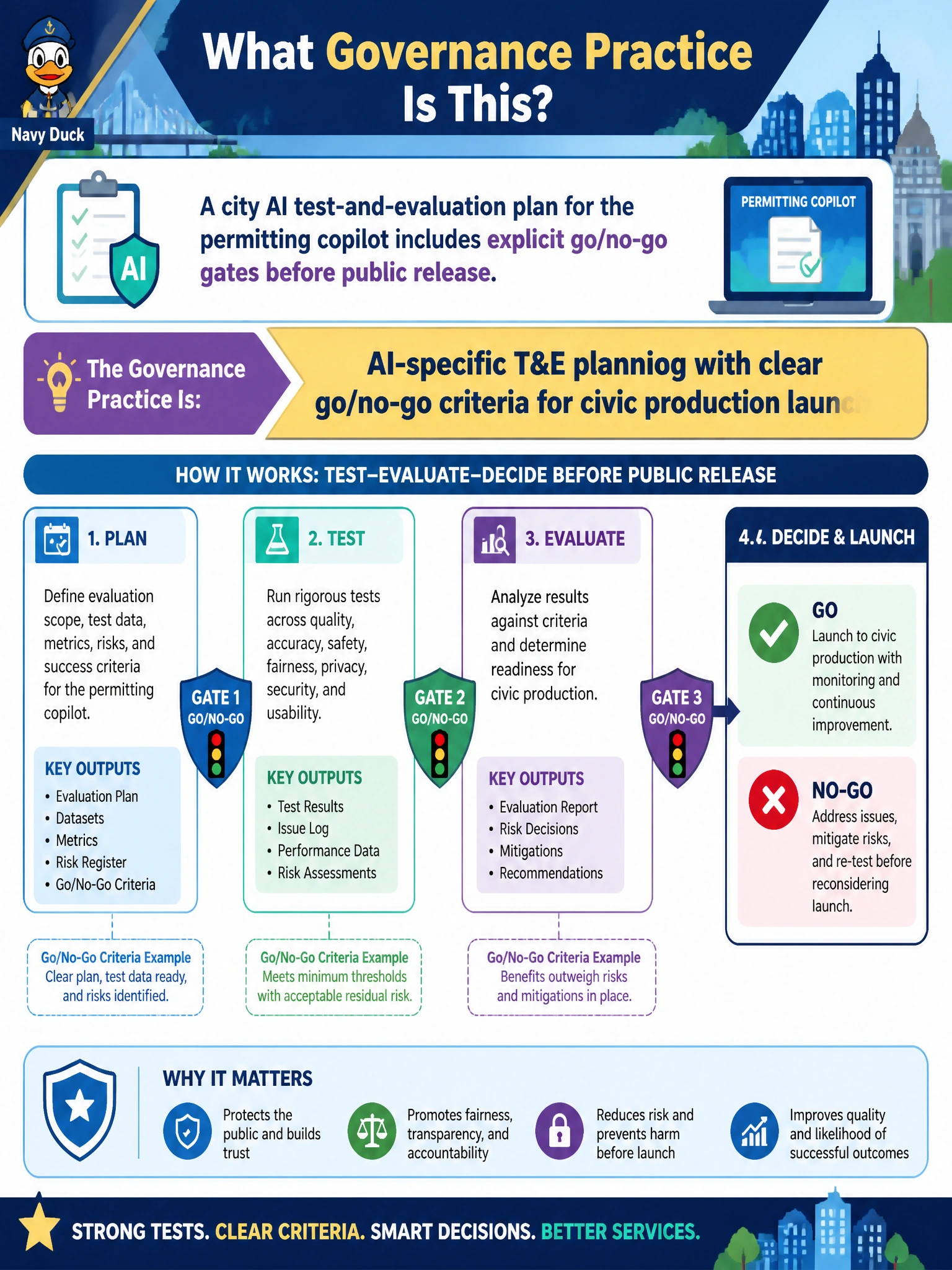
A city AI test-and-evaluation plan for the permitting copilot includes explicit go/no-go gates before public release. What governance practice is that?
Select an answer to reveal the explanation.
Short Explanation
Go/no-go gates are the runway lights for launch—if safety tests fail, the plane stays on the ground.
Full Explanation
Including explicit go/no-go gates before public release of a permitting copilot is AI-specific test-and-evaluation planning with clear go/no-go criteria for civic production launch. Municipal AI governance needs measurable thresholds for safety, security, bias, accessibility, and operational readiness so release is a controlled decision, not an informal demo promotion after a successful slide deck.
Applying standard software integration test gates for copilot production approval checks that the software components connect, not that the copilot resists jailbreaks, poisoning, or unsafe tool use—those need their own AI-specific evaluation. Logging vendor model cards and test summaries to support city readiness documentation is passive record-keeping; it does not create an independent city go/no-go gate or give the city authority to block launch based on its own criteria. Tracking post-launch copilot performance with continuous monitoring dashboards watches the system after release, but it cannot serve as a pre-release go/no-go gate; T&E must gate the launch before it happens. The governance practice is building explicit, AI-aware pass/fail criteria that the launch has to clear before going live.
Exam caveat: gates must be specific and evidence-based—suite results, residual risk, and named sign-offs. Vague “looks good” criteria fail audits and allow unsafe or noncompliant permitting guidance to reach the public without accountability.
Operational check: publish the permitting copilot T&E plan with named go/no-go metrics, required evidence artifacts, escalation paths for failed gates, and a recorded decision forum before any public endpoint is enabled. Archive each go/no-go decision with evidence links so auditors can reconstruct why the permitting copilot was or was not released.