
An assessor office bans exporting full logit vectors from internal valuation models. What defensive goal does that serve?
Select an answer to reveal the explanation.
Short Explanation
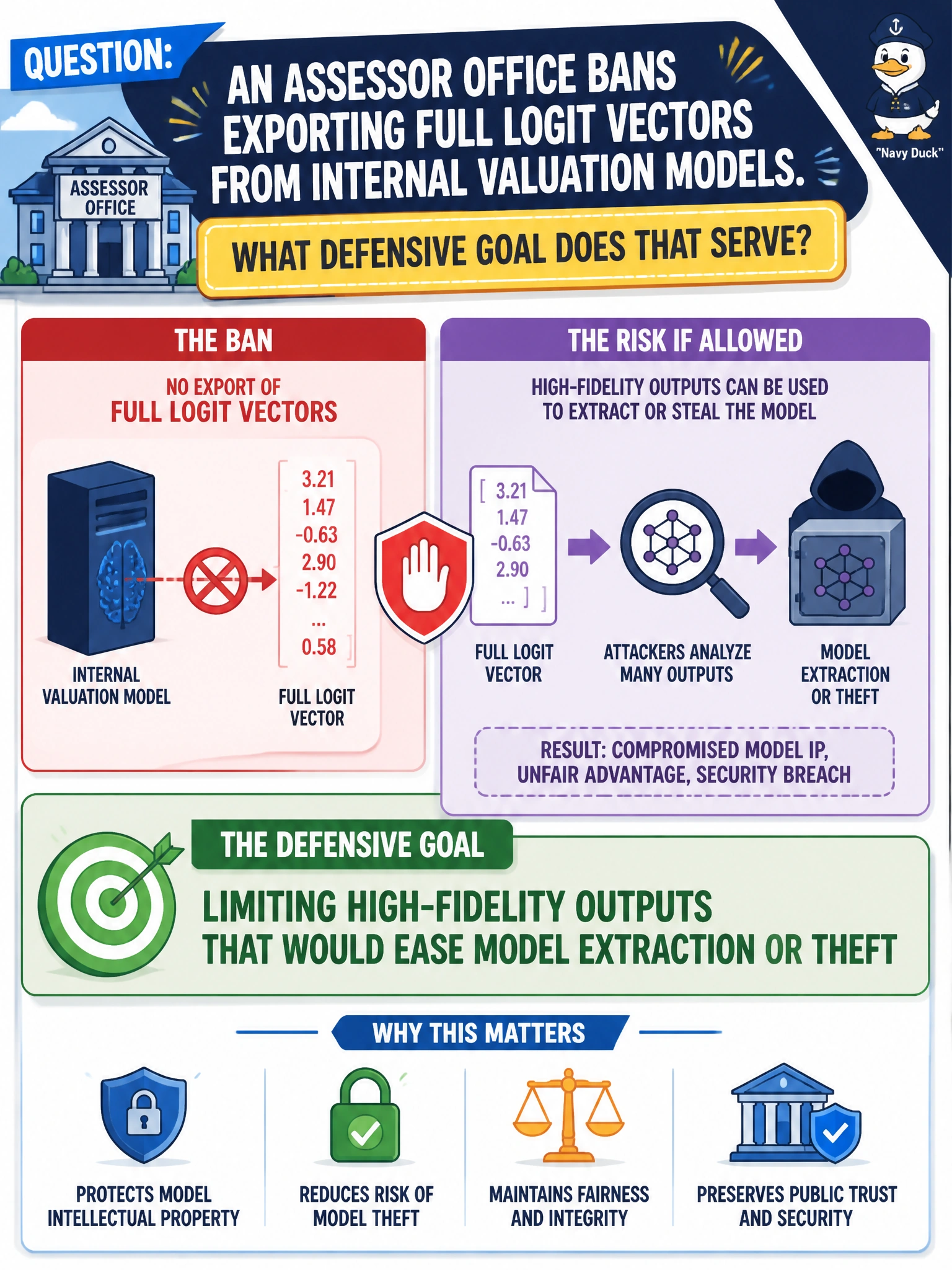
Full logits are a cheat sheet for cloning the model’s mind—keep those dense outputs off the export menu.
Full Explanation
Banning export of full logit vectors from internal valuation models serves the defensive goal of limiting high-fidelity outputs that would ease model extraction or theft. Dense probability vectors leak far more about decision boundaries than sparse labels or coarse scores, making surrogate training and competitive model theft substantially easier if assessor or internal APIs expose them freely to broad audiences.
Monitoring inference logs to catch exfiltration is a detective control after the fact; banning the export outright is preventive, which is a different and stronger layer than monitoring alone. Preventing poisoned sales records from corrupting scheduled model retraining is a data-integrity goal, not an output-fidelity goal; restricting logits does nothing to block tainted training data from entering retraining pipelines. Embedding traceable watermarks in outputs to prove model ownership is an attribution control, not a restriction on model detail; it does not stop attackers from using dense logits to train a surrogate. The specific defensive goal of the export ban is denying attackers the rich, high-fidelity signal—full logit vectors—that would make reconstructing the model much easier.
Exam caveat: restricting logits is one control among many; determined actors may still extract from labels alone given enough queries. Also ensure legitimate analytics that need calibrated scores have approved, audited alternatives rather than informal backdoors.
Operational check: configure valuation APIs to return only necessary low-fidelity outputs by default, deny logit export except under narrowly approved research roles, and log exceptional access for audit and periodic access review.