
A clerk document summarizer returns overly faithful detail that could reconstruct source filings. What extraction-related issue should reviewers flag?
Select an answer to reveal the explanation.
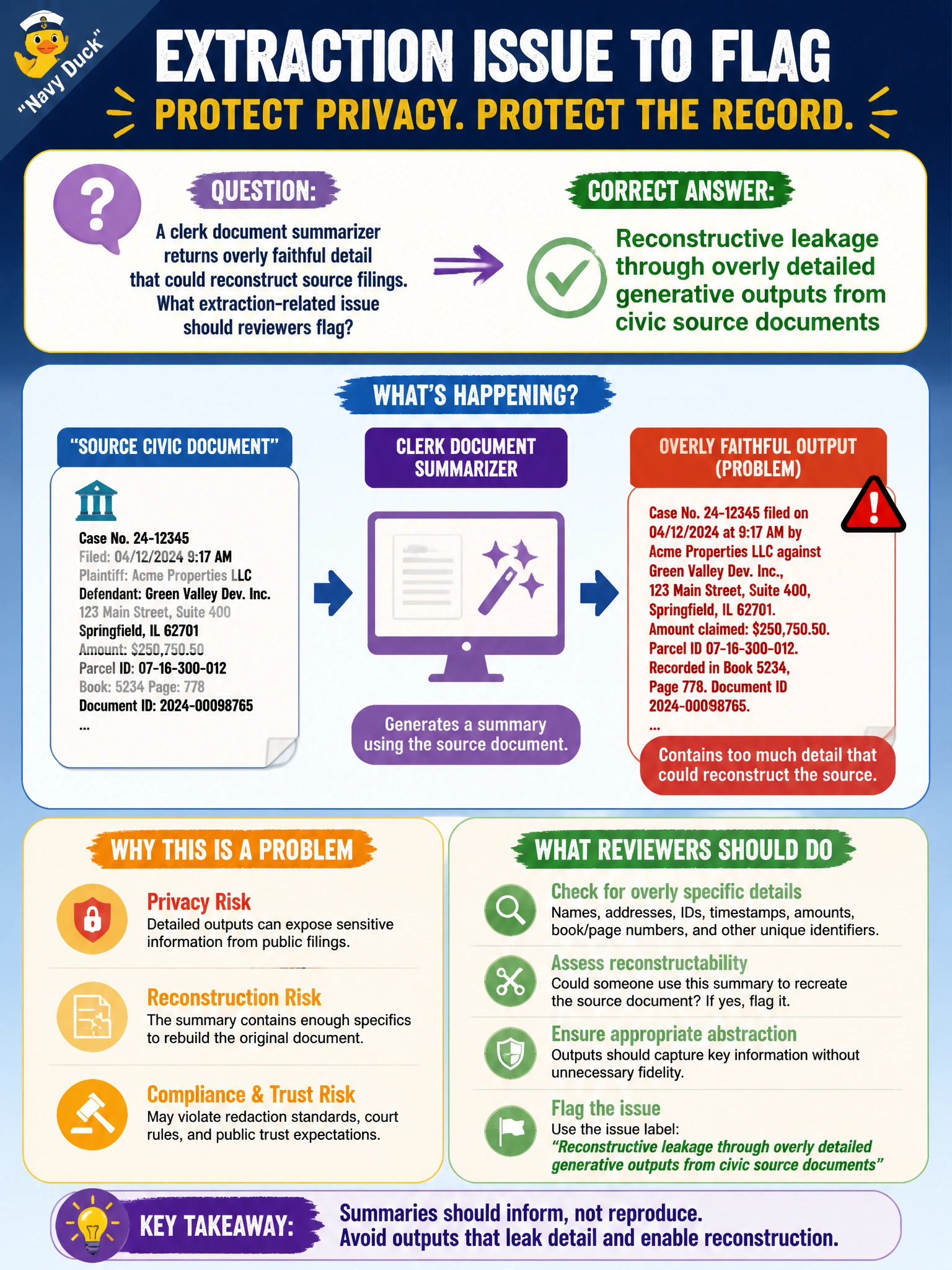
Short Explanation
If the summary reads like a photocopy, you may have leaked the filing—tone down fidelity where privacy matters.
Full Explanation
When a clerk document summarizer returns overly faithful detail that could reconstruct source filings, reviewers should flag reconstructive leakage through overly detailed generative outputs from civic source documents. Excessive fidelity can effectively re-expose confidential filing content even when the interface is labeled “summary,” undermining privacy, need-to-know, and municipal records-handling rules for clerk workflows.
Aggressive abstraction stripping material procedural context is a different failure mode—summaries that lose needed detail—while the issue here is that the summary is so faithful it effectively reconstructs the source filing's substantive content. Entity conflation merging distinct parties across adjacent civic filing records is a different error—mixing up parties across records—while the issue here is that the model reproduces one document's detail too faithfully; it's the wrong failure mode for this issue. Hallucinated docket references inserting fabricated details misses the actual risk entirely—the problem is real content reproduced too faithfully, not invented details; a fast, over-faithful summary is just as leaky as a slow one. The issue to flag is reconstructive leakage: outputs detailed enough to let a reader rebuild the original record.
Exam caveat: not every detailed summary is a violation—risk depends on data classification and audience. Distinguish intentional authorized full-text retrieval from unintended reconstruction via generative verbosity that bypasses summary policy.
Operational check: set summarizer policies for maximum detail by data class, test with sensitive filing samples for reconstructive leakage, and require redaction or abstraction rules before any clerk-facing generative release.