
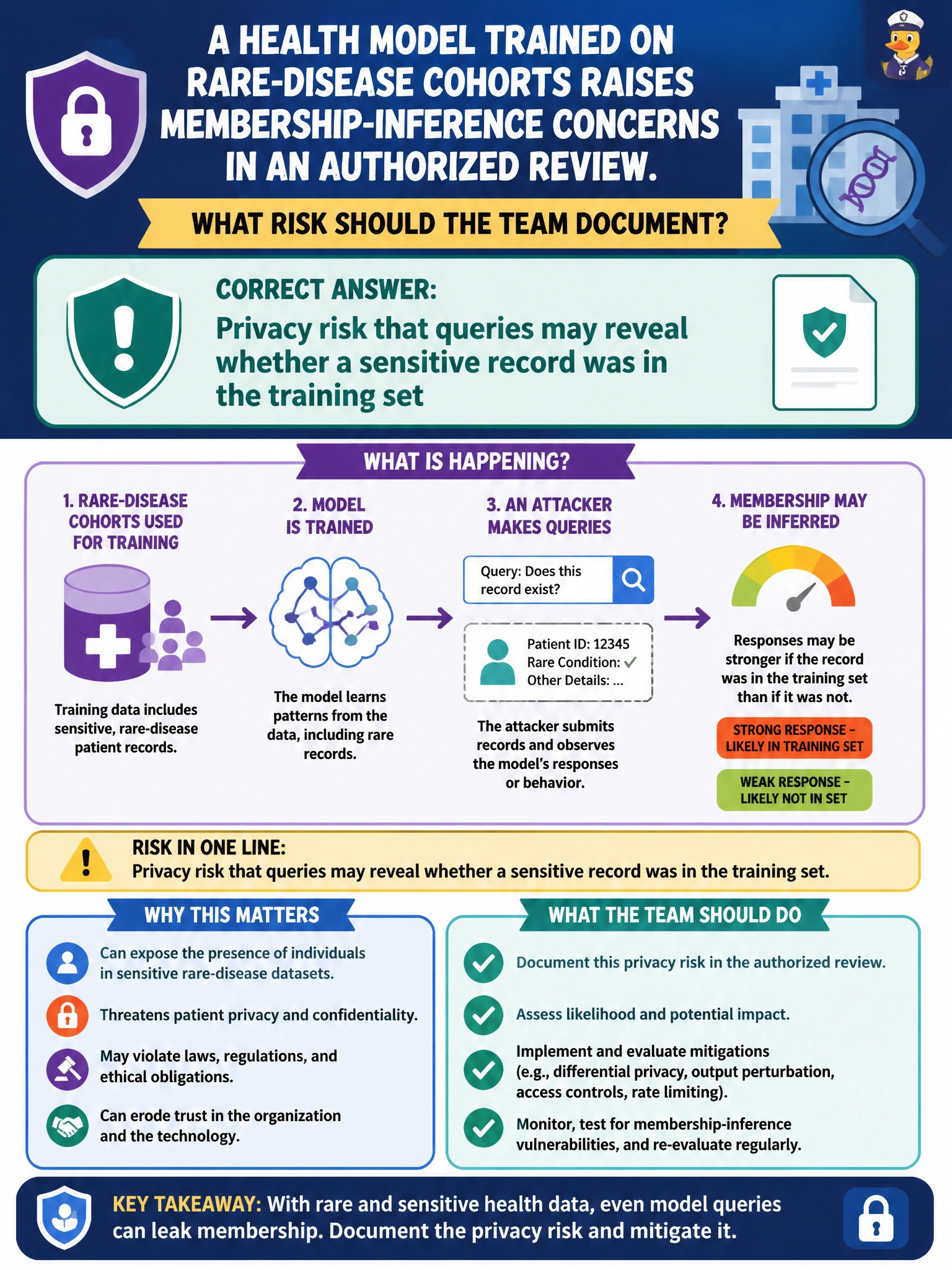
A health model trained on rare-disease cohorts raises membership-inference concerns in an authorized review. What risk should the team document?
Select an answer to reveal the explanation.
Short Explanation
If the model ‘remembers’ who was in the club too clearly, privacy leaks—membership inference is that worry. But guessing a patient’s missing attributes, leaking a condition’s overall prevalence across sites, or replaying memorized notes aren’t membership inference; they’re different privacy problems. You’re documenting whether a specific record was in the training set, not those other issues.
Full Explanation
For a health model trained on rare-disease cohorts, an authorized review should document the privacy risk that queries may reveal whether a sensitive record was in the training set—membership inference. Small or distinctive cohorts raise the chance that an adversary can tell if a particular individual’s data was used, which is especially serious for rare-disease and other sensitive municipal public-health contexts.
Inferring missing clinical attributes for a patient already known to be in the dataset is attribute inference, not membership inference; it targets a specific individual’s unknown data rather than establishing whether that individual’s record was in the training set at all. Revealing overall prevalence of a rare condition across contributing study sites is an aggregate disclosure concern, not membership inference; it describes group-level statistics rather than whether a particular individual’s record was used to train the model. Reconstructing verbatim sensitive clinical notes through repeated queries is a memorization or model-extraction style leakage, not membership inference; it exposes training-data content rather than answering whether a specific record participated in training. The specific risk membership inference names is that a query pattern can reveal whether a particular person's record was used to train the model at all, which is a disclosure risk independent of accuracy.
Exam caveat: membership inference is distinct from model extraction and from reconstructive leakage of full records; controls and metrics differ. Risk severity depends on cohort uniqueness, model access modality, and output richness available to the querier.
Operational check: document membership-inference threat scenarios for rare-disease cohorts, evaluate mitigations such as access limits and output minimization where appropriate, and include residual privacy risk in the health model’s release and audit package.