
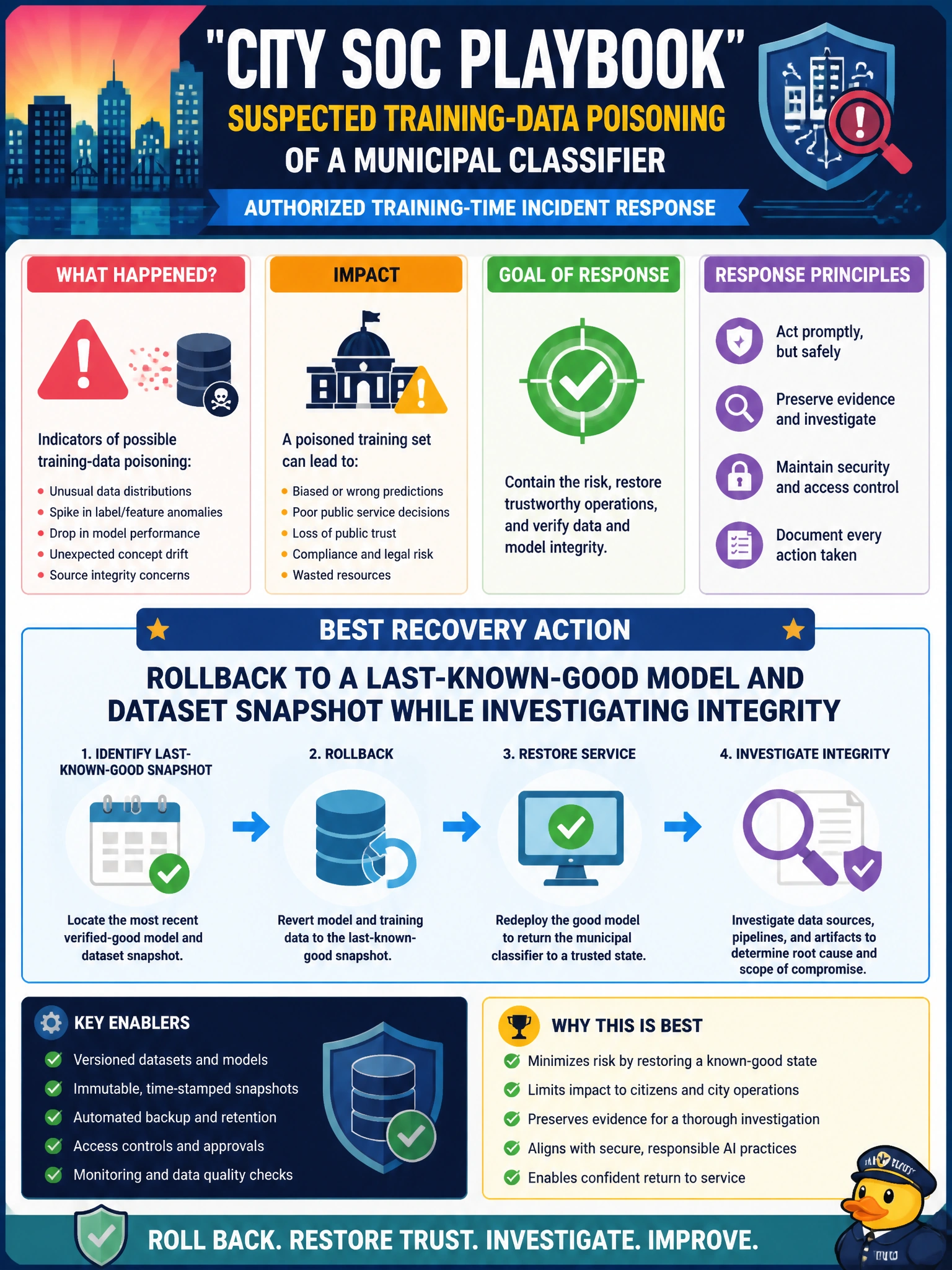
A city SOC playbook covers suspected training-data poisoning of a municipal classifier. What recovery action best fits an authorized training-time incident response?
Select an answer to reveal the explanation.
Short Explanation
If the recipe went bad, pull the last clean batch off the shelf—rollback first, then dig into how poison got in.
Full Explanation
When a city SOC playbook addresses suspected training-data poisoning of a municipal classifier, the recovery action that best fits authorized training-time incident response is rollback to a last-known-good model and dataset snapshot while integrity investigation continues. Restoring a verified inference artifact and training baseline contains impact quickly, preserves forensic options on the suspect pipeline, and avoids leaving a potentially poisoned classifier in civic production during analysis.
Deploying updated input validation filters to production inference while retaining suspect weights leaves the poisoned model in civic production and only adds a surface filter that may miss poisoning effects, which is operationally reckless even though it sounds proactive. Retraining the classifier from the current dataset with augmented regularization to absorb tampering risks baking the same poisoned data into the replacement model, because regularization cannot reliably remove training-data influence and you have not confirmed which snapshot predates the tampering. Tuning decision thresholds for conservative outputs during the provenance review does not remove poisoned training influence or restore a verified baseline, so the suspect classifier keeps making real decisions during the window the incident is supposed to be contained. The response that actually limits exposure is rolling back to a verified clean snapshot first, then investigating from there.
Exam caveat: rollback is containment and recovery hygiene, not proof of root cause. Teams still need integrity forensics on data lineage, access logs, and training jobs. Also confirm rollback criteria are pre-authorized so operators do not improvise under pressure.
Operational check: verify the playbook names snapshot owners, storage locations, rollback decision thresholds, and post-rollback monitoring for residual anomalous predictions on municipal workloads.