
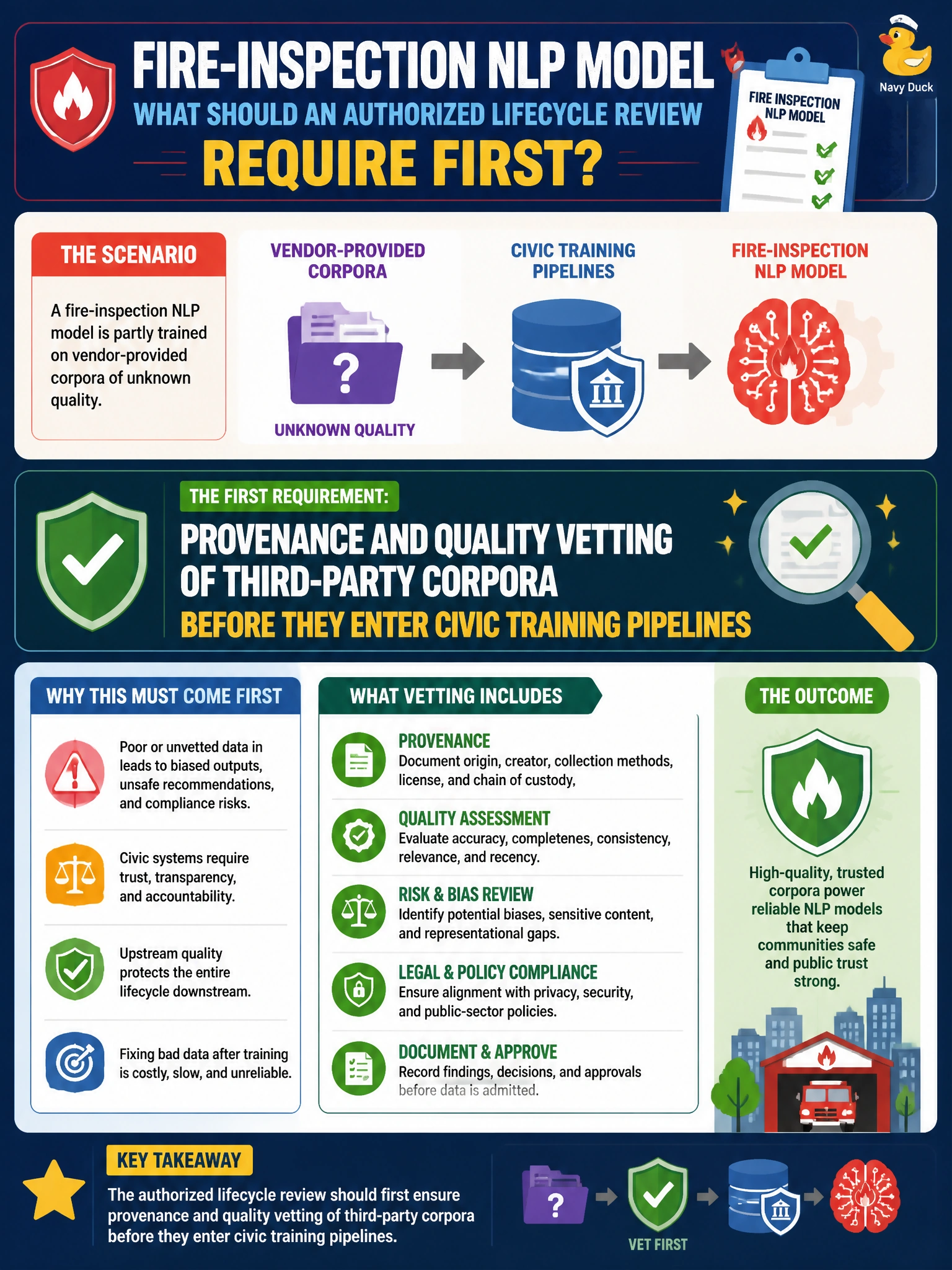
A fire-inspection NLP model is partly trained on vendor-provided corpora of unknown quality. What should an authorized lifecycle review require first?
Select an answer to reveal the explanation.
Short Explanation
Unknown vendor text is like mystery soup in the training kitchen—taste-test provenance before the model learns from it.
Full Explanation
In a municipal fire-inspection NLP lifecycle, third-party vendor corpora are not automatically trustworthy training assets. An authorized lifecycle review should require provenance documentation and quality vetting before those corpora enter civic training pipelines: source lineage, collection conditions, licensing, labeling methods, known bias or toxicity screens, and acceptance criteria that match the fire-inspection use case. Without that gate, the city risks training on poisoned, mislabeled, outdated, or jurisdictionally inappropriate text that quietly degrades inspection recommendations and creates downstream liability for public-safety decisions.
Relying on continuous scheduled bias monitoring of deployed inspection predictions using civic fairness dashboards in production addresses bias only after predictions are live, not before vendor text enters the training pipeline; the lifecycle review must gate corpora up front, and production monitoring cannot substitute for that pre-training provenance and quality vetting. A documented review of vendor service-level agreements for hosting uptime and operational support coverage concerns infrastructure and support terms, not the lineage, quality, or suitability of the training corpus itself, so it cannot replace the required pre-training data intake review. Validation of model-card performance metrics and reproducibility artifacts after training completion in staging occurs too late to serve as the first control on vendor data; the provenance review must happen before the corpus enters training, not after model training finishes.
Exam caveat: provenance and quality review is a first-order lifecycle control for third-party data, not a guarantee that the finished model is fair or secure—those require separate evaluation. Also distinguish vendor marketing claims from evidence the city can audit.
Operational check: require a documented data-intake checklist (lineage, license, quality tests, residual-risk sign-off) before any vendor corpus is merged into fire-inspection training sets, and retain that evidence for audit.