
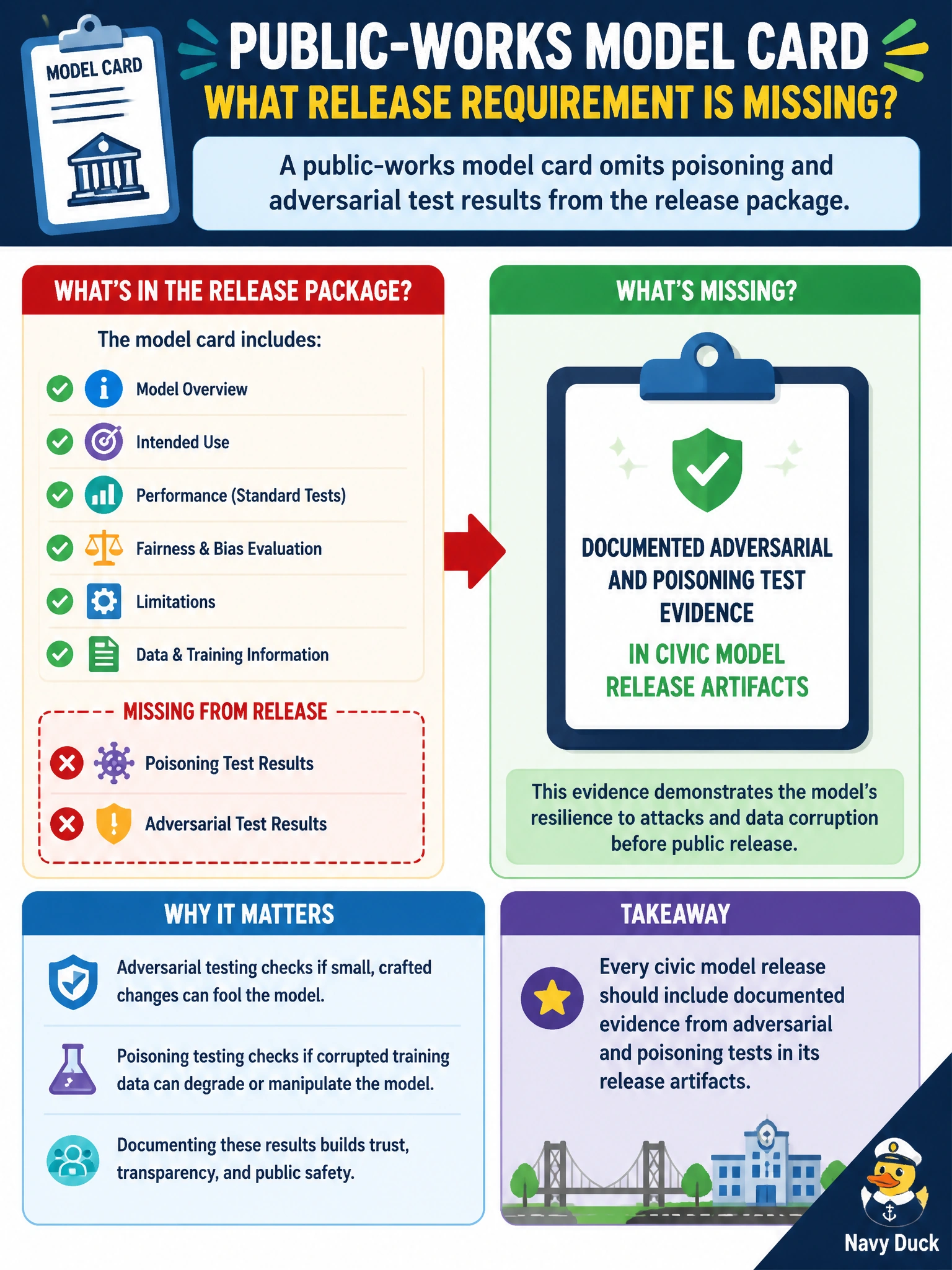
A public-works model card omits poisoning and adversarial test results from the release package. What release requirement is missing?
Select an answer to reveal the explanation.
Short Explanation
A model card without poison-test results is a report card missing the hard subjects—put the evidence in the packet.
Full Explanation
A public-works model card that omits poisoning and adversarial test results from the release package is missing documented adversarial and poisoning test evidence in civic model release artifacts. Release reviewers need to see what training-time and adversarial evaluations were run, against which suites, with what pass/fail outcomes and residual risks. Without that evidence, accuracy metrics alone can overstate readiness of models that route work orders or safety-related triage. The correct release requirement is inclusion of those results—not inference latency benchmarks, hyperparameter logs, or data licenses.
Recorded inference latency benchmarks and cost profiles are performance metrics and do not convey adversarial evidence. Archived hyperparameter tuning logs and training configurations are development records unrelated to test completeness. Logged data version histories and source licenses alone track provenance, not proof that poison tests occurred. These distractors fail because they confuse operational or provenance paperwork with assurance content required for civic release.
Exam caveat: documenting tests is not the same as passing them—failed results can still support a conditional release with compensating controls, but omission hides risk. Keep methods reproducible (suite versions, seeds, thresholds). Distinguish model-card security sections from generic marketing one-pagers.
Operational check: amend the public-works release checklist so promotion is blocked unless adversarial/poisoning sections are populated with dated results and owners. Spot-check a recent release package for empty security sections. Archive the evidence with the model version so auditors can reconstruct what was known at promotion time.