
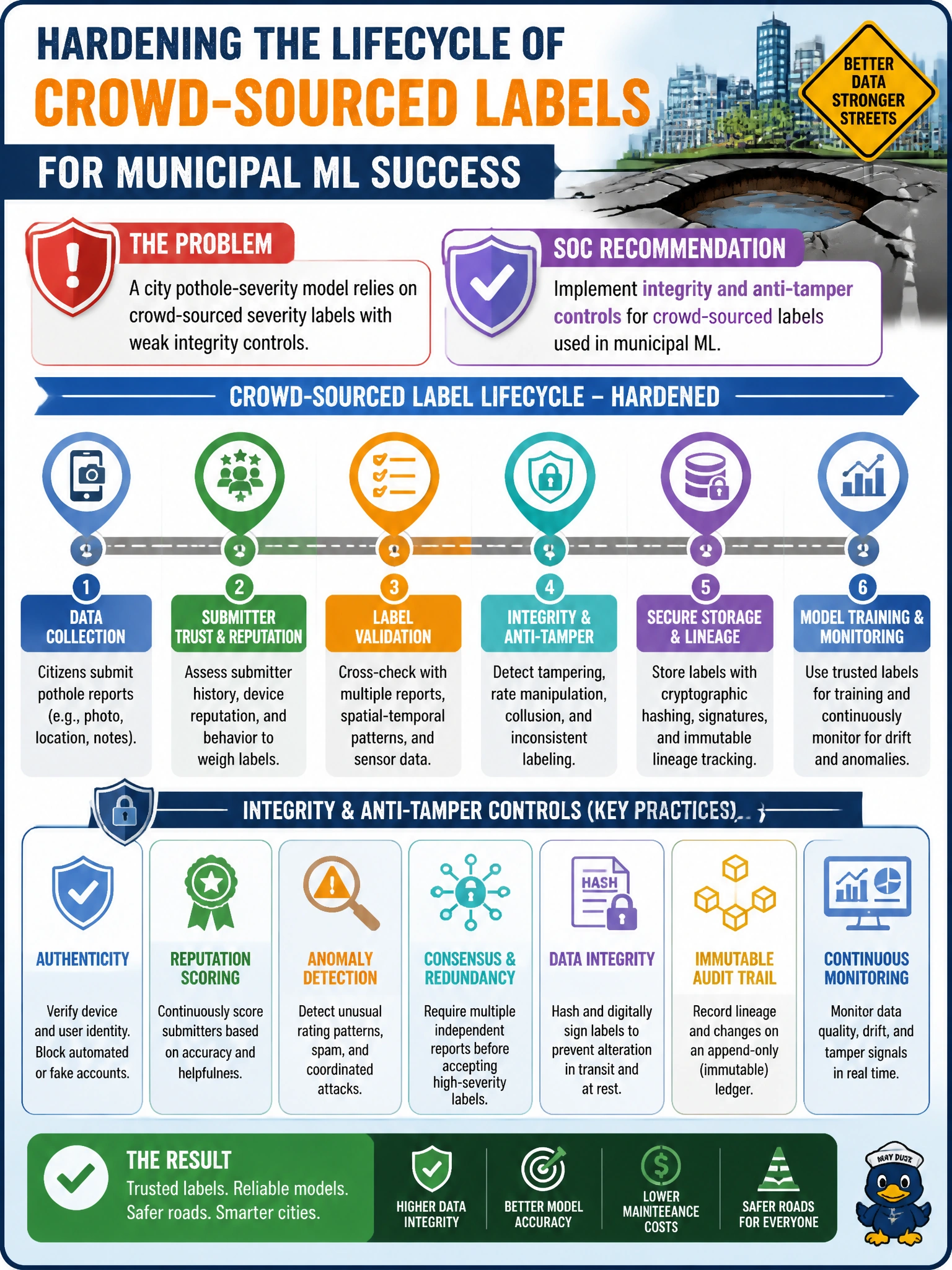
A city pothole-severity model relies on crowd-sourced severity labels with weak integrity controls. What lifecycle hardening should the SOC recommend?
Select an answer to reveal the explanation.
Short Explanation
Crowd labels without checks are like letting strangers grade the roads. You've got to verify before the model learns.
Full Explanation
A city pothole-severity model that relies on crowd-sourced severity labels with weak integrity controls needs integrity and anti-tamper controls for crowd-sourced labels used in municipal ML. Crowd labels are attractive poison and vandalism targets: residents or bots can systematically under- or over-rate severity to divert crews or create noise. Hardening includes authenticated raters where appropriate, consensus or multi-rater checks, outlier detection, reputation scoring, audit sampling against inspector ground truth, and limiting how fast crowd labels influence retraining.
Encrypting training data stores with centralized key management protects data at rest, but it does nothing to confirm that crowd-sourced severity labels are authentic or untampered before training; the weak integrity control gap stays open. Adding differential privacy noise to severity outputs is a privacy protection, not an integrity control; it can blur the label signal and does nothing to stop false crowd ratings from entering the pipeline. Watching inference latency on a service health dashboard tracks prediction performance, not data integrity; it won't catch poisoned crowd labels or keep them out of the model. None of these describe an actual anti-tamper or integrity control on the crowd-sourced pipeline.
Exam caveat: crowd sourcing can remain valuable for coverage if integrity controls are proportionate; the finding is weak controls, not the mere use of residents. Distinguish malicious poison from honest disagreement about severity—use inspector spot-checks to calibrate. Do not equate mobile-app UI polish with data integrity.
Operational check: sample crowd severity labels weekly against public-works inspector scores; alert on accounts or geohashes with extreme disagreement; require stronger authentication or throttling before those labels enter training. Document the control set in the pothole model card. If unauthenticated anonymous severity taps can move crew prioritization after retrain, treat the integrity gap as open.