
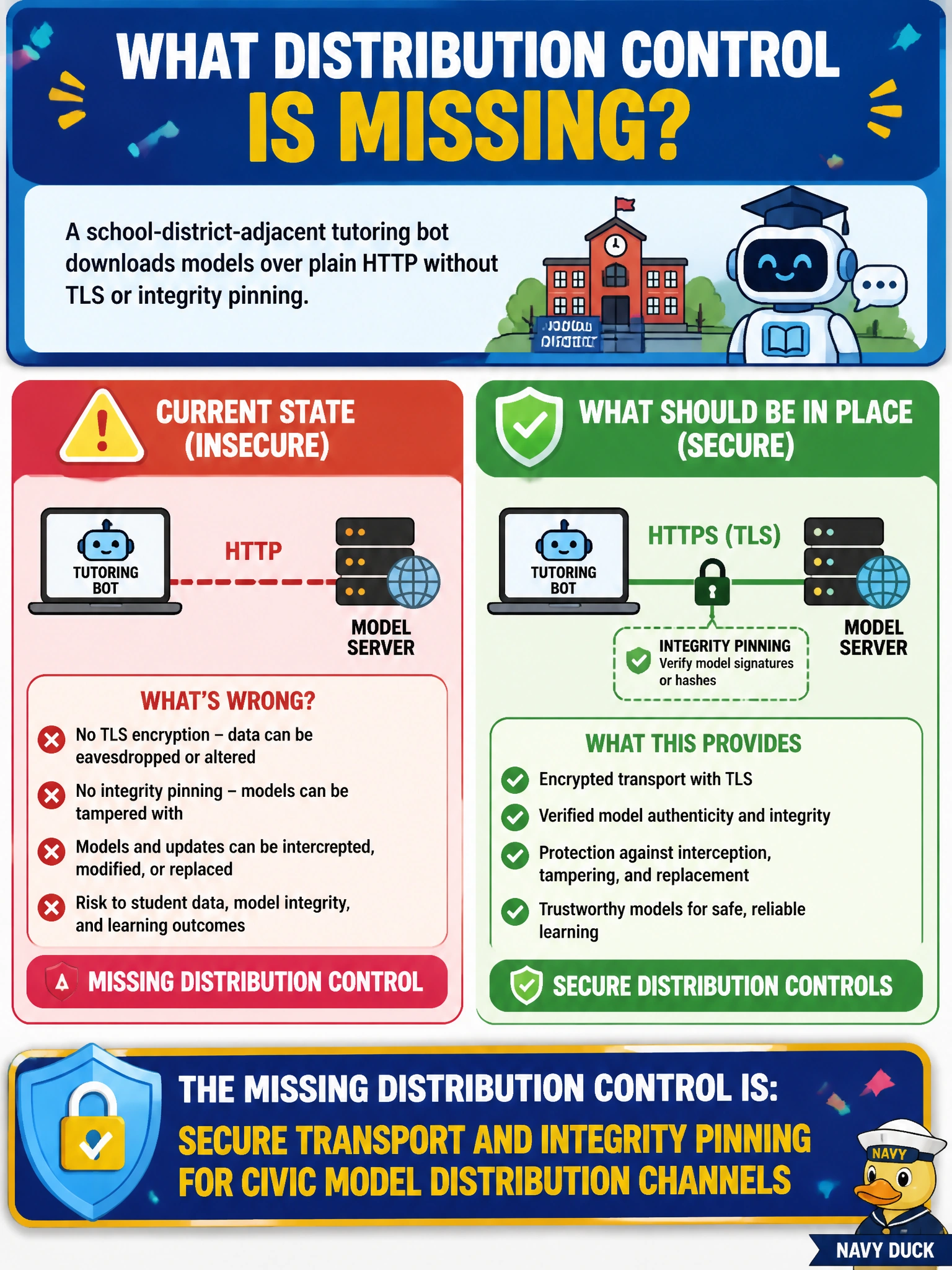
A school-district-adjacent tutoring bot downloads models over plain HTTP without TLS or integrity pinning. What distribution control is missing?
Select an answer to reveal the explanation.
Short Explanation
Pulling models over plain HTTP is like mailing answer keys on postcards. Encrypt and pin integrity.
Full Explanation
A school-district-adjacent tutoring bot that downloads models over plain HTTP without TLS or integrity pinning is missing secure transport and integrity controls on the model distribution channel. Without encryption and pinning, intermediaries can tamper with weights in transit, substitute malicious models, or eavesdrop on distribution metadata. Civic and school-adjacent AI must use TLS and verify digests or signatures before models enter tutoring runtimes. Campus décor does not secure model downloads.
Pinning TLS certificates for tutoring bot inference API connections does not secure the model download channel, checking only file size instead of a cryptographic digest lacks real integrity verification, and encrypting cached civic models at rest on district tutoring servers does not protect models in transit; none of them describes the complete secure-transport-and-pinning control the channel is actually missing.
Exam caveat: HTTPS alone is incomplete if the client does not pin or check the artifact hash—TLS protects the channel, while pinning binds the expected model content; use both. Operational check: reconfigure the tutoring bot to fetch models only via HTTPS from an approved registry, enforce digest verification before load, attempt a mitm substitution in a lab network and confirm rejection, and document the distribution standard for school-adjacent AI services.