
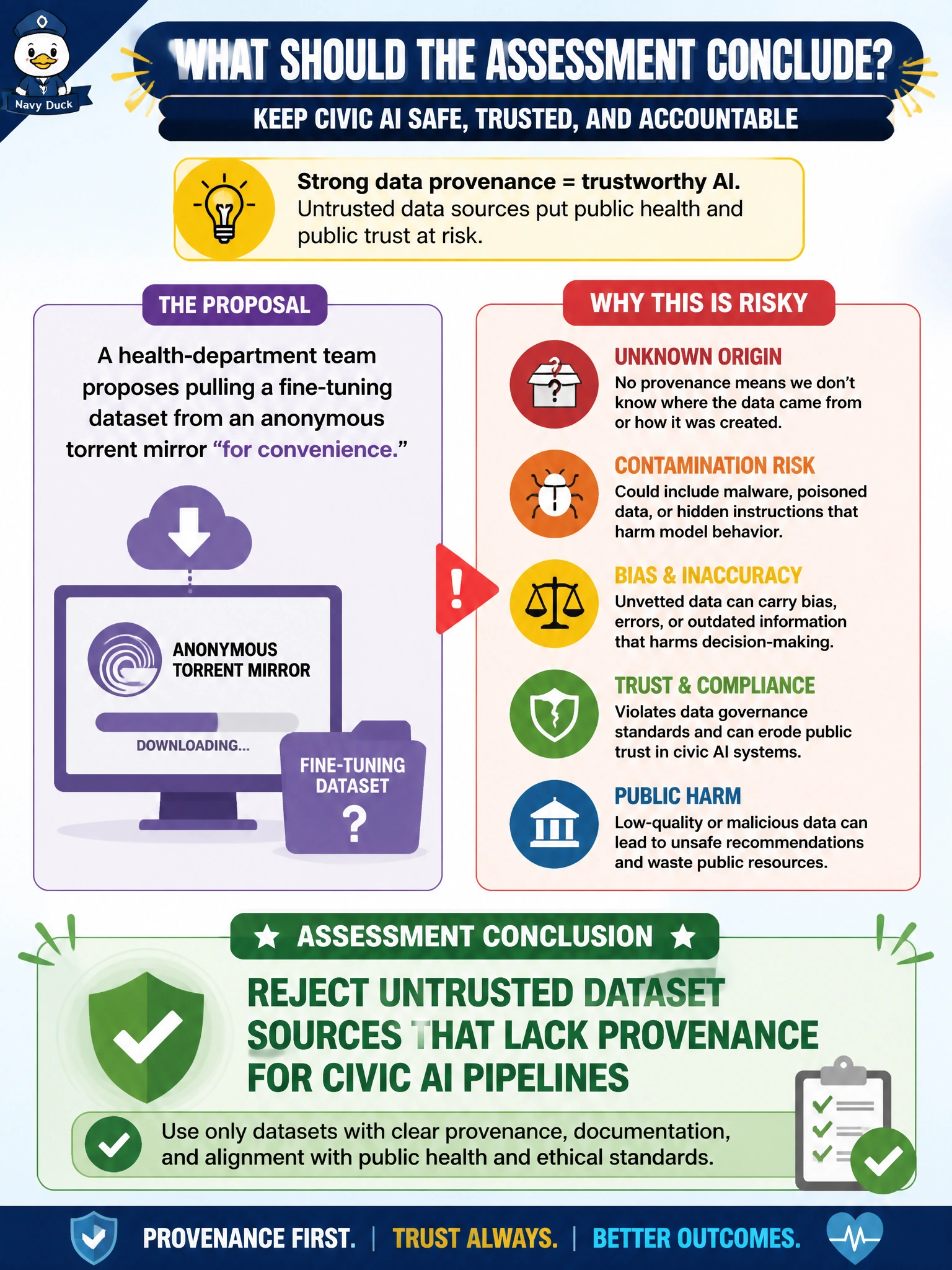
A health-department team proposes pulling a fine-tuning dataset from an anonymous torrent mirror 'for convenience.' What should the assessment conclude?
Select an answer to reveal the explanation.
Short Explanation
Anonymous torrent datasets are unmarked barrels—don't pour them into public-health models. Provenance or no-go.
Full Explanation
Proposing to pull a fine-tuning dataset from an anonymous torrent mirror “for convenience” should be rejected: civic AI pipelines—especially health-department workloads—require trustworthy provenance, integrity, and licensing for training data. Anonymous mirrors provide none of those guarantees and are a supply-chain anti-pattern that can introduce poisoned samples, malware sidecars, or unlawful content into public-health models. Assessments conclude reject untrusted sources; facilities aesthetics and download speed do not establish dataset trust.
Accepting mirror datasets based on schema validation and format checks, approving anonymous mirrors when a local checksum matches the mirror-provided hash, and permitting torrent datasets for pilot fine-tuning with provenance review before launch are each a way untrusted data could slip through — but the assessment's required conclusion is to reject the untrusted source outright, not to accept it under any of these conditions.
Exam caveat: even if a torrent’s files match a known public dataset hash, the distribution channel may still violate policy if the city cannot document a legitimate acquisition path—prefer official repositories with HTTPS and attested releases. Operational check: block anonymous torrent ingestion in MLOps runbooks, require registered dataset sources with license and hash in the health AI inventory, quarantine any data already fetched from the mirror, and restart fine-tuning only from an approved, verified corpus.