
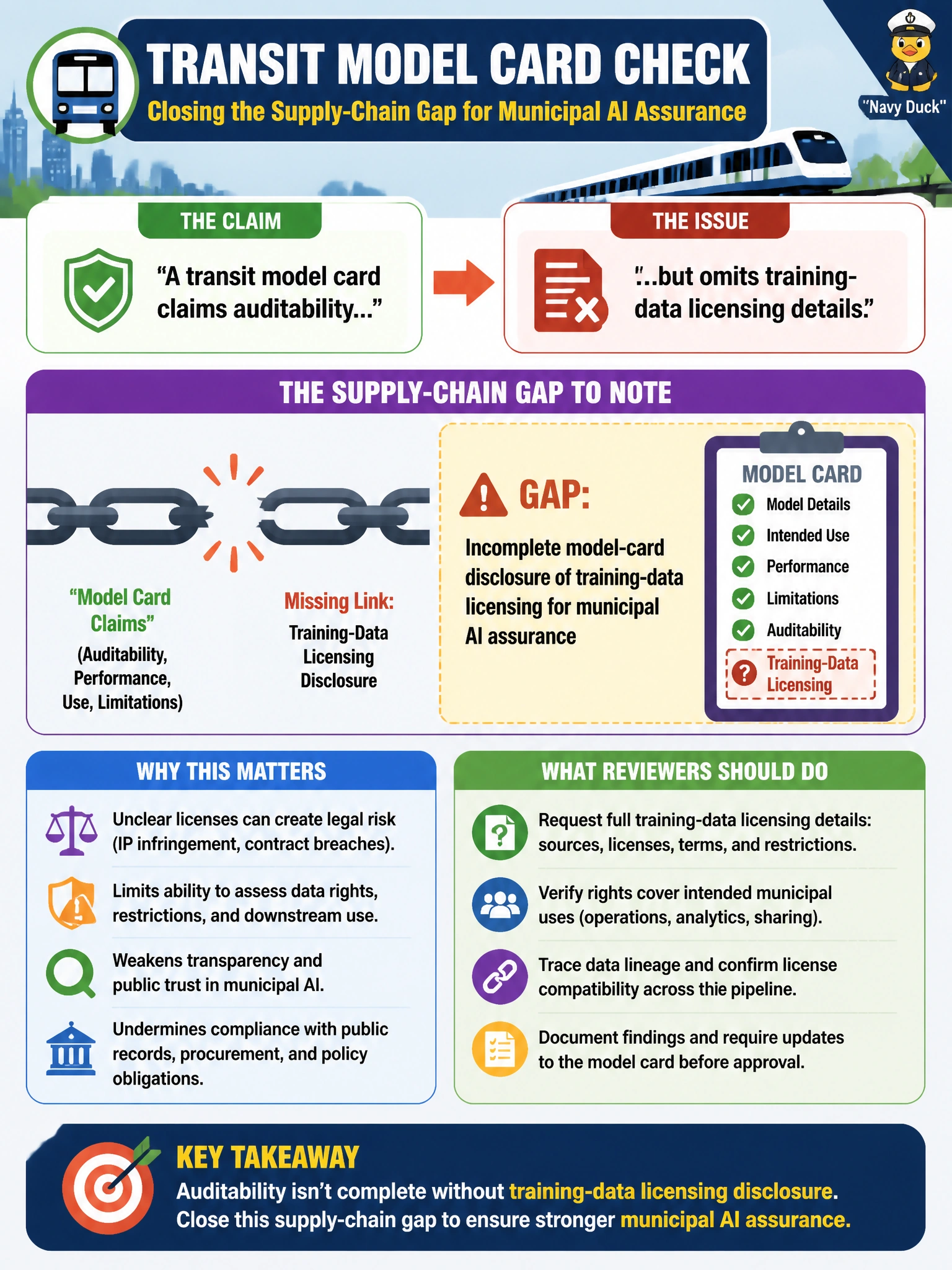
A transit model card claims auditability but omits training-data licensing details. What supply-chain gap should reviewers note?
Select an answer to reveal the explanation.
Short Explanation
A model card that brags 'auditable' but skips licensing is incomplete paperwork. Put the data license on the card.
Full Explanation
A transit model card that claims auditability but omits training-data licensing details presents an incomplete disclosure gap for municipal AI assurance. Model cards supporting civic review should document licensing and provenance of training data—not only high-level audit slogans—so legal, privacy, and procurement teams can accept the model for rider-facing or operations use. Missing licensing undermines supply-chain and compliance review even when other card sections look polished. Transit décor does not fill those omissions.
Declaring only dataset sizes instead of sources, recording licensing in unstructured notes without legal review, and omitting provenance because documentation 'isn't available yet' are all variations of the same incomplete-disclosure problem the reviewers are asked to identify, dressed up as acceptable interim practices rather than named as the gap.
Exam caveat: “open weights” does not imply open or redistributable training data—licenses can differ, and derivative civic fine-tunes may inherit restrictions that block public release. Operational check: require an updated model card listing dataset names, licenses, and redistribution constraints before transit AI go-live; legal review sign-off on the card; and refuse promotion of models whose cards omit training-data licensing fields.