
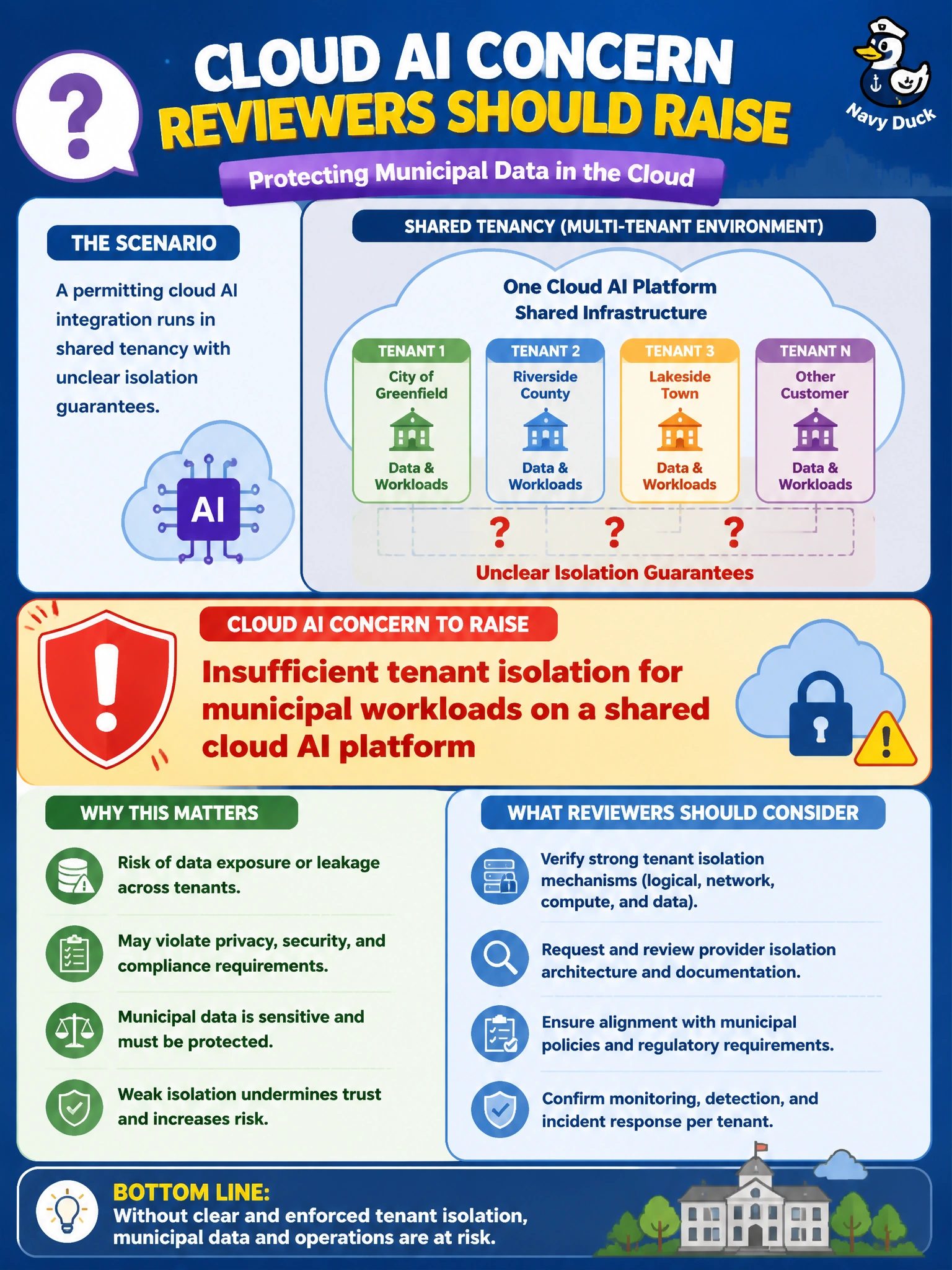
A permitting cloud AI integration runs in shared tenancy with unclear isolation guarantees. What cloud AI concern should reviewers raise?
Select an answer to reveal the explanation.
Short Explanation
Shared tenancy without clear walls is like filing city permits in a shared locker room. Isolation matters more than lobby flowers.
Full Explanation
A permitting cloud AI integration running in shared tenancy with unclear isolation guarantees raises a core cloud AI concern: municipal prompts, embeddings, caches, or fine-tuning artifacts may mix with other customers if logical isolation, encryption keys, and data-path separation are weak. Reviewers should demand evidence of tenant isolation—dedicated keys, partitioned storage, non-shared prompt caches, and contractual commitments—before placing permit-application content on the platform. Insufficient isolation is an architecture and assurance finding for civic workloads, independent of front-counter amenities.
Fresh flower arrangements at permit counters fail by concept: décor does not prove cryptographic or logical tenancy boundaries. Quieter queue-ticket printers improve noise, not data separation. Local sports on waiting-area TVs are amenities and irrelevant to whether embeddings or logs leak across tenants. Distractors test amenity-versus-isolation reasoning.
Exam caveat: “logical multi-tenant” can still be acceptable if controls are strong and evidenced; the failure mode is unclear or unverifiable isolation, not shared hardware alone—ask for architecture diagrams, pen-test scope covering cross-tenant access, and key-management details. Operational check: require vendor isolation whitepapers and test results, verify customer-managed keys where policy demands, probe for cache or log cross-tenant bleed in a controlled assessment, and withhold production permit data until isolation evidence meets city standards.