
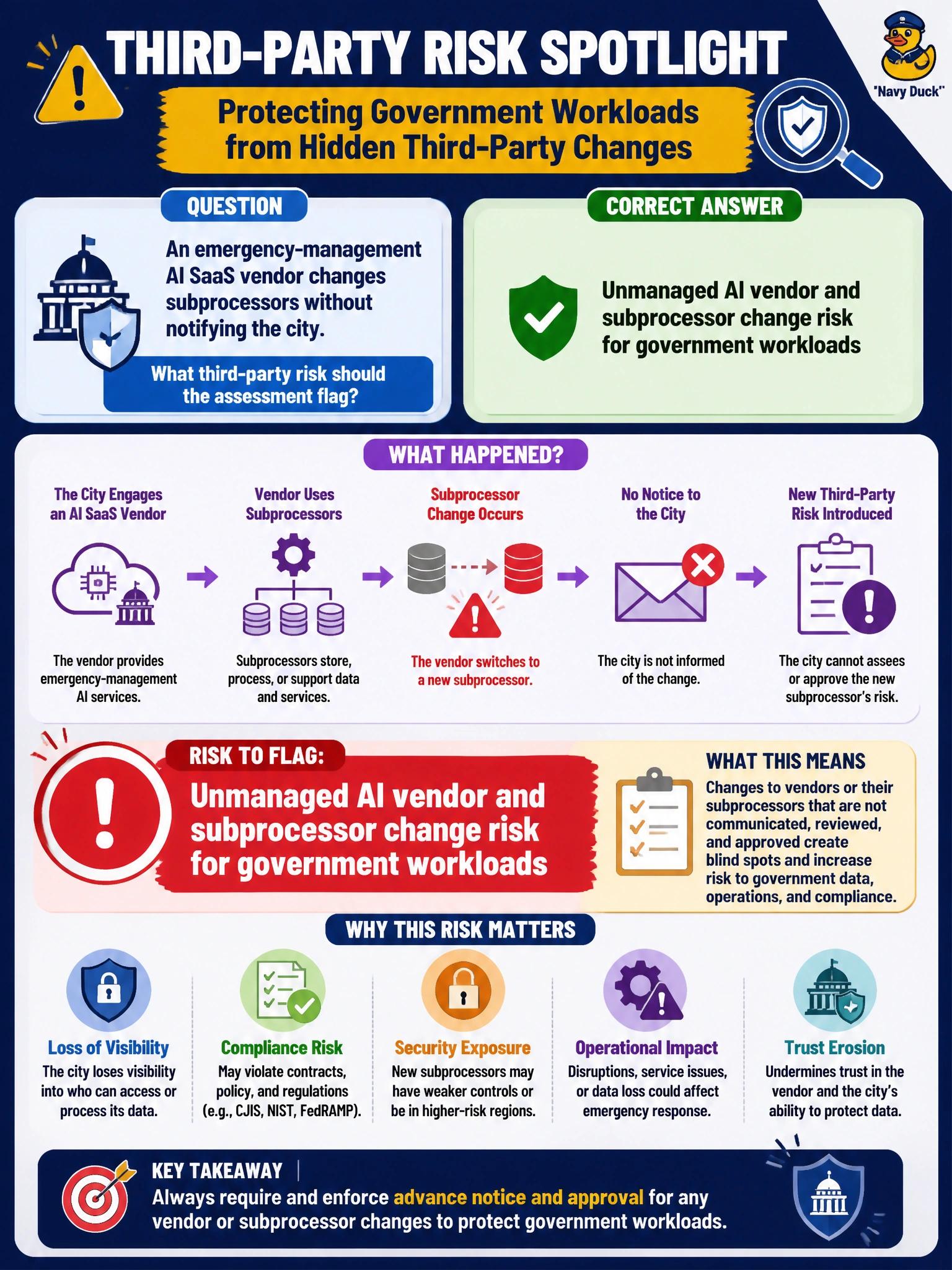
An emergency-management AI SaaS vendor changes subprocessors without notifying the city. What third-party risk should the assessment flag?
Select an answer to reveal the explanation.
Short Explanation
Silent subprocessor swaps mean your data may ride new rails you never approved. Delayed vendor incident disclosure during an outage isn't the same as a subprocessor swap you never approved.
Full Explanation
When an emergency-management AI SaaS vendor changes subprocessors without notifying the city, assessments should flag unmanaged vendor and subprocessor change risk. Government workloads often require contractual disclosure and approval when processing roles, data residency, or security posture shift because resident emergency data may move to new jurisdictions or weaker controls. Undisclosed subprocessor swaps break the city’s ability to evaluate DPIAs, residency commitments, and incident-response reachability. The correct finding language is third-party supply risk tied to contract and governance failure—not facilities presentation. Delayed vendor incident disclosure for emergency outage events concerns post-incident timing, not the failure to obtain advance approval before a subprocessor change, so it does not name the unmanaged-change risk itself. Unverified civic data isolation across shared AI infrastructure is an assumption about architectural separation, not the undisclosed subprocessor swap the question describes. Approved vendor data transfer with retrospective documentation updates treats after-the-fact paperwork as authorization, rather than identifying the gap where the city was never notified before the change. Exam caveat: some vendors bury subprocessor lists in changing web pages; cities need written notice SLAs, flow-down security requirements, and the right to object—silence in a portal changelog is not adequate for emergency-management AI. Operational check: review the SaaS agreement for subprocessor notification clauses, demand a current subprocessor inventory with regions and roles, compare against the last approved list, and require written approval before any new processor touches city emergency prompts or datasets.